

The following in an excerpt from “Eros of Orthodoxy,” translated by Fr. Nicholas Palis and written by Mr. Pantelis Paschou.
The Holy Fathers separate the senses of the body into two categories: 1) vision and hearing, which are reasonable and “more philosophizing and dominating than the others” and 2) taste, smell, and touch, which are irrational and beastly. When they work in the bodily will, they are all dangerous and dreadful. They give us the impressions that we thirst for something toward which we direct our senses. As they drag us, we see that they lead us in a deep, narrow well that as easily as one enters falling, it is just as difficult for him to come out and be freed.
While one unsuspectingly allows his glance to fall someplace, he starts spiritually losing ground and falling. Because the first glance is followed by thought of thoughts, pleasure, pleasure by yielding, yielding by deed, deed by habit, habit by necessity, necessity by despair, despair by condemnation to Hell.
“The first glance is followed by thought of thoughts, pleasure, pleasure by yielding, yielding by deed, deed by habit, habit by necessity, necessity by despair, despair by condemnation to Hell.”
Let one not think that if the material senses overrule us they will allow us to think of anything else. No matter where you are they will ask you to eat and drink according to their appetite. Even in church, Satan flares up our senses and has us use them for sin. Or he sends his men to scandalize the church gathering with their sins.
That which is written in an old spiritual book is hair-raising and dreadful but one may take out many teachings from this. When—this book says—a saint was teaching one night on Holy and Great Thursday, he started shouting in a loud voice, “Bring light, bring light because at this time my God is being harmed.” And the servants of church, running quickly with lit torches, found two most wicked youths, who together hugging one another, were burning having died infamously, like two torches without going out till they were incinerated. (Spiritually Taught, in the year 1642, pg. 232)
Here it clearly shows how from our senses death passes into us as quick as lightning without us managing neither to repent nor to become prepared for the visitation of death. Death is like smoke and like the thief, says St. Syncletica: “Through our senses, even if we do not wish, thieves enter for how is it possible for smoke to be moving in from the outside while the doors are open, for you to not be blackened?”
So rightly, one will ask, how will we escape the death that our bodies’ senses bring us? Behold a few answers from those that the Holy Fathers give this question.
“Sight to vigilance, hearing to studying, smelling to prayer, tasting to restraint and touching to stillness.” — St. Niketas Stethatos
St. Niketas Stethatos says that we must gather together and pair off the five senses of the body with the five senses of ascesis, that is, “sight to vigilance, hearing to studying, smelling to prayer, tasting to restraint and touching to stillness.” Thus man may go “beyond sense” and to “thoroughly enjoy the delight of the invisible ones.” For this leap, however, a person must have a strong divine “eros” which “loosens the soul from the bonds of the senses and convinces her to adopt the manners of freedom.”
This freedom which St. Niketas Stethatos tells us is an ideal state, to which only those who become unbound by the bonds and senses of the world may reach: “Those who have thrown off the bonds of the all-worldly senses leave the senses in freedom from every servitude, living only in spirit and conversing with it.”
Abba Neilos remembers the narrow windows in Ezekiel (41:16) and suggests the same method to us as well: “So that the pleasures of the senses do not enter our soul, we must put thickly sewn nets on the windows of our senses. These nets are the memory of death, our defense at the hour of fearsome judgment and the memory of the eternal damnations.”
St. Isidore of Pelusium says that for us to guard our senses from pleasures, our mind must reign like a king, and have fearsome thoughts armed like soldiers to protect the gates of the senses and to stay on guard there, to prevent the enemies from entering. If they do not enter, the battle and victory are easy. If the opposite occurs, the battle becomes difficult and the victory doubtful.
St. Theoleptos of Philadelphia advises whoever wishes to avoid the pleasures of the senses with these words: “Flee the senses and you have become free from the pleasure of the senses.” Analogous also is the stance of St. Maximus the Confessor, who says that the apostles in the upper room “like doors having closed the senses” were granted to see the Lord.
In the life of St. Theodosios the Coenobiarch we find these words of St. Nikephoros the Monastic: “And this great Theodosios, through gathering together his senses and leading them inside, became ‘crushed’ with love of the Creator.” Thus, a closing of the gates and a stern vigilance of the guard, who is the mind or the thought.
If the desires that have become passions have happened to previously enter us, these also with their being cut off from the world of senses, slowly will be deadened. “Like the snakes,” says Abba Poemen in the Sayings of the Desert Fathers, “when they are enclosed in a certain vessel not receiving food little by little, die, thus the passions also which are inside our hearts when they are enclosed and do not receive their filthy food from outside through the senses of the body, from length of time, they become weak and die.”
The struggle that the Christians make to choke the pleasures that the senses of the body offer him is not at all easy. Man must fight here with his own self. To submit his senses and body to the ruler mind, a thing that is more difficult than to submit to external enemies. “Winning this first, he wins himself.” Whoever does not come out a victor in this invisible war with the sin of his own self, even if he defeats thousands of barbarians, he is a very small victor. St. Isidore of Pelusium says it epigrammatically: “Not he who defeats the barbarians from outside may be naturally called trophy bearer, but rather he who takes hold of the pleasures of the inner battle, for many defeating them, are foully and wretchedly overtaken by these.”
In this battle of his, the believer must not forget the opposition as well which exists between the senses and faith. St. Diadochos, the bishop of Photike, enlightens this side for us: “For all the senses of the body oppose the faith. For the former occurs only at present while the latter promises the luxury of the future goods.” For this reason, life as well, which is attached and bonded with the senses of body, brings us slowly to disbelief without us realizing it.
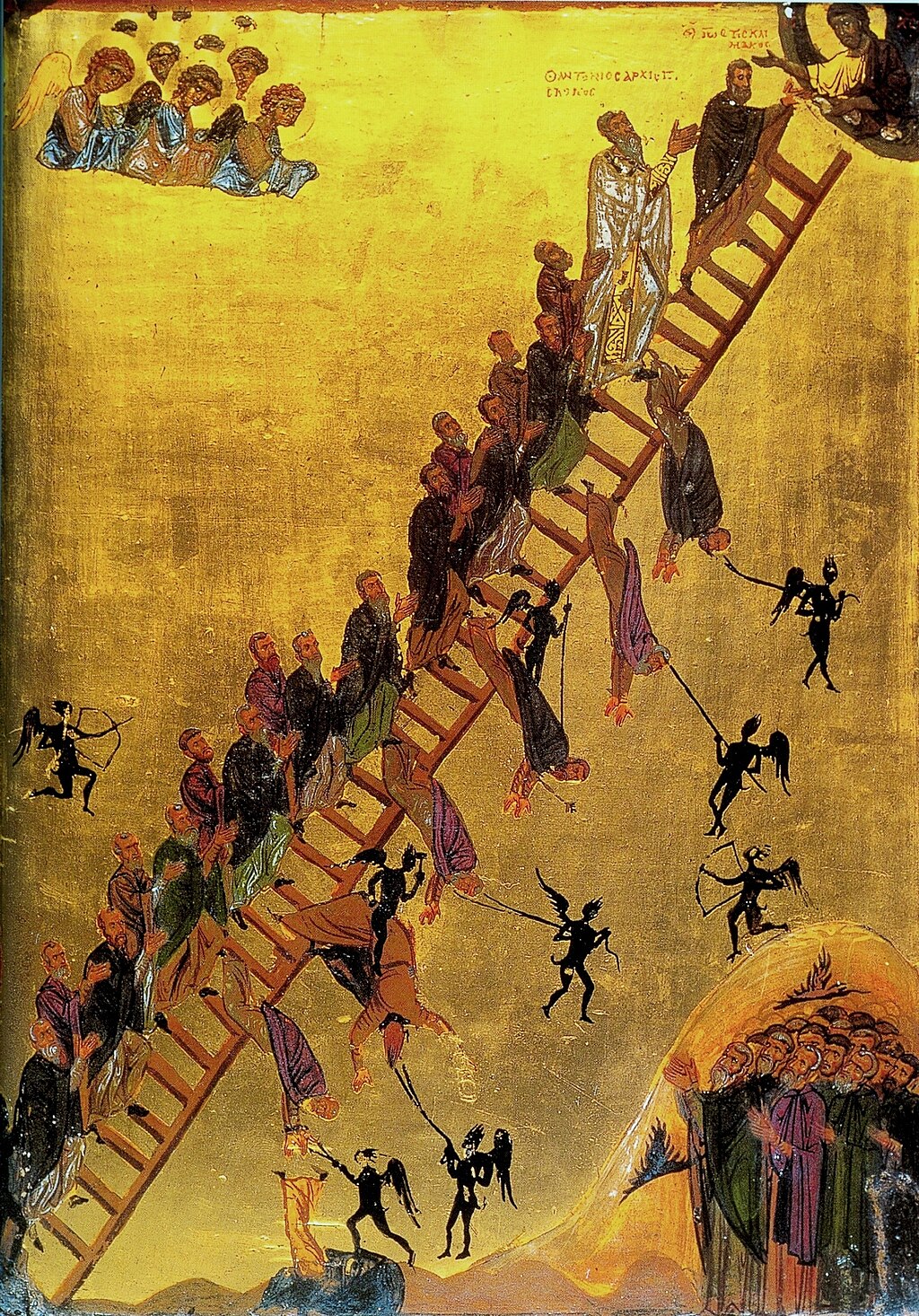
However, the greatest weapon for one to fight the earthly things is to exchange them with the heavenly ones. Because if man knew those, he would never give himself nor be tied down to the material and earthly things which please the senses and the enjoyments of the body. “He who tastes the above,” says St. John of the Ladder, “readily puts down the things of below. He who has not tasted those rejoices upon temporary things.”
“Life in God is the downfall of the senses. When the heart lives, the senses fall down.” — St. Isaac
When your soul touches God, it is impossible for you to recall the mud in which your bodily senses throw you. “When our soul, by noetic energies is moved upon the noetic things, the sensorial things with the senses are superfluous.” (Dionysios the Areopagite). Life in God makes our senses become weak and slowly disappear because our heart no longer needs them. It has been wholly given up to her heavenly Bride, to Christ. “Life in God is the downfall of the senses. When the heart lives, the senses fall down.” (St. Isaac). This is the road that leads to the freedom from the senses of the body according to the Holy Fathers of our Church.
We will conclude with a small excerpt from a great mystic of our Church, St. John of the Ladder: “They who are easily moved and unrestrained in desire should always hold their thought in their prayer and let them quickly leave from the evil recollection of prodigality, without thinking of it and thus their prayer will become God pleasing and beneficial. It is also possible with the stretching out of the hand for man’s body to become polluted, because there is no graver and more difficult beast to restrain than this because when one touches a foreign face or hand or other bodily member, the sleepy and responsive dog immediately gets up and barks and wakes up desire and lifts up the flesh to diabolical errors and burns from both sides like the touched charcoal which burns the hands which hold it as well, and the flesh which touches it.
“For this reason, flee it greatly, if you want to not burn in hell. Always look below around you, so as to not open up to a beautiful face and do not believe your eyes. Stop up your ears to not hear ugly speech. Guard your words and lock them inside you, and do not respond. Tie your members so they do not suddenly hurl you down a cliff. But the best thing of all is to leave the place and person as quickly as possible if you want to escape from the bodily danger.”