
Blow the trumpet in Zion; sanctify a fast; call a solemn assembly; gather the people. Sanctify the congregation; assemble the elders; gather the children, even nursing infants. Let the bridegroom leave his room, and the bride her chamber.
Joel 2:15-16
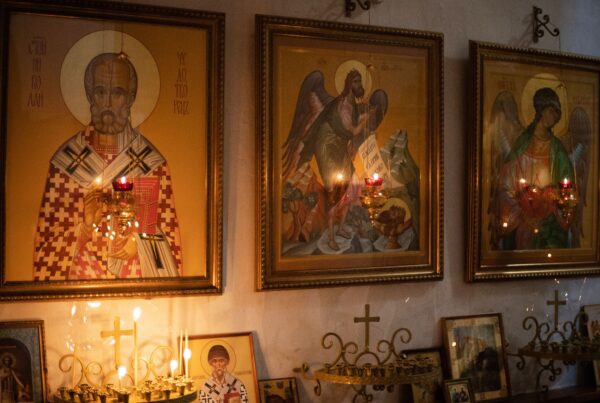
Sanctify and trust, two important words to examine today. The word “sanctify” is not a word that gets into our daily vocabulary. In Greek, the word is “agiason” which means “to make holy,” and “holy” means “to set apart.” Let’s unpack this. The word we translate as “saint” is “agios” (male) or “agia” (female) in Greek. So, St. Nicholas is “holy, set apart” Nicholas and St. Katherine is “holy, set apart” Katherine. These saints, and so many others, are recognized as saints because of the holy and set apart life that they lived. Each saint has lived a life that is distinguished from their peers in terms. This might be because of their extreme witness, i.e. being martyred for their faith. It might be for their extreme piety, such as being noted for prayer, counsel or miracles. It might be for an extreme talent used for the glory of God, like the Fathers for their writing and sermons. Each person recognized as saintly or holy has done something notable in their faith.
Each of us is called by God to be holy, to set apart. During the Divine Liturgy, the priest says, “The Holy Gifts are for the holy people of God.” Most people either don’t understand or dismiss the meaning of this phrase. This line refers to the struggle for holiness, not attaining it. We don’t pronounce ourselves, or even our peers, to be holy in this life. But the word “agios” does not just refer to a destination, but a journey. Those who were recognized as saints each made a “set apart” journey that led them to sainthood. And while the destination is holiness, the journey is marked by striving to set ourselves apart from sin, from the things that take us away from God. The journey is not a race to set ourselves apart from other people, but to set ourselves apart from sin and focus on God.
Let’s move to the word “trust.” The word “trust” has two meanings in English. The first has to do with faith, i.e. believing without seeing or comprehending. A big part of our Christian faith involves trusting in a God we cannot see and working our way towards a place we cannot comprehend. Just writing that out makes the Christian journey seem not only daunting, but even kind of strange. To believe in a God we cannot see, and to work our way daily to a destination we cannot comprehend. While we do not know the essence of God—this will not be fully revealed in this life, only in eternal life—we do know the energies of God. God is love, and we know what love is. There is so much around us that we cannot comprehend, beauty so deep that we could not possibly create it, experiences so profound that point to power greater than us being at work among us. Faith is not based in complete knowledge, but in acknowledging that the power of God is at work among us. We can’t live our life without trust. We have to trust a pilot to fly the plane we do not know how to fly. We have to trust the doctor to heal the pain we cannot understand. We have to trust the infrastructure of our country that brings food to our stores, keeps water drinkable and keeps the electricity on. And we also have to trust in the plan for God who allows the sun to come up each day, who gives us breath and life, who provides the talents the provide the pilots, the doctors and the brains behind the infrastructure.
The second meaning of “trust” has to do with inheritance. People who are living put their possessions in a trust, so that they are protected and preserved. Descendants of people who have died received assets from trusts, gifts not of their own making, but rather gestures of love left for them by those who have passed on before them. Faith does not only require trust in the sense of believing without seeing. It involves trust in the sense of investment of our time, talent and energy. It involves investing our lives in a sacred trust that will protect us in this life and preserve our souls for eternal life. God’s trust also allows us to experience His blessings in this life.
Putting all this together, we pray “sanctify those who put their trust in You.” Which means “make holy/set apart those who have placed their faith and invested their effort in You,” make us saints, number us in Your heavenly Kingdom as a reward to placing our faith and investing our efforts in the Lord. The path to holiness is just that, a path, a journey. It is not something that is accomplished in one moment or one day. Each day provides us with an opportunity to choose to take a step on the path to holiness, to step off the path and head towards destruction, or to sit still and do nothing. The second and third choices both lead to destruction, the intentional bad choice or the choice to be indifferent. We must ask ourselves each day, will we be taking a step forward or a step backward on the path. This prayer asks God to set apart those who are having the trust to take a step forward today.
O Lord, bless those who praise You and sanctify those who put their trust in You. Save Your people and bless Your inheritance. Protect the whole body of Your Church. Sanctify those who love the beauty of Your house. Glorify them in return by Your divine power, and do not forsake us who place our hope in You. Grant peace to Your world, to Your churches, to the clergy, to those in public service, to the armed forces, and to all Your people. For every good and perfect gift is from above, coming down from You, the Father of Lights and to You we send up glory, and thanksgiving, and worship, to the Father and to the Son and to the Holy Spirit, now and forever and unto the ages of ages. Amen.
Put your trust in God today. Choose to take a step forward in your journey to salvation.