

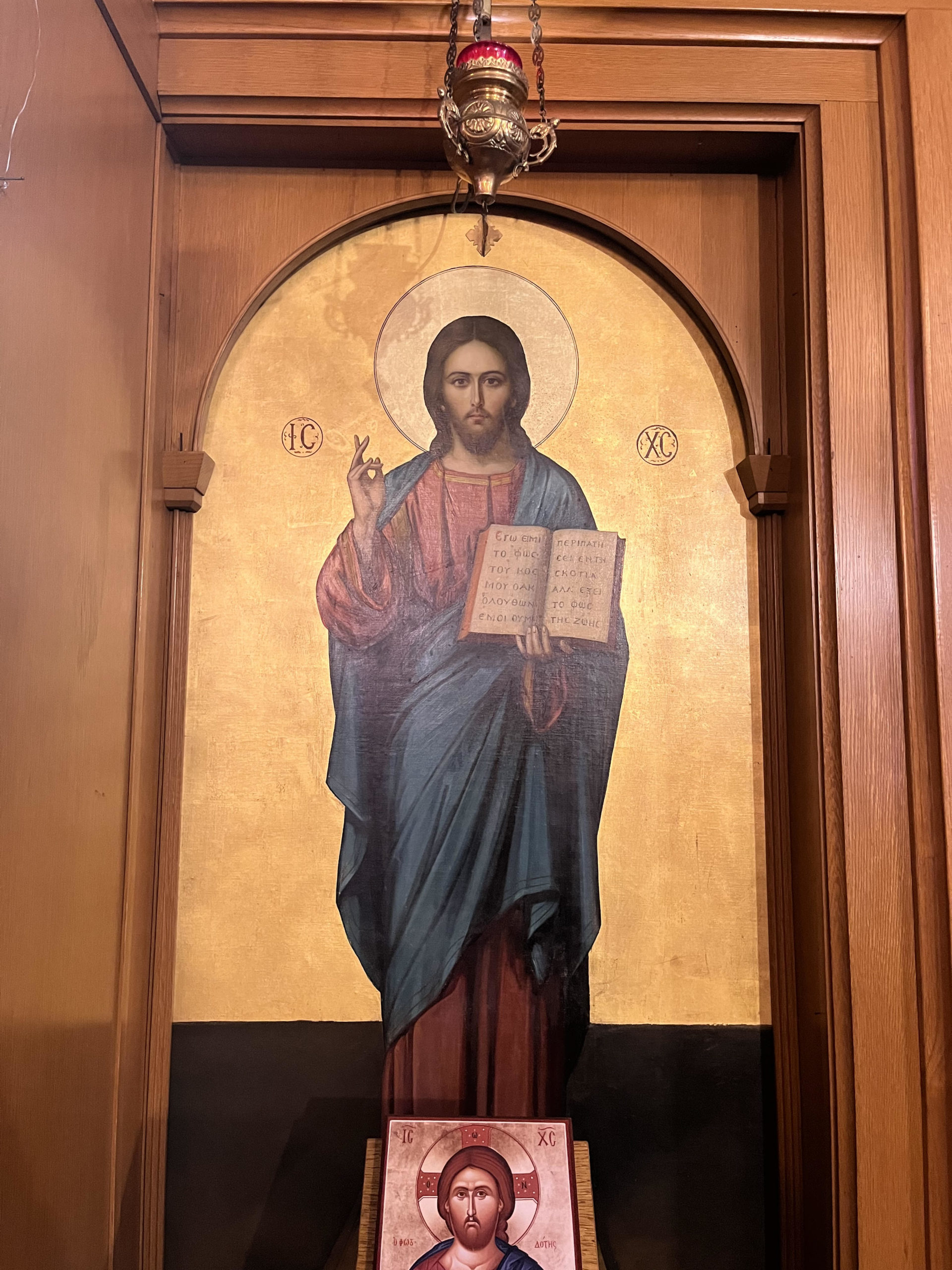
The Jesus was led up by the Spirit into the wilderness to be tempted by the devil. And He fasted forty days and forty nights, and afterward He was hungry. And the tempter came and said to Him, “If You are the Son of God, command these stones to become loaves of bread.” But He answered, “It is written, ‘Man shall not live by bread alone, but by every work that proceeds from the mouth of God.’”
Matthew 4:1-4
We have just finished celebrating the Feasts of the Nativity and Theophany. We know that Christ came to earth as a baby. He entered the world as we do. He had a hometown, a childhood, even a trade. His experience would be a fully human experience, including suffering in the way that human beings suffer. However, in His human experience, He would succeed, despite the struggle, to stay in unity with God. He would show us the example of how to live in a fallen world.
At age thirty, Jesus was revealed to the world at His baptism. He approached John the Baptist and asked to be baptized. The purpose of baptism at that time was in order to be cleansed of sin. John would have prevented Him, as we read in the Gospel of Matthew, insisting that it was John who should be baptized (cleansed) by Jesus. The hymnology of our church paints a beautiful image of John’s quandary—How can an unclean vessel (John) clean a vessel that needs no cleaning? How can one give light to the one who created light? So, Jesus was baptized and in that moment, the Holy Trinity was revealed. Unlike at the Nativity, where the arrival of Christ on earth was revealed only to simple shepherds and later to the Magi, at the baptism, we see the manifestation of God, or Theophany. The Son is seen in the water, the Spirit hovers over Him in the form of a dove, and the voice of the Father is heard endorsing Jesus as the “beloved Son.” (Mark 1:11) Jesus has fulfilled the Law by being baptized. He has been revealed as the Son of God. The ministry is about to begin. But first. . .
Jesus is led into the wilderness. For forty days and forty nights, He fasts. And prays. It is interesting that before so many of the significant events in His life, we read that Jesus deliberately withdraws to pray. This is, indeed, an example for all of us. That prayer and fasting should be part of our regular life, and most especially when one is going to do something significant. Most people prepare for marriage with bachelor parties and revelry. How many people would think of fasting as part of their marriage preparation? Just a thought.
Forty is a significant number when it comes to preparation. Moses fasted forty days before He received the Ten Commandments on Mount Sinai. He prepared to receive the Old Covenant with fasting. Jesus, in preparing to become the New Covenant, also spends forty days fasting. Fasting is not about deprivation, but about discipline. Fasting is designed to help us maintain control over a passion we all have for food, so that in turn we can have discipline to avoid temptations and other passions for things that are not healthy, like ego, greed, power and lust.
Forty is the number of days of the flood in the time of Noah. Forty is also the number of years the children of Israel wandered in the wilderness on their way to the Promised Land. Forty is the number of days Jesus walked the earth after His Resurrection.
The Spirit leads Jesus into the wilderness. In this case, it is not only a real wilderness, but a metaphorical battleground where Christ fights the battle between good and evil. At the same time that He is praying to God and disciplining Himself through fasting, He is battling temptation that comes directly from the devil. His place of quiet contemplation becomes a place of spiritual warfare. One of the things we discover when we seek spiritual renewal (as many of us may be doing now as we begin a new year, or will try once Great Lent arrives) is that the devil comes to us, even in our good intentions, to try to throw us off of our game.
The devil challenges the relationship between Jesus and God the Father. He wants to sever the relationship by tempting Jesus to go against the will of God. He tells Jesus “If you are the Son of God, command these stones to become loaves of bread.” (Matthew 4:3) For someone who is severely hungry, this is indeed a significant temptation, to take the thing one really wants in order to satisfy material, or even physical, desire. It takes great strength to maintain discipline, especially when one has been weakened by circumstance. Yet, in this instance, Jesus rebuffs the devil. He will not sever His relationship with the Father under any circumstance.
Jesus is showing us an example that obedience is a choice, and a difficult choice at times. He also demonstrates that one does not want to labor for bread which perishes, but the bread that leads to eternal life, the living bread, which comes from God, through Jesus Christ. Jesus first triumph over temptation is a rejection of materialism. This is the first level of temptation for us to master as well. This is why we fast from food, something that physically and materially gratifies us. Jesus reminds us in Matthew 4:4, that “Man shall not live by bread alone, but by every word that proceeds from the mouth of God.” Our true sustenance does not come from material things, or food, but from spiritual things and spiritual food. In order for us to approach to receive the Divine Bread, the Eucharist, it presupposes a battle against temptation, a good effort against the devil. We are not Jesus. We will not be perfect. And He knows that. This is why He focuses on effort and not success. This is why the greatest virtue to pursue is not perfection but repentance, turning back to God especially in times of struggle and even failure.
Lord, thank You for Your example of discipline and focus in the face of temptation. Help me to have the same discipline and focus. Help me to be disciplined in my body, my mind and my soul, so that my actions will reflect my relationship with You. Please come to me and guide and strengthen me in times of spiritual attack. Give me the discipline in my body to fast, and in my mind to be content. Help me to see treasure and value in spiritual things, and not only in material things. Amen.
Fasting is an important spiritual discipline. Yet, fasting is often accompanied by spiritual warfare, attacks by the devil who comes at us and tempts us. It is in these moments that we must remember the temptation of Christ and His reaction to it, maintaining His relationship with the Father and being intentional in that effort.