

Blessed are the peacemakers, for they shall be called sons of God.
Matthew 5:9
There is a difference between a peacemaker and a peace-taker. A peace maker is someone who tries to bring calm into a situation. A peace-taker brings chaos. A peacemaker lowers the blood pressure of people in a room. A peace-taker raises it. The peacemaker promotes an environment where people feel safe to be honest, even feel safe to make a mistake, knowing that peacemakers know how to forgive. Peace-takers promote environments of dishonesty and falsehood, where people are on edge and afraid to be truthful.
A peacemaker does not necessarily passively endure actions that are not peaceful or roll over and appease people. The peacemaker is neither a compromiser nor indifferent. The peacemaker speaks the truth in love, calling out things that are wrong in the eyes of God. The peacemaker creates bridges that unite people. Sometimes it is hard to be a peacemaker because the peace-takers often ridicule the peacemakers.
Each of us falls into one of the two categories at any given time. However, most trend one way more often than the other. The peace-takers, the ones who build walls of hatred, bitterness and prejudice, these ironically are often walled in themselves, lonely and without any sense of peace in their own life. The peacemaker, the one who builds bridges over the chasms that separate people, is unfortunately targeted by the peace-takers. Despite this, the peacemaker is able to not only work outwardly for peace but enjoys it inwardly as well.
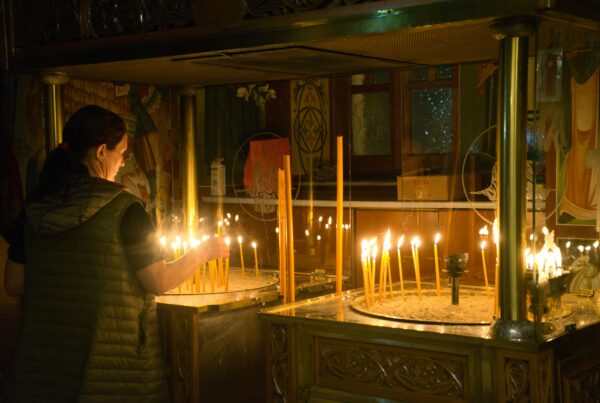
Peace is a prominent theme in the Divine Liturgy—the Liturgy begins with the words “Blessed is the Kingdom” because this is where peace reigns supreme. The first three petitions are for peace—“In peace let us pray to the Lord”, “for the peace from Above and the salvation of our souls,” “For peace in the whole world. . .” Peace is imparted before all the important parts of the Liturgy—before the Gospel, before the Creed, before Holy Communion. And towards the end of the Liturgy, we are exhorted to “depart in peace.”
Peace is based on—
~The Holy Spirit—Peace be with you. Receive the Holy Spirit. (John 20:21) Those who have acquired the Holy Spirit acquire peace.
~Peace is not a feeling of inner tranquility with the idea that there will be no hard times in life. God doesn’t prevent storms from coming to us, but He comes to us in the midst of the storms to bring peace.
~“Have no anxiety about anything, but in everything by prayer and supplication with thanksgiving let your requests be made known to God. And the peace of God, which passes all understanding, will keep your hearts and minds in Christ Jesus.” (Philippians 4:6-7) Having peace involves relinquishing anxieties to God.
~The peace of God comes to those who make peace with God through daily repentance.
~It comes to those who spend time with God each day in silence and prayer.
~Peace comes through learning, in times of disagreement, to work towards resolution rather than prolonged conflict.
In Luke 2:14, when the birth of Jesus is revealed by the angels to the shepherds, the angels sing a hymn: “Glory to God in the highest, and on earth peace among men with whom He is pleased!” This passage is often mistranslated as “and on earth peace goodwill among men.” This mistranslation would seem to indicate that the incarnation of Jesus Christ in the flesh is meant to bring peace and goodwill to everyone. The correct translation indicates that peace is a gift to those who pleasing to God. Those who receive peace are those whose hearts pursue goodwill.
As for the “Sons of God”, when scripture calls someone a “son” of something or someone, frequently it means the two have the same character or nature. So, those who are called “sons of God” act like God, they resemble God in their actions. In Isaiah 9:6, several names are attributed to God: “Wonderful Counselor, Mighty God, Everlasting Father, Prince of Peace.” Those who strive to be peacemakers resemble God in their actions, hence the title, “sons of God” because they model themselves after the Prince of Peace.
Praise the Lord! For it is good to sing praises to our God; for He is gracious, and a song of praise is seemly. The Lord builds up Jerusalem; He gathers the outcasts of Israel. He heals the brokenhearted, and binds up their wounds. He determines the number of the stars, He gives to all of them their names. Great is our Lord, and abundant in power; His understanding is beyond measure. The Lord lifts up the downtrodden, He casts the wicked to the ground. Sing to the Lord with thanksgiving; make melody to our God upon the lyre! He covers the heavens with clouds, He prepares rain for the earth, He makes grass grow upon the hills. He gives to the beasts their food, and to the young ravens which cry. His delight is not the strength of the horse, nor His pleasure in the legs of a man; but the Lord takes pleasure in those who fear Him, in those who hope in His steadfast love. Praise the Lord, O Jerusalem! Praise your God, O Zion! For He strengthens the bars of your gates; He blesses your sons within you. He makes peace in your borders; He fills you with the finest of the wheat. He sends forth His command to the earth; His word runs swiftly. He gives snow like wool; He scatters hoarfrost like ashes. He casts forth His ice like morsels; who can stand before His cold? He sends forth His word, and melts them; He makes His wind blow, and the waters flow. He declares His word to Jacob, His statutes and ordinances to Israel. He has not dealt thus with any other nation; they do not know His ordinances. Praise the Lord! Psalm 147
Points to ponder: In what ways am I led to be a peacemaker in my home life? At work? In my community? What peace-taker tendencies do I recognize in myself?