

The following in an excerpt from “Eros of Orthodoxy,” translated by Fr. Nicholas Palis and written by Mr. Pantelis Paschou.
Despite the fact that Christmas is celebrated in the heart of winter, a Christian feels a strange warmth during these “holy Twelve days.” This warmth is somewhat incomprehensible for most. They say that Christmas is a celebration of the home, it brings together the scattered members of the family, the children and the grandchildren to celebrate together with their parents and their grandparents. Yes, this is a reason too. But the deeper reason is that during these days we give the cave of our existence for Christ to be born in us.
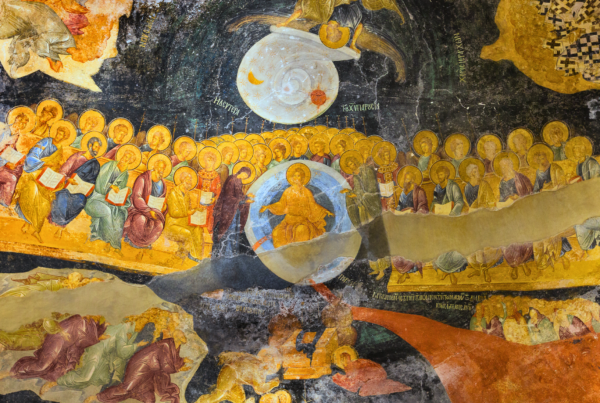
The eternal journey of man towards his salvation and theosis finds—with the birth of Christ—an assured and secure spot to lean its tired anguish: and this is the incarnate Word of God. The most basic and critical point in the Christmas celebration is that incarnation, the incarnation of the Word of God. And the tradition of Byzantine hagiography underlines this most fittingly, relating with a holy simplicity the mystery of incarnation. It avoids the indifferent and overburdened details of western painters, the “composition” of which reminds one more of touching family occurrences or theatrical scenes than the birth of Christ “who became a babe for our sakes.”
A Christian must see the divine “emptying” (kenosis) of his God, who is born naked inside a cave to garb the world. He, who is garbed by the earth and the sky, was undressed to garb man. It is here where man feels the mystery of his unification with God who descended from the heavens. Man is fallen in the mire of earth. God is found in the dwellings above heaven. How is it possible for man to be united with God, without Him descending or without that earthen lump of dirt ascending a bit above his mire?
This is the reason Saint Gregory the Theologian also says with the incarnation of Christ—which “potentially saved man from the bonds of perdition and death”—that man can’t be saved fatalistically and without a struggle. God, out of love for man, descends and becomes a man to be united with man and to save him—this is the first condition for his salvation. But man must also want to struggle in order to rise up towards God, who stretches out his hand. If man doesn’t stretch out his hands towards the heights, the hand of God will remain alone, without a response to the heavenly invitation of theosis. The mystical and divine Maximos the Confessor wittingly renders this dogmatic truth of the Orthodox Church concerning the salvation of man: “God became human for man to the same degree that man was able himself for God’s sake to become deified. God was able to seize man’s intellect to knowing God to the degree that man was able to reveal the naturally invisible God through the virtues.”
Every year when I hear “Christ is born, glorify Him,” I feel I love the hymnography of our Orthodox Church even more. All the ecclesiastical liturgical arts, which are uplifting, elevate man with an awesome mysticism, befitting sacredness. However, the art of hymnography together with the poignant Byzantine music of Orthodoxy I believe have the grace of guiding your soul up to the gates of Paradise. Every single word of the sanctified troparia of our Church hides a secret depth, a wealth of spiritual experience, which along with the melody teaches in a most direct manner.
An example from the first canon of Christmas: “Christ is born”! This present tense of the “is born” is placed there with great wisdom. However, why “is born,” and not “was born”? It is very customary for the rhetoricians, of course, as an ancient interpreter says, to “pronounce things past in a present tense, to show them as present events in the eyes of the auditors and thus to make viewers out of them rather than auditors.” However, for each Christian who hears, reads, or chants it, that “is born” declares a new birth of Christ within him: now, in this instant, Christ “is born.”
To each one of us it says prepare your cave. Chase away every sinful deed or thought from you, and run to welcome Him. Lift yourself up from the earth and from earthy things to give all of your love to Him, who now descends to earth for your sake. If you don’t have anything else to offer Him as a gift, like the Magi and the shepherds, remove your sins and offer them. Thus the place “in your quarters” shall be emptied so that you can offer hospitality to Him who comes as a babe. Don’t delay and don’t put it off. “Christ is born” now. Receive Him now in the manger of your soul.
Saint Nikodemus the Hagiorite says to all Christians, “those chanting, as well as those reading and listening to the Christmas troparia, let us ask the newly born Master and Mary the Theotokos who gave Him birth, to grant us the following: to spend these days which are called the Twelve days, with orderly conduct and respect, with prudence and Christ ethos, with almsgiving and charity to the poor as well as with every other good work and virtue as befits Christians. Not with luxuries and revelries, not with songs and games, not with dances and with other vile and pagan deeds, at which the Devil rejoices and leaps for joy, while Christ the Master grieves and mourns over them. This is the reason he cried when he was born in the cave, to disclose the mischievous activities that Christians do during those days.”
Throughout the Twelve days, when Christians meet they say to one another, the Twelve days are upon us so let’s eat, drink and be merry. Since we’re allowed to eat all foods, let’s take part in revelry. Many, instead of saying “we are permitted to eat,” slip and say we are “free to eat,” resulting in that wise motto: “the tongue by accident speaks the truth,” because this liberation and release is perdition. The freedom to eat any foods brings about pleasure, pleasure causes drunkenness, and drunkenness causes every sin.
Yes, Christians should remember and rejoice during the Twelve Days, not bodily but spiritually. Not with foods and drinks, but because they’ve been made worthy to see the newly born Babe, the Master of all, and because they will (in a few days) see that Master baptized in the Jordan. For this reason, whichever Christians love their salvation should ask the pre-eternal Babe and His Most Pure Mother to be made worthy to spend these Twelve days without sin, to worship Holy Epiphany God-pleasingly, with the grace of the newly born Christ who will soon be baptized.
How much more spiritually would we celebrate the Twelve Days if we were strengthened in the Patristic Tradition of Orthodoxy and if we lived our Churches’ Liturgical Life!