I have said this to you, that in Me you may have peace. In the world, you have tribulation; but be of good cheer, I have overcome the world.
John 16:33
As we continue our way through this “good and perfect” prayer, there is a request for peace. The prayer reads “Grant peace to Your world, to Your churches, to the clergy, to those in public service, to the armed forces, and to all Your people.” There is a lot to unpack here.
The phrase begins with “Grant peace to Your world.” In Greek it reads “Irinin to kosmo Sou dorise“. The word “kosmo” can be translated as “world” or literally it can be translated as “cosmos.” This covers things outside of earth, and even outside of the known world. This is a prayer for everything to function in peace, whether that is the proper alignment of the planets, or the proper behavior of people. Everything should be in a peaceful balance.
Let’s define the word “peace.” Peace is most often defined as “absence of conflict.” The peace of God is actually peace in the midst of conflict. St. Paul writes, in Philippians 4:7, “And the peace of God, which surpasses all understanding, will keep your hearts and your minds in Christ Jesus.” The peace of God passes our ability to comprehend it. Because the peace of God brings calm in the midst of chaos, clarity in the midst of confusion. Thus, we are praying for God to bring this kind of peace to the whole world.
We next ask God to grant peace to some specific categories, and we begin with the church. Someone recently asked me “what is the church?” I hadn’t really meditated on that question in a while. In trying to think of a succinct answer, I went to the short “mission statement” that the parish I serve has adopted—Love God, serve others, share the Gospel of Jesus Christ. The Church is what helps us understand and achieve this mission. It helps us to understand Who God is, which is what kindles faith. It teaches us how to serve others and why that is important. It gives us a base from which to worship, learn and serve. It gives us a sense of community. And the church, as a whole, seeks to spread the Gospel of Jesus Christ in a way one could not possibly do individually.
Spiritual warfare is the constant battle of good against evil, God versus the devil, righteousness versus temptation. This warfare occurs in every life and in every church. And it happens continuously. There is never absence from this conflict. Thus, we pray for the peace of Christ in the midst of the conflict, that we will find the peace of God in the midst of the spiritual battle.
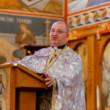
The next group of people who are prayed for are the clergy, tis ierefsi in Greek. In Greek, the word ierosini, which translated literally is “the priesthood,” refers to all levels of clergy. The priesthood has three ranks—the deacon, the presbyter (which is usually is referred to as the priest) and the bishop. In Greek it is the diakonos, presvyteros and episkopos. The priests/clergy are the ones who lead the church, and are charged with leading the worship, educational and philanthropic efforts of the church. Yes, there are Sunday school teachers and philanthropic organizations in the church, and the priest makes sure that these function well. The priests also have their own spiritual battles. Thus, they need the peace of God and need people to pray for that for them.
“Those in public service,” appears in Greek as “tis arhousi imon,” which translates to “leaders” and in past centuries, the appropriate word would have been “rulers.” While we are not “ruled” in our country, our civic leaders, whether on a national, state or local level, make decisions that affect our church, our world and our individual peace. There is so much strife, especially politically, in our country. We need to pray for those in authority, that the peace of God, along with His wisdom, will guide their decisions.
“To strato” translates to “armed forces.” The armed forces are charged with keeping peace and managing conflict. We have freedom to worship because we have people who protect that freedom, our armed forces. There are many countries in the world where people are not able to worship freely, or move without fear. We pray for “the armed forces” and not just ours, we pray that all people will be free to worship in peace.
And the final category of prayer extends “to all Your people.” We want this peace of God to come to all people. Peace is not just a gift, but a responsibility. It is not only something given but something that is strived for. There are people who are peacemakers and there are also people who are peace-takers. There are people who when they enter a room bring down tension, just as there are people who enter a room and escalate tension. The kind of person each is, is a matter of personal choice. One works to shape his or her identity in so many ways, including this one. If we are praying for peace for all people, we are also praying for people to have the wisdom to choose peace, to be a peacemaker rather than a peace-taker. As we read in Psalm 34:14, “Depart from evil and do good; seek peace and pursue it.” This prayer for peace not only prays for the result of finding peace, but for kindling the desire in each of us to pursue it.
O Lord, bless those who praise You and sanctify those who put their trust in You. Save Your people and bless Your inheritance. Protect the whole body of Your Church. Sanctify those who love the beauty of Your house. Glorify them in return by Your divine power, and do not forsake us who place our hope in You. Grant peace to Your world, to Your churches, to the clergy, to those in public service, to the armed forces, and to all Your people. For every good and perfect gift is from above, coming down from You, the Father of Lights and to You we send up glory, and thanksgiving, and worship, to the Father and to the Son and to the Holy Spirit, now and forever and unto the ages of ages. Amen.
Be a peacemaker. Seek peace and pursue it. Remember that the peace of God is not an absence of conflict, but a calm that comes in the midst of conflict.
0 Comments