For it was fitting that we should have such a high priest, holy, blameless, unstained, separated from sinners, exalted above the heavens. He has no need, like those high priests, to offer sacrifices daily, first for his own sins and then for those of the people; he did this once for all when he offered up himself. Indeed, the law appoints men in their weakness as high priests, but the word of the oath, which came later than the law, appoints a Son who has been made perfect for ever. Now the point in what we are saying is this: we have such a high priest, one who is seated at the right hand of the throne of the Majesty in heaven, a minister in the sanctuary and the true tent which is set up not by man but by the Lord.
Hebrews 7:26-28; 8:1-2 (Epistle from Feast of St. Gregory the Theologian)
On January 30, the Orthodox Church will celebrate the Feast of the Three Hierarchs—St. Basil the Great, St. Gregory the Theologian and St. John Chrysostom. Each lived in the fourth century. Each left a major mark on the theology of the Orthodox Church. And each has his own separate feast day. St. Basil is commemorated on January 1. St. John Chrysostom is commemorated on November 13. And St. Gregory the Theologian is commemorated on January 25.
St. Gregory the Theologian lived between 329 and 390 and was the Archbishop of Constantinople (Patriarch) from 380 to 381. He was close friends with St. Basil. St. Gregory was a priest and later a bishop, who struggled between a life of service to the church and the desire to live a solitary, monastic life. St. Gregory was one of the leading voices at the Second Ecumenical Council in Constantinople in the year 381. This Council finalized the Creed that had been drafted in Nicaea in 325. The Nicene-Constantinopolitan Creed is the Creed we still confess as Orthodox Christians today. He did an extensive amount of writing on the Holy Trinity and other aspects of Orthodox Theology. And because of his written and oratory skills, he has the title “the Theologian.”
The same Epistle reading is heard on the Feast of St. John Chrysostom (November 13, January 27), Sts. Athanasios and Cyril (January 18) and St. Gregory the Theologian (January 25), which is why we had the rare occasion of this Epistle lesson being read in close proximity, as we just heard it on the feast of Sts. Athanasios and Cyril.
The word for priest in Greek is “ierefs” or “ieris”. There are several words that we translate as “bishop.” One of them is “episkopos,” which means “overseer,” literally “over (epi) the area/scope (skopos).” The bishop is the leader of a diocese, or a metropolis or an archdiocese. The other word for bishop is “arhieris,” or “Archpriest.” At the heart of it, all clergy—deacons, presbyters and bishops—are all priests. The role of each office is liturgical (celebrating services), catechetical (teaching) and pastoral (healing). The “arhieris” has authority to give direction to those below him. The Bishop is the overseer of the priests and the deacons.
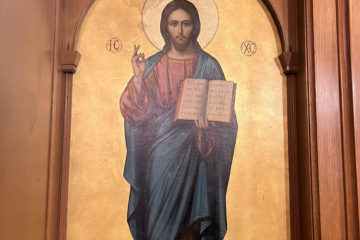
In spiritual terms, there is one “high priest”, the “arhieris” to the “archieris,” and that is Christ. At the time of Christ and before, one of the Jewish priests was called “the high priest,” because he had authority over all the other priests. He was the leader of the temple. However, even though he was the leader of all religious expressions, he was still not perfect. He was still sinful.
In his letter to the Hebrews, St. Paul paints an image of Christ as the high priest. But unlike the other “high priests” referred to in Scripture and respected by the Jews, Jesus is “holy, blameless, unstained, separated from sinners, exalted above the heavens. (Hebrews 7:26) Central to Jewish practice at the time of Christ and before, is the concept of sacrifice. The priests continually offer sacrifices as atonement for the sins of the people, as well as for their own sins. Christ, now the consummate high priest, is different than the high priests who came before Him. His sacrifice on the cross is once and for all. There is no need for continued blood sacrifices for the people because Christ shed His blood for all people. He is the sacrifice. This is why we offer a “sacrifice” that is bread and wine and is consecrated to become the Body and Blood of Christ. There is no need to shed blood for any future sacrifice. Christ shed His blood once for all people of all times. There is also no need for Christ to offer sacrifice for his own sins, as the previous high priests were required to do. He is without sin.
St. Gregory the Theologian was an “arhieris,” a high priest, a bishop, and the Patriarch of Constantinople. And like every other “arhieris” besides Christ, he was not perfect. He is recognized as a saint of the church because he lived a saintly life. But like all of us, it was not perfect. What makes St. Gregory stand out is that in his unique saintly life, he wrote a lot of the theology about Christ as the consummate High Priest. He helped to solidify the relationship of the Holy Trinity. And his writings and teachings have helped to shape Orthodox theology and practice from his time in the fourth century through the present day and beyond.
We pray for our bishops frequently in our services and that is significant. Because while the priest is the head of a church community, the bishop is the head of the priest, and in each diocese, he is the head of the Church. This is why we continually pray for our bishop to have wisdom as they lead, since none of them, or us, is perfect. The idea of a priest or high priest “arhieris” mediating for the people goes back the time of Moses. The bishop mediates to God on behalf of his flock in his diocese. Christ, the consummate High Priest, mediates to God on behalf of all people in all places.
The shepherd’s pipe of your theology overpowered the horns of the orators. For the more you plumbed the depths of the Spirit, ever greater eloquence was bestowed on you. O Father Gregory, intercede with Christ God, entreating Him to save our souls. (Apolytikion, St. Gregory the Theologian, Trans. by Fr. Seraphim Dedes)
It is critical that we offer the bloodless “sacrifice” of the Eucharist often, not because this is how we atone for sin, but this is what strengthens us against temptation, what connects us to God and what inspires us to seek after God.
0 Comments