
Icon copyright Theologic Systems
Now the birth of Jesus Christ took place in this way.
Matthew 1:18
One of the most beautiful Traditions in the Orthodox Church is iconography. Icons tell stories. Up until recent centuries, regular people were not able to read, and so icons became one of the means by which people learned about the Lord and the saints. And even now, as most of us can read, the icons actually speak to us with a depth that goes beyond words. The saying is certainly true, a picture (or in this case, an icon) is worth more than a thousand words.
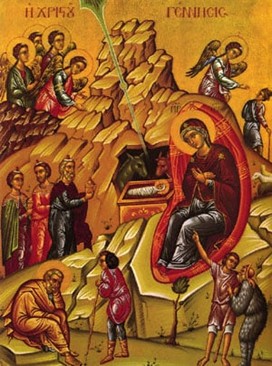
Let’s look carefully at the details of this icon. In the center of the icon is the inside of a cave, painted in black. The cave represents two things. First, the cave represents heaven, an infinite space, without beginning or end, just like the Lord who lays in the cave. Second, the cave represents the tomb where Christ will be laid after the crucifixion and before the Resurrection. This provides representation of beautiful bookends. Jesus is incarnate in a cave, and will be laid in a cave in burial.
It is also significant that the Nativity occurs in a cave, not in a barn or stable, as is often depicted in Nativity scenes. At the time of Christ, people who owned animals put them in caves, because they were warm and protected from predators. This sets up the later teaching of Christ that He was the good shepherd who would lay down His life for the sheep. The cave would have had a narrow entrance that could be protected by a shepherd. Also, the cave was something that occurred in nature. It was part of nature, not something created by man. How appropriate that the Creator of the human hands was Incarnate in a place not created by our hands, but by His. As for the “no room at the inn,” there could be no room in any inn created by human hands to hold the Creator of those hands.
Our focus next shifts to Jesus Himself. We know that it is Jesus because near His head are the letters “IC XC” which are the abbreviation of Isous Christos or Jesus Christ. He is depicted wearing not a blanket in which one would swaddle a baby, but in burial bands. He is also laid in what looks like a casket/tomb, rather than a manger. Both of these depictions are not historically accurate—Jesus would most likely have been wrapped in a blanket and we know He was laid in a manger, which was a wooden trough filled with straw. The icon shows symbolically the burial bands and the tomb because this is why Jesus came to earth, to die for our sins.
Moving on to the Virgin Mary. She is depicted in a blue robe with a red robe on top of it. In Orthodox iconography, blue represents earth and red represents heaven. The Virgin Mary is always depicted in this color scheme, even though at the Nativity, it is doubtful she wore either color. The Virgin Mary began her life on earth (blue) and at her death was assumed into heaven (red). Around her halo are the letters MP QU, which is the abbreviation for Mitir Theou or Mother of God. Those letters are always shown in her halo.
Angels are above the cave, singing God’s praises and announcing the good news of great joy. Some icons still depict the sky as a dark color (that is more iconographer preference, some iconographers paint a dark background on all of their icons) and many icons depict the sky as gold, lit up by the presence of the heavenly hosts.
The shepherds are scattered on the hillside with their flocks, hearing the news of the angels, and thinking about what it all means. The Magi are also shown traveling, They did not arrive at the cave to see the Babe. They would arrive two years later, and would see a Child in a house. The icon depicts the Magi with one as a younger man, one a middle-age man and one an older man. Some icons depict the Magi as three races—black, Oriental and white. The symbolism of the Magi is that they are diverse in age (and race) but united in gifts—Gold for a King, incense for God and myrrh that would anoint the Body of Jesus after the Crucifixion. The message taken from shepherds and Magi is that Christ came for all peoples, or all nations, races, ages, economic classes, etc.
A star rests over Christ. It is what guides the Magi. It also highlights that the Nativity was a cosmic event. All of the created world came to worship the creator in its midst. The rich and the poor, the angels, the earth (cave), the animals and even the stars. The Lord created all of them. Now all of them come to worship the Creator now becoming part of His creation.
The last figure to comment on is Joseph. He sits in the lower right corner of the icon. He is taking it all in, trying to make it all make sense. A young boy (and in some icons, an older man) is speaking with him. This person represents the devil, who tries to bring doubt into Joseph’s mind. The devil does not appear to us with horns and a pitch fork. If he did, it would be obvious we should not follow him. Rather, the devil comes to us in an ”acceptable form,” as an innocent young boy, or a grandfatherly older man. Who would suspect a venerable old man or an innocent boy of trying to lead people into temptation? And this is how the devil operates—he comes in an acceptable form to try to lead us into temptation.
The story of the Nativity is far more than the birth of the baby Jesus, visited by shepherds and Magi. It is the account of the Creator becoming part of the creation, and all of creation arriving to worship its Creator.
What shall we offer You, O Christ, because You have appeared on earth as a man for our sakes? For each of the creatures made by You offers You its thanks: the Angels, their hymn; the heavens, the Star; the Shepherds, their wonder; the Magi, their gifts; the earth, the cave; the desert, the Manger; and we, a Virgin Mother. God before the ages, have mercy on us. (Idiomelon from the Vespers of the Nativity, Trans. by Fr. Seraphim Dedes)
A picture is worth a thousand words. The Icon of the Nativity gives deeper meaning to the words shared in the Gospels of Matthew and Luke concerning the Nativity.