
By Fr. Michael Psaromatis
Greek Orthodox Archdiocese of Australia
There are some farewells that stay in your ears because they are spoken in the language of children. No polish. No performance. Only truth.
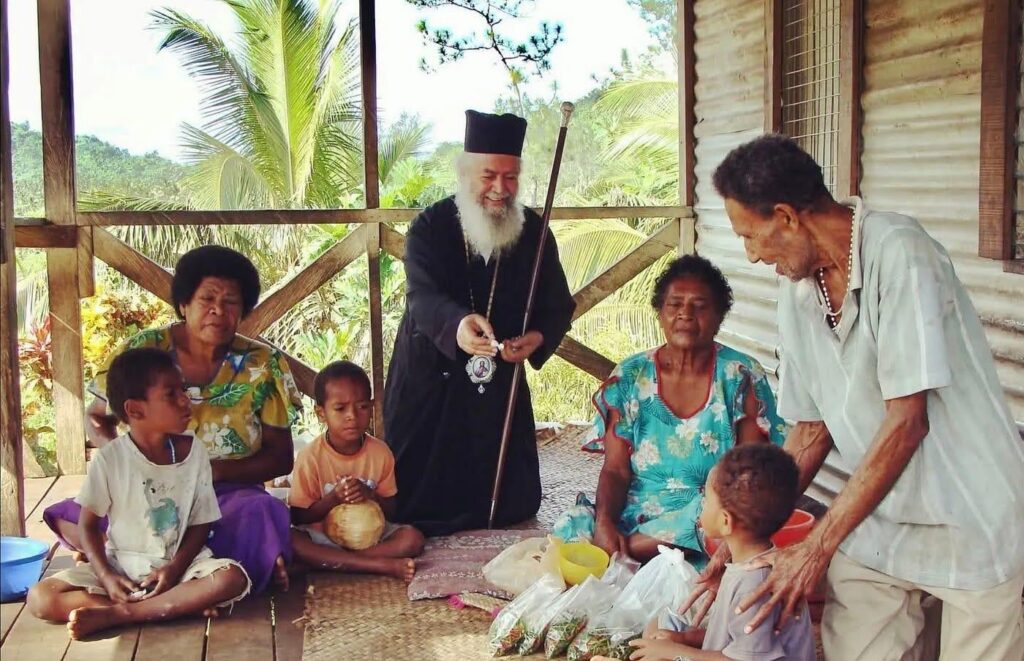
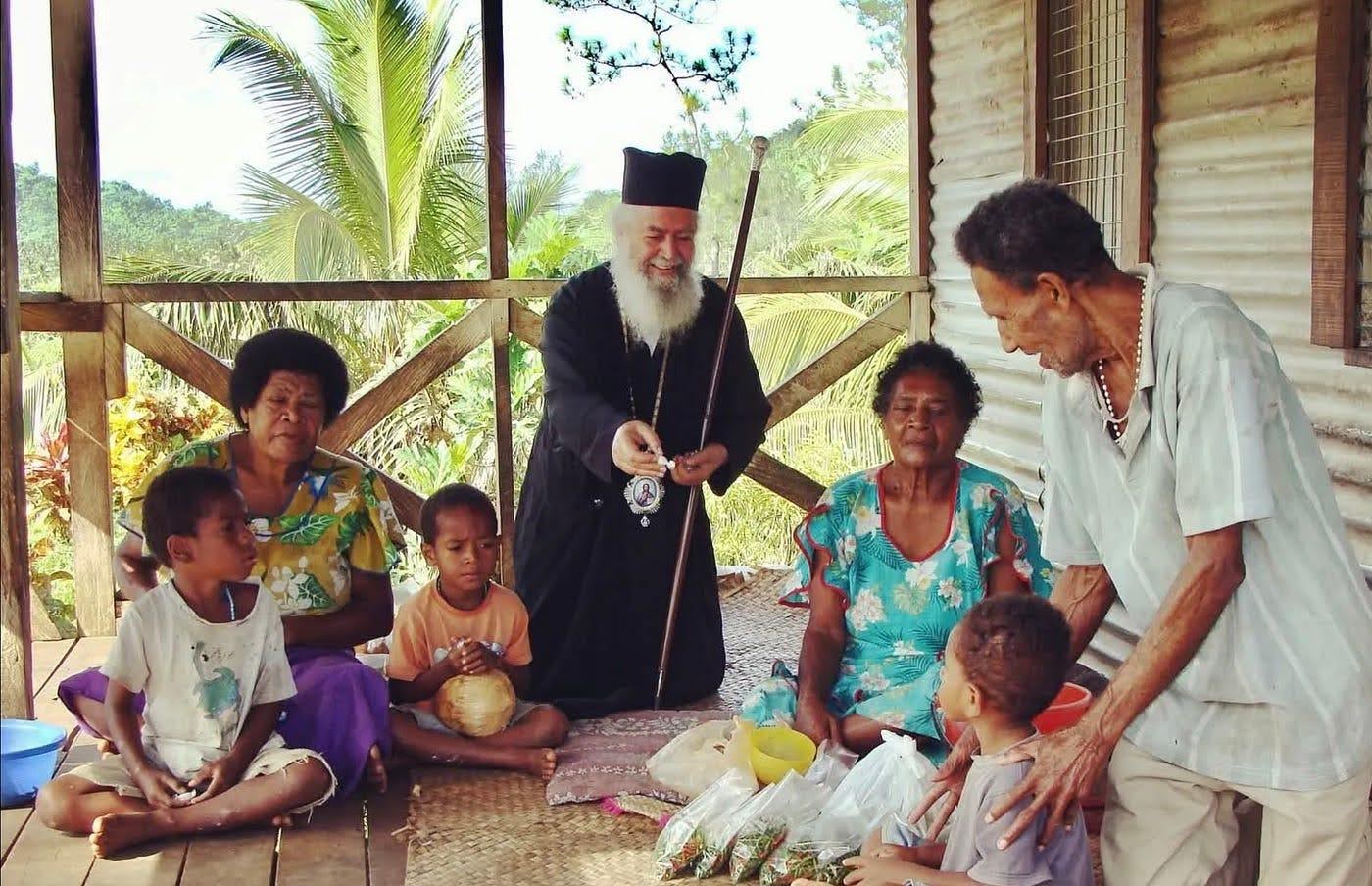
In Fiji, the children thanked him for everything. They told him they were waiting for him. They asked him to pray for them, and they promised their prayers in return. They spoke about the happiness he brought whenever he came. They held out small gifts with shy pride, as though placing their whole heart in one small object. In those simple words you hear what explains his life far better than any timeline. Metropolitan Amphilochios arrived as family. He made people feel that God is near. He left people with a hunger for prayer and a love for the Church that did not feel borrowed.
For many years this work lived quietly, almost hidden. It sat in the background of our lives as something deeply real, deeply costly, and strangely unseen. Very few people knew what was unfolding in those islands. Fewer still understood it. Yet the work was never done for applause. It was done because there was a calling. And the calling had a name and a face. It began, for many of us, with Geronda (Elder) Amphilochios Tsoukos.
Born in Lardos of Rhodes and formed in Patmos and Halki, he carried the same spirit into every station of his life. He laboured in Africa in the years of renewed Orthodox mission, later renewed monastic and pastoral life in Rhodes through Tharri, and then, as Metropolitan of New Zealand and Exarch of Oceania, became the father of a new missionary chapter in the South Pacific. What follows is not merely a list of places and dates, but a witness to the same inner thread that held them together.
Metropolitan Amphilochios reposed in the Lord in Rhodes late on Saturday 14 February 2026. His passing has been felt across Rhodes and the Dodecanese, across Greece, across New Zealand, across Australia, and across the Pacific Islands. In Fiji, Tonga, and Samoa the grief took the shape of family grief, because for them he was the man through whom Orthodoxy entered their world and became their way of life.
Africa wept as well, and it wept in a way that cannot be dismissed as words. It was the tears of children. The tears of the Congo, where he laboured near Saint Chrysostomos Papasarantopoulos. The tears of Kenya, where he also laboured, and where he stood close to his spiritual sister, Saint Gavrilia of Leros. And the tears of Tanzania, where the missionary labour of Orthodoxy continues to this day in the same apostolic spirit, carried forward by those who received his blessing and his prayer, always with that simple signature that captured his inner attitude: Ταπεινά εμείς, meaning, Humbly, we.
To speak about Metropolitan Amphilochios is to speak about a life that travelled far and remained consistent in spirit. Whether he stood in Patmos, in Africa, in Rhodes, in Wellington, in Sabeto, in Saweni, in Labasa, in Tonga, or in Samoa, people recognised the same quiet authority: the authority of love. He had the gift of meeting people and drawing them without pressure. He would walk, speak, bless, listen, and hearts would open. Many people were moved to tears simply by meeting him, and it happened so often that it became almost a pattern: a soul meets him, the heart breaks open, and something begins.
He was gentle. He was peaceful. He was approachable. He was poor in possessions and rich in giving. People who knew him closely speak of him as a man whose pocket would empty into the hands of the needy, and yet somehow the other pocket would fill again, so that he could continue meeting the needs of the poor and the suffering. He was unmercenary. He was blameless in spirit. He was humble without calculation.
And yet he could be dynamic, even fierce, when he heard the Name of God insulted, or the Theotokos mocked, or the Saints spoken of with contempt. His gentleness carried strength. His strength carried prayer.
Lardos, Patmos, Halki: The Making of a Priest Monk
Geronda Amphilochios was born on 15 March 1938, in Lardos of Rhodes, during the sombre years of the Italian occupation. In the world he was known as Adamantios, and among many he was affectionately called Diamantis, a name that later felt almost prophetic, because he became a true spiritual diamond, not through shine and display, but through hidden endurance, faith, and love.
That year, his birth fell during Great Lent, in the opening weeks of the fast, and many people remembered this as a fitting beginning. Great Lent is the Church’s doorway into repentance, fasting, prayer, and the struggle for purification. Those who watched him grow from boyhood often felt that his birth within the Lenten season carried a quiet symbolism, as though his life would be shaped from the beginning by the spirit of Great Lent: seriousness, humility, prayer, and a heart turned toward God.
He was born to pious, traditional parents, people who embodied the humble piety of the Dodecanese and carried the principles and values of the place in their bones. His father, Georgios Tsoukos, was a distinguished figure in the local society and served for many years as president of the community of Lardos. His mother, Panagiotta, was the quiet strength of prayer within the home, a humble housewife whose inner life was shaped by the Church. They raised the fifth of their six children according to the apostolic instruction, in the discipline and admonition of the Lord, planting in him from childhood the waters of faith and the love for the Church.
He was one of six children: five brothers and one sister. His brothers, their wives, his sister and her husband were not spectators. Their love, support, and steady devotion strengthened those around him, and they strengthened those who laboured beside him in the years when Tharri Monastery was being restored, established and shaped. Many who lived over the years at Tharri have testified that Geronta Amphilochios family’s presence and faith added measurably to the spiritual growth of those who were trying to serve, because holiness is sustained through people who love God and love the Church.
His childhood was formed by the home and by the living parish rhythm and liturgical breath of Lardos, especially in the Church of the Archangel Michael of his village. His young soul absorbed worship as reality. It was shaped also by the living tradition of the islands: the memory of ascetic life, the stories of holiness, the miracles and struggles of sanctified people known in the local conscience. The tradition of the angelic life lived as memory, and among the influences remembered in Lardos was the sanctified example of an ascetic father connected to the spiritual inheritance of Panagia Ypseni, whose life and miracles lingered in the local consciousness and helped form the imagination of the young boy toward dedication and ecclesial service.
The memory of his childhood and youth in Rhodes never stayed locked away as nostalgia. It became part of his missionary identity. He carried Rhodes as blessing and responsibility. Later, when the world opened before him in ways no one could have predicted, he still lived as a man who never forgot the soil that formed him.
He began from his birthplace, from the God protected Lardos, inspired by a local spiritual inheritance, including the example of Hosios Meletios, whose life he later wrote. Geronda Amphilochios travelled and recorded; he laboured and he taught; he built and he explained what he was building by pointing people to the saints.
At the age of thirteen, he was selected by the Metropolitan of Rhodes of that time to attend the Ecclesiastical Academy of Patmos. Even at a young age he was noticed for seriousness and promise, and the path opened early, as though the heart had already begun to whisper, Here I am, send me (Isaiah 6:8). Patmos was not a random destination. Patmos is the island of Saint John, the place of the Apocalypse, the landscape of sobriety and repentance. And it was there that he became a spiritual son of the now canonised Saint Amphilochios Makris of Patmos.
From that spiritual fatherhood, his whole life took its tone. Saint Amphilochios of Patmos belonged to that saintly line that passes through the Church like a living river. He was a spiritual child of Saint Nektarios of Aegina, and he carried that same spirit of simplicity and mercy, prayerfulness and practical love, holiness without self advertising. Under such an elder, the young Adamantios learned what no classroom can give: prayer as breath, repentance as life, obedience as freedom, gentleness as strength.
It is no accident that those who describe Metropolitan Amphilochios return again and again to one theme, because it truly became the inner model of his missionary priestly life. In the universal epistles of Saint John the Theologian, a line stands like a sword and a lamp: God is love. And Saint John continues with the sobering realism of the Gospel: whoever says, “I love God,” and does not love his brother, is lying. How can someone claim to love God whom he has not seen, if he does not first love the brother whom he does see (1 John 4:20). For Geronda Amphilochios, this became the measure of Christian authenticity. It became the standard by which he judged his own life. It became the spiritual logic of his mission: love must become concrete, love must become sacrifice, love must become action, love must take the shape of the neighbour standing before you.
After completing his primary schooling in his village, and with his heart already burning with the desire for the Holy Priesthood, he left for Patmos and enrolled in the renowned Patmiada School, that ancient and fruitful seedbed of ecclesiastical education. He completed his secondary studies there, distinguished for ethos and ability, yet beyond academic performance something deeper was happening: Patmos was taking hold of him.
His years at the Patmiada were not only school years. They became years of formation of the heart. His acquaintance and close companionship with the brotherhood of the Great Monastery of Saint John the Theologian, and his deep relationship with Elder Amphilochios Makris, cultivated his vocation at depth, stabilised his longing, and shaped the contours of his inner vision for what the Church should be in the world.
Those who lived near him as young students remember a man who fed both body and soul with the same fatherly instinct. His sanctified mother, Panagiotta, would send him provisions from Lardos, and he would share them before the students even climbed up to the school. He had a way of making sure no one remained hungry, and it was never only about food. He had a way of making sure no one remained spiritually hungry either. The evening prayers, the reading of spiritual books, the quiet conversations, the counsel and exhortation, these remained deeply imprinted in the hearts of those who were near him.
He had a rare gift: he could unlock the soul of a young person. Students surrendered themselves to his guidance without feeling coerced. They were won by his simplicity, his truthfulness, his uncalculated love, and above all his sincerity. This was a spiritual father being himself.
Having a thirst for broader formation and theological education, he departed with a recommendation letter from the then Metropolitan of Rhodes, Spyridon, and arrived in 1959 in Constantinople, enrolling in the University Department of the Holy Theological School of Halki. There his mind was trained with rigour, and yet he kept theology joined to prayer and repentance. The aim remained communion with God.
He graduated with honours in 1963, submitting his thesis on the dogmatic teaching of the Quran, a work that reveals theological seriousness and breadth of interest, because a man who studies another faith’s doctrinal framework seriously is often a man preparing for engagement with the wider world.
During his studies, on 8 December 1962, he was tonsured a monk in the Church of the Holy Trinity of the School, and the following day he was ordained a deacon by Metropolitan Maximos of Stavroupolis. A few months later, on 14 July 1963, in the same holy church, he was ordained a priest by the same Metropolitan. After receiving his degree, he remained for a further year on Halki by instruction of Patriarch Athenagoras, serving as epimelitis (curator) of the school, a sign of trust and proven steadiness.
He became, in time, a brother of the monastery of Patmos, and the discipleship of the Patmiada gave him the opportunity to drink deeply from the spirit of the Holy Cave of the Apocalypse. The Church’s services, the daily rhythm of worship, and the spiritual guidance of the fathers left a permanent imprint on him. His thirst for God increased. Like a deer thirsting in dry land, he ran again and again to the springs of life: to the holy services, to the study of Holy Scripture, and to the reading of the Fathers.
Africa: The Furnace of Love
In 1964 he returned to Patmos and entered fully into the blessed circle of his spiritual father. Full of divine zeal, theologically trained, and already carrying a missionary disposition, he began his ecclesiastical service under the elder’s guidance, serving as priest of the Monastery of the Annunciation and as preacher within the Patriarchal Exarchate of Patmos. In 1969 he was appointed as a teacher at his spiritual mother, the Patmiada School, and for many years he offered his educational service there, using a dialogical method and urging students to discover theological knowledge personally and connect it with the contemporary world and its needs, treating theology as light for life.
After the blessed repose of the venerable Amphilochios Makris in 1970, inspired by the elder’s example and following his missionary bequest, he made a conscious decision to enter the realm of external mission. It was the era of renewed mission toward the nations, a time when many left the comfort of home and the familiar patterns of Greek ecclesiastical reality to travel to unknown places, bearing the word of faith. For him it was as though the Church was hearing again the Lord’s command spoken plainly to the apostles, Go therefore (Matthew 28:19 to 20), and he followed with simplicity and obedience.
He began his missionary labour in 1972 in Africa, working in Kenya, Tanzania, and Zaire, cooperating with the outstanding figures of modern Orthodox mission: Saint Chrysostomos Papasarantopoulos, the venerable Gavrilia, and the then Bishop of Androusa Anastasios (later Archbishop of Albania). In an era when travel and communication were difficult, he carried out a multi dimensional work: catechising indigenous people, baptising, founding parishes, building churches and mission centres, and awakening missionary societies in Greece, who then became practical support for the work on the ground.
The African years stripped away anything unnecessary. They strengthened what mattered. They confirmed what Patmos had taught him: the Church exists for the salvation of human beings, and love always demands sacrifice.
Africa also reveals something essential about him: he formed people. He shaped priests, monastics, catechists, and co workers through shared hardship and prayer, through example more than instruction. Many who later carried missionary labour in their own right were first strengthened by the atmosphere of Geronda Amphilochios’ life. The great missionary Fr Kosmas Grigoriatis was one of these.
It was within the African field too that Saint Gavrilia of Leros intersects with his life in a way that reveals the unity of Orthodox mission. He met her personally in Kenya, and later met her again in Athens in Patissia, and later again on Leros. Those encounters mattered because he recognised in her the same Orthodox wholeness he had learned in Patmos: love that goes out, love that returns into prayer, love that remains simple and fearless.
His missionary labour in Africa was recognised and sealed in a concrete ecclesial way in 1974, when Patriarch Nikolaos of Alexandria awarded him the office and dignity of Archimandrite of the Alexandrian Throne in the Church of the Annunciation in Lubumbashi. After about six years of fruitful missionary work, he returned to Patmos and resumed his earlier duties, carrying Africa within him like a hidden fire that never extinguished.
From Africa, the testimony that remains is living. The tears of the Congo and Kenya still speak, and the missionary labour continues in other parts of Africa with the same blessing and the same spirit, carried by those who stood near him and learned from him. Those that Geronda Amphilochios left in Africa to continue the work, those who had received him, laboured with him, are those who now carry his prayer forward in their own missionary fields.
Rhodes: Tharri and the Renewal of the Dodecanese
In 1989, his birthplace became again a station of service. At the invitation of the Metropolitan of Rhodes, Apostolos, he settled in Rhodes and assumed duties as preacher and later as abbot of the Monastery of the Archangel Michael at Tharri. He developed a vigorous liturgical life, travelled through the parishes of the province, taught, confessed, guided as spiritual father, reformed consciences, renewed and expanded the monastery of Tharri, gathered and formed its brotherhood, and became in a very real sense a new ktetor (founder), rebuilding what had been weakened and re establishing what had been neglected.
He established a sisterhood at the Monastery of Panagia Ypseni and took care for the re gathering and expansion of its buildings. He cared for other monasteries of the island. He founded the radio and television station of Tharri and the ecclesiastical bookshop. His presence on Rhodes became a gift, because he did not simply serve a monastery; he carried an entire pastoral movement: preaching, confession, renewal of monastic life, the strengthening of liturgical ethos, the steady cultivation of a Church consciousness that could survive the pressures of modernity.
There is an episode from the early years of this vision that reveals the size of his faith. He travelled to Athens and went to the Church of Greece radio station to speak with the director. He expressed his desire clearly: he wanted to establish in Rhodes an ecclesiastical radio and television station, and he would put Nektarios in charge. The director responded with the logic of experience: television is a difficult undertaking; even the Vatican has struggled; with what money will you do this? Geronda Amphilochios answered with the kind of simplicity that belongs only to faith: he had, for a beginning, five hundred drachmas, and God would help. Great works, he would say, are accomplished without money.
His love for Rhodes was personal and pastoral. He loved the people who loved him. He loved the Dodecanese. He loved Patmos, Leros, Kalymnos, Kos. He loved the smaller islands too, the places most people pass over quickly: Saria, Agathonisi, and the scattered points of life that feel small on the map and immense in the heart of a bishop who knows what it means to belong. He loved Lardos, the village of his birth. He loved the Archangel Michael at Tharri, and the whole brotherhood and life there. He loved Panagia Ypseni, and he carried a tender concern for the Gerontissa and the sisters there, insisting that they be cared for and never neglected. He loved the sanctuaries and chapels that formed the spiritual spine of Rhodes: Saint John the Theologian at Artamitis, Saint George in the local places that held the faith steady, and all the holy points of the island where prayer has been offered for generations.
And he carried a clear legacy from his spiritual father, Saint Amphilochios of Patmos to never forget the Dodecanese and Asia Minor. That legacy stayed with him all his life. He did not forget. He did not abandon the few, because in the Church’s mind the few can be immeasurable. He carried the islands. He carried Asia Minor in his heart. He carried Cyprus and Crete. He carried the whole embrace of Hellenism and Orthodoxy as love of homeland purified by love for Christ.
A spiritual child who later became abbot of Tharri remembers a first childhood encounter that never left him. It was a winter downpour, on 8 November 1981, at a family wedding. In that rain he saw a venerable priest monk and asked his father, Who is that little old man who looks like Christ. It was the first time he heard the word missionary, the first time he heard that this man had baptised thousands of African children, the first time he heard that he was a teacher in Patmos. From that day the thought planted itself: I want to go to the Patmiada.
Years later, the same elder walked into a vespers service, remembered that child by name, and placed into his hand a small icon of the Panagia, saying with quiet tenderness, This will protect you from now on. And the child felt something that can only be called a spiritual call.
When that young student later arrived in Patmos and felt the ground disappear under his feet, far from home, the elder approached him with fatherly simplicity: Do not be sad. September has passed. October is coming. We will celebrate the Saint. Then comes November, your feast. Then comes Christmas and you will go home. And with that small sequence of months the knot loosened and the heart became free. You came here to study theology, to read much, and to be joyful. Words simple, fatherly, liberating.
That spiritual child would become Archimandrite Nektarios Pokkias, and his story is not separate from the elder’s story. It is one of its clearest fruits.
New Zealand and Oceania: A Missionary Metropolis
In 2005, following a recommendation by the Metropolitan of Rhodes, His Eminence Kyrillos, to His All-Holiness the Ecumenical Patriarch of Constantinople, Bartholomew, the Patriarch submitted the proposal to the Holy and Sacred Synod, which then elected him Bishop of the once illustrious Diocese of Erythrae. On 9 July 2005, he was consecrated Bishop at the Cathedral of the Annunciation of the Theotokos in Rhodes, by the Metropolitan of Rhodes, His Eminence Kyrillos. His ministry as auxiliary Bishop to the Metropolitan of Rhodes proved brief, for the Providence of God had already prepared a new mission for him.
During that brief episcopal period in Rhodes, he did what he always did: he read souls. He knew the longing of a young man for the diaconate and priesthood. Out of discretion he never pressured him. Then, in a moment that felt both simple and prophetic, he came to Saint Christophoros and said with fatherly clarity, in front of the parents: he wanted a deacon to help him, and that deacon would be Nektarios (Pokkias whom we refer to above).
When the news came that he had been elected Metropolitan of New Zealand, many worried. They pleaded. Geronda, where are you going so far away, to the edge of the earth. Twenty hours on an aeroplane. His answers were immediate and disarming. With God’s help he would endure, because the same Holy Table and the same Christ would unite them.
The aeroplane journey, he would say, is among the most personal and undistracted hours of prayer. People travel twenty hours by ship and consider it normal; he would travel twenty hours by plane and use the same hours as prayer. The one thing human beings cannot endure, he would say, is sin, because sin wounds us.
He also showed a clear ecclesial mind in the way he handled his spiritual children. A young man wanted to follow him. The elder wanted him too. Yet he looked at needs and said: remain here, in Rhodes, in Tharri, and in the station, because they need you more. That is how he thought. He loved mission, and he also knew that mission sometimes means staying.
On 13 October 2005, he was elected Metropolitan of New Zealand and Exarch of Oceania. He assumed this new ministry at an advanced age, already sixty seven, and yet he worked with a youthful spirit for the development of his Metropolis and the founding of missions in the island states under his canonical responsibility: Fiji, Tonga, Samoa.
To understand what he did in New Zealand, it helps to understand the peculiar history of the Metropolis itself. In 1970 the Metropolis of New Zealand was established. For a time it held an enormous jurisdiction across the Far East. Over time that vast region was reorganised as the Church established other structures in Asia. By the time Metropolitan Amphilochios was elected, New Zealand was entrusted with New Zealand and Oceania: Fiji, Tonga, Samoa, and the surrounding island world.
Metropolitan Amphilochios entered New Zealand to a scattered flock, few clergy, long distances, and a secular climate. His approach was clear: he carried the Metropolis as apostolic territory. He strengthened existing parishes and communities. He opened new ones. He ordained clergy. He encouraged monastic life. He established places of worship so that people could live the sacramental life of the Church.
During his tenure, concrete milestones became anchor points for the Church in New Zealand. A parish dedicated to Saint Nicholas was founded and organised in New Plymouth in December 2006. A parish dedicated to Saint Demetrios was opened in Hastings in 2008. The Monastery of the Holy Archangels was opened in Levin on 1 May 2010, becoming the only Orthodox monastery in New Zealand, a spiritual centre that carried confession, liturgy, hospitality, and prayer for the whole Metropolis.
Around these foundations, parish life was strengthened in places such as Auckland and Wellington and beyond, with the same steady insistence that the Church must be lived as a way of life. Catechism became part of the daily rhythm of parish and monastery. The work demanded translation, correspondence, drafting documents, establishing accounts, registering church entities with government, meeting officials, building trust, protecting the integrity of the Church’s presence, and careful responsibility in sensitive areas, particularly as the mission began caring for vulnerable children and needed cooperation and accountability with welfare authorities.
New Zealand also revealed how much was missing simply because the Church was still young and small in that setting. The needs were basic: chanters, teachers of Byzantine music, iconographers, people who could teach basic Church crafts, prayer ropes, liturgical order. Monastic life needed practical skills: gardening, animals, farming, building. When a Church is small, everything must be built slowly, patiently, one person at a time.
Metropolitan Amphilochios carried all of this with the same faith he carried in Africa. He stepped out, and he trusted. People who worked beside him saw this repeatedly. He would lay foundations without seeing the money. He would begin projects because love demanded it. Then help would appear, often from directions no one anticipated.
When the time came for him to step aside, his tone was one of thanksgiving, not nostalgia. He carried the words of the sacred Chrysostom on his lips, Glory to God for all things, and he spoke about what had been done with sobriety and gratitude. He had come by obedience to the Church, by the call of the Ecumenical Patriarch, and by the grace of God the work unfolded without specific economic resources and without human certainty.
During his tenure as Metropolitan of New Zealand, the Metropolitan Church of the Holy Apostle Andrew was renovated inside and out. Ready Protestant churches were purchased and transformed into Orthodox temples. A chapel was established at the Greek Orthodox cemetery in Wellington in the name of Saint Lazarus. The great and wondrous Pantokrator was painted in the dome of the Cathedral of the Annunciation. The Monastery of the Archangels was built from the foundations, with chapels of Saint Basil and Saint Amphilochios, Bishop of Iconium.
The churches of Saint Andrew in Wellington, Holy Trinity in Auckland, and Holy Trinity in Saweni in Fiji were consecrated. The great church in Saweni, together with the orphanage, was completed through donations offered for the work of external mission. The missionary centre at Sabeto in Nadi became a substantial building with a chapel of Saint Paraskevi. There, the first baptistery was made, where the first baptisms took place, including Senibulu who received the name Bartholomew in honour of the Ecumenical Patriarch, and his wife who received the name Lydia in honour of Saint Lydia, the first Christian of Greece and Europe.
Other baptisteries were established in the Monastery of the Archangels, in Saint Nicholas at New Plymouth, in Holy Trinity at Saweni, in the church of Saints Nicholas and Athanasius on Vanua Levu, a church built through the offering of an anonymous sister in Christ from Macedonia, and also in the church of Saint George in Tonga, where there is also the chapel of Saints Peter and Paul.
In Samoa land had been purchased with a view to build a church in the name of the Apostle and Evangelist John the Theologian. He spoke about the women’s monastery in Saweni, in the name of the Dormition of the Theotokos, with the first two Fijian nuns, Melani and Anyssia. He spoke about clergy and the need for spiritual shepherds, and he rejoiced that the Metropolis had been staffed by good and spiritual priests, six in New Zealand and five indigenous priests in Fiji, Tonga, and Samoa.
Upon leaving Geronda spoke about his successor with gratitude and confidence. He said that Orthodoxy had been founded in those places and would spread more with the in every way worthy new Metropolitan who succeeded him, Metropolitan Myron, from the great island of Crete. He spoke about returning to Greece because of age and health, and also because the New Zealand authorities did not grant further permission for his stay, a detail he received as God’s providence.
He thanked God for both good and trial, thanked the Patriarch who supported him with prayer and understanding, thanked all co workers and supporters in Greece, America, and Australia, and then said that he had nothing more to add except to repeat again, Glory to God for all things.
Here it must be said clearly and with gratitude: the Lord granted the Holy Metropolis a worthy successor, Metropolitan Myron, who has honoured this inheritance. He has continued the work. He has carried it forward with reverence and strength. He has kept Geronda Amphilochios within the living consciousness of the mission. Until the elder’s repose, the mission continued to look to him as a spiritual grandfather. His name remained present in counsel, prayer, direction, and the quiet seeking of blessing. The mission kept him close, as a family keeps close the elder of the household.
Fiji, Tonga, Samoa: Where Christ Comes Ashore
When Metropolitan Amphilochios arrived in Oceania, he did not begin by announcing grand strategies. He began by going, by visiting, by looking, by praying, by waiting for the opening. He visited Fiji. He visited Tonga. He visited Samoa. He travelled the islands extensively, searching for the first door God would open. He lived the counsel that the Scriptures give to every Christian trying to walk without self will: Trust in the Lord with all your heart, and He will direct your paths (Proverbs 3:5 to 6). He asked the Lord first. He watched for signs. He moved forward when the peace was there.
After those visits, he decided that the place to begin was Fiji.
There are moments in the mission when theology stops being discussion and becomes breath. One such moment came on the sea. The larger ship that had carried the missionaries from island to island remained behind, and a small open boat rose and fell between grey sky and broken water. Wind pulled at clothes. Salt stung eyes. The Jesus Prayer rose quietly between clenched teeth. The bishop prayed aloud and entrusted the journey to Christ and to His Mother. The Fijian crew traced the sign of the Cross with the quiet faith of people who understand the ways of the sea. Wave after wave lifted the bow and dropped it again, and through the grey a dark line formed, then sharpened into the shoreline. Land.
When they stepped onto the sand, the village welcomed them with songs, garlands and open arms. Children ran to embrace them. The journey across dangerous water and the warmth of the welcome revealed what the mission so often teaches: human strength is small, and God’s providence is real.
In Fiji, Metropolitan Amphilochios attended a Pentecostal church on a Sunday because there was no Orthodox church. After the service, the pastor met him. Metropolitan Amphilochios spoke plainly about who he was and why he had come. The pastor did not become Orthodox, yet he and his wife were helpful at the beginning.
A decisive link at the start was Lydia, later Presvytera Lydia. She introduced her husband to the Archbishop. Her husband was a military man. When he met the Archbishop, he wept. Many people were moved to tears simply by meeting him.
During that dinner, Metropolitan Amphilochios asked him: how would you like to become the first Orthodox priest in Fiji. He did not think first in terms of importing clergy. He thought first in terms of indigenous priests who could carry the Church from within. After catechism and formation, he accepted.
On 12 September 2009, at Tharri in Rhodes, Metropolitan Amphilochios ordained Bartholomew Senibulu to the Holy Diaconate. Later he ordained him to the Holy Priesthood, and Father Bartholomew became the first native Fijian Orthodox priest.
On that same early period, Metropolitan Amphilochios encountered another man and asked him: how would you like to become the first Orthodox priest on this island. The man was Hindu. He answered yes. That man became Father Barnabas.
On 29 May 2011, Father Barnabas was ordained in Greece at Tharri in Rhodes. He returned to Fiji and served faithfully, especially in Labasa. He reposed in the Lord in 2022. Following his passing, his spiritual son, now Father Alexios, assumed the clerical responsibilities and continues to serve the community Father Barnabas helped establish.
On 29 May 2011, Father George Pillay was ordained to the Holy Diaconate, and on 13 June 2011 he was ordained to the Holy Priesthood in Thessaloniki. He served the mission for more than a decade across Fiji, New Zealand, and Tonga.
Father Panagiotis Singh, an Indo Fijian priest ordained in New Zealand under Metropolitan Amphilochios’ spiritual guidance, served faithfully at the Cathedral of the Holy Trinity in Saweni and often at Saint Paraskevi in Sabeto. He later reposed after illness, and his memory remains alive among the faithful.
From that point, Metropolitan Amphilochios began building Fiji with steady determination. He built the chapel of Saint Paraskevi. He established the mission centre. He established the orphanage dedicated to Saint Tabitha. He established the monastery in Saweni, often called New Ypseni. He built the great church of the Holy Trinity, a large and beautiful temple for local Fijians.
When the monastery life began to take shape in Saweni, Geronda spoke about it in a way people never forgot. He said that it would be a candle always lit in the middle of the ocean. He called it an eternal symbol of divine worship and prayer in the islands of the Pacific, a steady flame teaching the islands the rhythm of Orthodoxy. He loved the simplicity of that image: the stars in the heavens, and the lamps on earth, in monasteries and churches and in the corners of Christian homes.
For him, monastic life in Fiji was not an ornament. It was the heart of the mission. A living lamp that would keep burning even when visitors leave, even when funds come slowly, even when the islands feel far from the rest of the world.
People say openly that he achieved more than anyone could have imagined between 2005 and 2018. They say it because they remember what the mission looked like at the beginning: no churches, no Orthodox people, no structures. Then, within years, churches stood, communities formed, indigenous clergy served, monastic life began, children were cared for, and a whole region began to speak about Orthodoxy as something alive.
In the early years of Fiji, when everything was fragile and every day required improvisation, Mr Lambros Kouniaris and his wife Andriana stood as integral members of the mission’s life. Lambros carried responsibility for the missionary centre. Andriana shared the labour with steady endurance. When the St Tabitha home began to take shape, Lambros carried responsibility in its early years, overseeing practical running and holding together the daily logistics that determine whether a home collapses or continues.
Metropolitan Amphilochios wanted these children to be cared for with dignity. He built with excellence. He insisted on quality. He treated this work as the Church’s natural obedience to the Gospel, because pure religion before God is not theory; it is care for the vulnerable (James 1:27). Love expressed itself in concrete dignity.
On Vanua Levu, in the earliest days, there was a moment that has stayed with me because it shows exactly how Geronda thought. A family arrived from the forest, parents with six children, and four more left behind sick with fever. The children who came were exhausted, unwashed, dressed in torn and dirty clothes, and the sight of them pierced everyone. The first response was simple and immediate. Ariadne and Maria, the wife of Barnabas, washed their little hands and their little faces. Then they were brought to the table to eat and recover from exhaustion.
They struggled, partly from shyness, and partly because they were not used to tables. Their table is the mat. The mat is their dining room, their living room, their bed, their whole world.
After they recovered with milk and what was placed before them, Geronda spoke to them as future members of the Church. He welcomed them, explained who we were, and received their desire to become Orthodox Christians as something precious.
Then he did what is profoundly Orthodox. He proposed a practical path that would become a spiritual path. He encouraged them to move closer to the Church, to settle near Labasa so they could be baptised, worship, and grow, and so that by cultivating the garden and selling the fruits and produce, the two families could live with some stability, forming the first Orthodox nucleus of that region.
In that moment you could see the Church’s method: salvation of the whole person, dignity, community, worship, and a life re ordered around Christ. It is also why he returned again and again to the Lord’s words, I was hungry and you gave Me food, I was thirsty and you gave Me drink (Matthew 25:35), because for him these were never slogans. They were the criteria of real Christian life.
The daily life of the home became structured with care: early rising, prayer, duties, school, vespers, homework, community. Visitors describe a shock of joy when they encounter the children. They see poverty and sacrifice, and then they see faces that shine with happiness. Many visitors leave with a single confession: they went to help, and they were helped.
His love for these children included their future. He looked at them and saw education, formation, opportunity, a way forward that would allow them to stand on their own feet and then return as servants and leaders of the Church.
In July 2009, three native Fijian Orthodox youths were selected to travel to Greece for theological and linguistic formation: Moses, Vasili, and Gabriel. They went to study theology and Greek language at the Patmian Ecclesiastical School. Moses later continued advanced Greek language studies at the Aristotle University of Thessaloniki. Vasili later reposed in the Lord in December 2025. Gabriel continued his formation in language, Scripture, and theology.
Alongside the boys, the mission carried a long term vision for women’s formation. Two Fijian women, Pelagia and Catherine, were sent to Tinos for spiritual formation.
The monastic thread took concrete form through the lives of Sister Melani and Sister Anyssia. In 2012, they were tonsured and sent to Tinos for monastic training. In 2018, Sister Melani was appointed Abbess, entrusted with leadership, and the Monastery of Panagia in Saweni became a living local reality carried by indigenous monastic leadership.
In all of this, the long term aim remained clear: not simply to run projects, but to form local leadership who could receive and pass on the faith. The apostolic method is generational: what you receive, you entrust to faithful people who will then teach others (2 Timothy 2:2). That is how a young Church becomes stable.
In Vanua Levu and Labasa, Father Barnabas carried the faith with remarkable simplicity. A Muslim man with a longstanding skin ailment travelled from church to church asking for healing. He came to Father Barnabas. Father Barnabas took him into the church, dipped his fingers into the oil of a vigil lamp kept burning, and anointed him. The man returned healed and later entered the Church through catechism.
In Labasa, Father Barnabas also received support from Father Savvas, a monk from Mount Athos who carried a small portion of the Holy Cross of Christ. People witnessed the power of prayer and the Cross in moments of spiritual affliction, spoken of with sobriety and trembling.
Alongside Fiji, the mission in Tonga began with small steps: a chapel dedicated to Saints Peter and Paul, the gathering of a small flock, and the gradual rising of the Church of Saint George. The mission carried a heavy need there: people on the ground, steady hands, humble hearts, and God willing indigenous clergy.
One of the clearer examples of how this mission draws help from unexpected places is the story of Michael Jones, a carpenter from Eagle River, Alaska, and his wife Megan, together with their four children. Michael had never set out to do missionary work. Yet God found him through a simple word, in a simple moment, and turned his life toward Tonga.
The call came through Fr Paul, because Fr Paul spoke plainly and asked plainly. Michael heard about Oceania and the mission, and one sentence struck him with the force of a personal summons. Michael obtained a passport, stepped forward with Megan’s blessing, and travelled more than once to Tonga.
He saw the obvious reality that every mission eventually faces: a building can reach a certain point and then stall, because there is no one on the ground to coordinate and guide the work steadily. He understood that finishing a church requires presence, and presence requires sacrifice.
So the Jones family carried in their hearts the possibility of returning for a longer stretch, months even a year, so the work could be completed and the small flock supported. Then the pandemic closed doors, and the mission felt the ache of distance. Yet even that did not erase the call. It clarified what was needed.
In Samoa, another story became emblematic of what it was like to live with Metropolitan Amphilochios and to learn from him. A mission team travelled to Samoa. Money was scarce. The Archbishop asked to stay near the ocean. Human logic resisted. Yet a resort by the water, owned by a Greek, accepted the same cost the team was already paying elsewhere. The team prayed by the beach, and an Orthodox family appeared: a Greek Orthodox mother from Australia, a Samoan father, five baptised Orthodox children. This encounter became relationship, and relationship opened other relationships. The mission moved forward.
The Pacific world Metropolitan Amphilochios entered carried historical complexities. Hindus and Muslims arrived in Fiji largely through colonial history, when sugarcane industries drew workers from India. This created long standing separations within the country. Mission had to move carefully, respectfully, lovingly, meeting people as persons. Metropolitan Amphilochios entered all of this with a simple approach: treat people with respect, love them, serve them, teach them patiently, and let the Holy Spirit do what only the Holy Spirit can do.
Spiritual Family: Carrying it Forward
Metropolitan Amphilochios formed a spiritual family. That family now stands across continents and islands, continuing the labour in different forms. There are of course many spiritual children carrying out the work of the Lord inspired by Geronda Amphilochios. They are too many to mention however below I refer to a few as a means of describing and showing how Gerondas’ spiritual legacy is carried forward.
Metropolitan Dimitrios of Irinoupolis carries Africa in his breath and prayer as one who was formed in the missionary atmosphere of Tharri and then poured out for the Gospel in the field. His work has long been bound to the Orthodox mission in Tanzania and the Seychelles, not as an administrator alone but as a man who inherited Geronda Amphilochios’ inner logic, to love people patiently into the Church, to build slowly, and to carry burdens without spectacle. Those who heard Geronda speak of him at the time of farewell remember that he did so with the tears of Africa, Congo, Kenya, Tanzania, and the conviction that the elder’s intercession would now strengthen the work from the Kingdom.
Metropolitan Savvas of Nubia stands among those in Geronda Amphilochios’ spiritual family whose obedience at Tharri matured into the weight of Africa. Tonsured at the Holy Monastery of the Archangel Michael in Tharri under Geronda’s hand, he carried that monastic ethos into a life of episcopal service within the Patriarchate of Alexandria. His path moved through demanding fields and responsibilities, and today in Nubia he bears a ministry shaped by the same spirit, a quiet steadiness, a readiness to be sent, and a refusal to separate prayer from labour. In him, the Tharri legacy is a living method, mission sustained by endurance, humility, and fatherly blessing.
Bishop Fanourios of Tyana shows how the same spiritual family continues in the diaspora, where mission often looks like patient construction rather than dramatic expansion. Formed from youth at Rhodes and tied to Tharri through monastic tonsure under Geronda Amphilochios, he served the Church in parish life and pastoral responsibility before being called into wider diocesan service abroad. In Switzerland he carried heavy administrative and spiritual burdens close to the centre of the Metropolis’ life, and then received episcopal ordination as an auxiliary bishop. His ministry speaks in another dialect of the same missionary language, steadfast witness, order, pastoral care, and the building up of Orthodox life among scattered people and many tongues.
Monk Thaddeos represents a hidden strength of the missionary family, the catechist and teacher who lays foundations that others later build upon. At Tharri he absorbed the monastery’s missionary rhythm, and in Africa he laboured in the slow work of preparing souls, explaining the faith, forming consciences, leading people patiently toward baptism and life in the Church. Many also remember his time alongside the Pacific mission, where the same service continued in another form, teaching, encouraging, and supporting the Church’s witness across islands and parishes far from the familiar world. His thread is a simple one, but it holds, Tharri’s prayer, Africa’s harvest, the Pacific’s struggle, and the same quiet obedience running through it all.
Archimandrite Meletios Pantic born in Belgrade during an atheistic environment where Church life was absent, later found himself in Rhodes at Tharri, encountered the Church and monastic life, was baptised there, remained for years under the guidance of Geronda Amphilochios, and then was invited to New Zealand to help establish the monastery in Levin and to carry the work of the Pacific mission. Over time he became one of the central labourers of the mission, and under Metropolitan Myron he continues to carry the practical and spiritual burdens of that work.
Fr Paul Patitsas’ story reveals another side of Metropolitan Amphilochios’ influence, the way he drew entire families into missionary life through the quiet force of his presence. In New Zealand, mission demanded family sacrifice. It demanded a presvytera who became chanter, who baked holy breads, who helped with Bible studies, who comforted parishioners. It demanded children who lived the Church as life. It demanded a household willing to be sent and willing to carry burdens quietly.
Fr Christodoulos Papadeas holds a distinct place in this family. His formation was long and deep. He spent ten years in the Patmian environment, shaped by the Patmiada and by the spiritual atmosphere of Patmos, and in that period he was shaped decisively by Geronda Amphilochios. At Geronda Amphilochios’ request, Fr Christodoulos travelled to India and remained there for about a year, offering his service where there was need, carrying the Church’s witness with the humility of a man trained to obey.
When the Pacific mission began to take flesh, Fr Christodoulos travelled to the field and assisted Geronda directly. He was present in Fiji at decisive moments, including the opening of St Tabitha’s home and the consecration of Holy Trinity Church in Saweni, witnessing first hand the fruit of what Geronda Amphilochios had laboured for with such zeal.
Later, returning to the United States, Fr Christodoulos embraced monastic life and established a monastic presence that nourishes souls and keeps the missionary spirit alive through prayer.
At Tharri itself, one of the most significant spiritual sons and collaborators of Geronda Amphilochios has been Archimandrite Nektarios Pokkias, abbot of the monastery and director of Tharri TV. Over years he enabled much of Geronda Amphilochios’ wider labour through steady monastic leadership, practical support, and the continuation of the monastery’s spiritual voice across Rhodes and beyond. Those who knew the elder closely also know this: Nektarios stood beside him in the final period of his life, cared for him, protected him, and carried burdens that very few people saw, remaining faithful to the elder’s requests to the end.
Among those who served the mission for many years in Fiji, the names of Mr Lambros Kouniaris and his wife Andriana belong among its very foundations. After years of dedicated labour in Fiji, Lambros returned to Rhodes and embraced the monastic life at Tharri, receiving the name Petros. He continued to labour there in obedience and prayer until his repose in 2025.
Sister Thekla from Kowlezi in the Congo is another of Geronda Amphilochios’ spiritual children who continues to carry his legacy forward in Africa. She has become a driving force behind orphanages and in teaching and handing on the Orthodox Christian faith and the sacred arts of the Church, including iconography, chanting, vestment sewing and much more, to the next generation of Orthodox Christians. She has also spent considerable time in Fiji offering similar service, particularly through soup kitchens and feeding programs, quietly sustaining the mission through works of mercy and formation.
Sister Gavrilia also belongs to the inner circle of his spiritual children in a way that many people in the wider world never fully saw. For more than twenty five years she stood beside him with a constancy that only God can measure. In the early years, she became one of the steady hands of the South Pacific mission itself, helping carry catechetical work, practical needs, and the daily rhythm of service that allows a mission to breathe and survive.
And later, when Geronda’s health declined and he needed ongoing full time care, she remained at his side again, this time carrying a different kind of mission: the hidden ministry of love, vigilance, and quiet endurance. Many people speak about support in the abstract; she lived it as a life, first in the field, and then at the bedside, faithful, unglorified, indispensable.
And now I add what I have personally carried in my own heart regarding this holy hierarch.
I first encountered Metropolitan Amphilochios at the Divine Liturgy of the first Episcopal Assembly in Sydney in 2009. Even then, what struck me was his love for the Church. It had weight. It drew you in without effort. It was quiet. It was real. Later, as a priest in 2013, I met him again, and in 2014 I travelled to Fiji and began to see with my own eyes the life he was planting. After that, he drew me into the work more directly, with the blessing of the late Archbishop Stylianos of Australia and through our local bishop at the time, Nikandros of Dorylaeon, who conveyed the request and placed it within the obedience and blessing of the Church.
Geronda would ring me regularly while he was carrying the mission in Oceania, and he kept ringing after his retirement. His calls carried purpose; they felt like fatherly check ins.
Most of the time his calls came right in the middle of spiritual trials. It would be one of those moments where you feel weighed down, inwardly tangled, trying to carry too much at once, and then the phone would ring. There was no human way for him to know what was happening, yet he would speak as if he had been standing beside you. He would laugh gently, the way only he could, and say, Μην τιμωρείς τον εαυτό σου, Μιχαήλ, meaning, Don’t punish yourself, Fr Michael. And then he would cut straight through the fog: we have more important things to concern ourselves with, things that actually help save us and others. That was his gift. He didn’t let you spiral. He brought you back to Christ, back to repentance, back to gratitude, back to the work of love that heals the soul.
He would encourage me to stay with the mission, to keep offering what was possible from where I was, to keep my heart anchored to the people of the islands. He understood the demands of parish life. He understood what it costs for a parish priest to take leave and be continually present on the ground. He would say, in his own simple way, that when the heart truly wants this work, God opens paths through obstacles, and God did.
Those of us who were bilingual around him learnt quickly one of Geronda’s lighter quirks, and it always came with the same holy urgency. He would place you under sudden pressure, without warning, to translate on the spot, in conversation, in exhortation, in encounter, because he wanted the message of Christ to reach the person in front of him straight away. Your heart would race for a moment, and then you would realise what he was doing: he refused to let language become an obstacle to grace. He wanted the Gospel to be heard, and he wanted it heard now, while the heart was open.
And those who met Geronda’s big dog, Frixo, in Rhodes will smile at the memory. Next to Geronda Amphilochios’ office in Rhodes there was a small chapel, and in its quiet rhythm you could hear him call out, Φρίξο, καμπάνα, meaning, Frixo, go and ring the bell. The dog would obey with astonishing seriousness, take the bell rope in his mouth, tug at it, and ring the bell at the front of the chapel as though he understood he was participating in the life of prayer.
From Adelaide, South Australia, our involvement has taken the shape of what we could actually sustain: fundraising, material support, practical mobilisation, and steady advocacy for the South Pacific Mission over more than thirteen years. This support in Adelaide has a longer story than my own involvement. Fr Nektarios Pokkias’ cousin, Mrs Irene Kassidonis, and the late Litsa Toumbas carried deep love for Geronda and for the mission for many years, with a loyalty that was constant and unshowy.
Irene’s service deserves to be remembered plainly. She spent time caring for Geronda on the islands during a period when he needed help, even while he insisted on remaining present and overseeing the work in harsh conditions, because his heart could not accept distance from the people he had embraced as family.
By the mercy of God, my own participation has also included something closer to my priestly vocation: being present for the young people of Saweni and supporting pathways for formation that can carry the mission forward. One of the young men we have been blessed to mentor is Amphilochios the younger. With the help and blessings of Archbishop Makarios of Australia and Metropolitan Myron of New Zealand, we have supported him during his theological studies at St Andrew’s Theological College in Sydney. My Presvytera Cynthia and I have walked beside him from his younger years, encouraging him, guiding him, and helping him carry the seriousness of the path he has chosen.
Amphilochios himself speaks about the spiritual lineage with gratitude and awe: Geronda Amphilochios as the one who birthed him into Orthodoxy, Saint Amphilochios of Patmos as his spiritual grandfather, and Saint Nektarios of Pentapolis as his spiritual great grandfather. This is the Church’s living reality: grace received, and responsibility embraced.
Spending time with Geronda in Australia, in New Zealand, and in Greece formed me in ways that words struggle to convey fully. He taught me joy in sacrifice. He taught me the freedom that comes when a person stops calculating and begins to serve with simplicity. He showed me how mission becomes natural when the heart has learned Christ. He showed me what it means to trust God, and to keep moving forward with whatever strength is given that day.
And when I try to name what, in the end, I received from his teaching, it comes down to the same steady notes I heard again and again, whether in his counsel, in his urgency for the Gospel to be understood, or in the quiet seriousness of his love for the Church. He did not teach repentance as self punishment, but as a return to Christ. He taught that gratitude clears the mind and steadies the heart. He taught that the work of the Church cannot be separated from love for the neighbour, because love is the proof that the Gospel has reached the soul. He taught urgency without anxiety: do the next good thing, refuse to delay grace, and keep your attention on what actually saves. And he taught that mission, if it is truly of God, is carried forward not by force, but by prayer, humility, and the patience of daily obedience.
Above all, he taught me to ask God before embarking on anything new, especially in the work of the mission. He would say, in the way only a true gerontas can say it, that the Lord speaks within the heart when the heart has learned to live in Christ. When we pray, when we repent, when we try to keep the Gospel in our daily life, we become sensitive to that inner word, that quiet direction that brings peace and clarity. It shows the next step. And when you follow it with humility, you find that God has already prepared the way ahead.
And perhaps that is why the children of Fiji spoke the way they did. They thanked him for everything, promised their prayers, and waited for him, because he had taught them, not only with words, but with presence and sacrifice, that God is near.
Scripture gives us words that feel written for him: “The righteous shall be in everlasting remembrance” (Psalm 112:6), and “the memory of the righteous is blessed” (Proverbs 10:7). “Precious in the sight of the Lord is the repose (death) of His saints” (Psalm 116:15). So we commend our Geronda to Christ, and we ask his prayers, that from the heavenly altar he would continue to bless the mission he loved, strengthen the labourers, protect the children, and keep the Church of the Pacific steadfast in faith, hope, and love.
May his memory be eternal. May we have his blessing.
This account draws on personal encounters, the testimony of coworkers and spiritual children, and the living memory preserved in the communities and missions he served.
Please also read my spiritual reflection dedicated to Geronda Amphilochios titled: Where Christ Comes Ashore: The Gospel of Belonging in the Pacific.