

By Fr. Michael Psaromatis
Greek Orthodox Archdiocese of Australia
Christ is Risen!
There are moments when the ordinary supports of life are suddenly taken from beneath us, when breath becomes difficult, movement is taken, and a family finds itself standing at the edge of grief, while the body, once trusted without thought, becomes the place where fear, prayer, love, and endurance meet.
A poem titled D’s Den was written around the suffering of a young woman whom I will simply call D.
After an operation, her body began to react terribly, and those who loved her came close to losing her. When she survived that terrible period, breath was difficult, movement had been taken from her, and the ordinary stability of life had suddenly been removed, yet by the mercy of God she was sustained and carried into a life that could still be lived, though with a difficult cross.
Such suffering belongs near Bethesda, where the body is humbled, waiting becomes heavy, those who love the sufferer search for help, prayer becomes urgent, and the familiar rhythms of life reveal their fragility. In the poem, this experience is gathered into the image of stability taken away.
“The rod of stability
Confined by physicality
The enabler of ability
To bear sanctity
Worthy of humility
Removed”
The word ‘removed’ stands alone, carrying the suddenness of loss.
Breath, movement, health, memory, strength, routine, and the simple ability to rise in the morning and pass through the day with ease are often treated as permanent until one of them is taken. Then the body becomes unfamiliar, the future narrows, and the soul begins to search for sturdy ground.
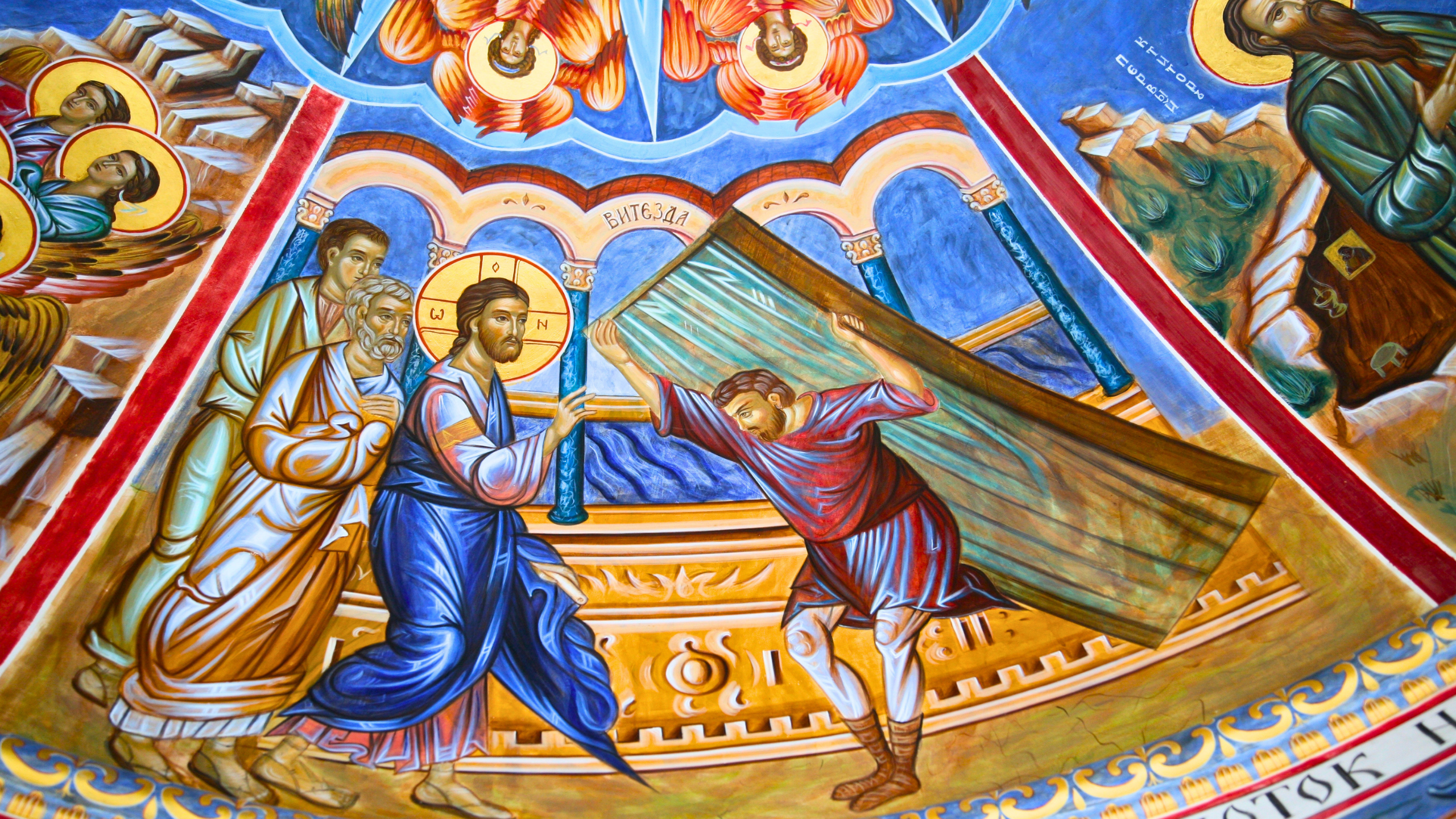
The Fourth Sunday of Pascha brings us to a man who also knew what it meant for life to be reduced to waiting, for at the pool of Bethesda, beneath the five porticos, the sick, the blind, the lame, and the paralysed waited for the stirring of the water (John 5:1–15). Among them lay a man paralysed for thirty-eight years, near the water, close to the place of healing, surrounded by others, yet still carrying the devastating sentence, “Sir, I have no man to put me into the pool when the water is stirred up” (John 5:7).
His bed had become both stability and captivity, holding him up while also holding him down, and in this we see one of the severe trials of suffering, where the very thing that helps a person survive can begin to set the boundaries of life. A bed can be physical, but it can also be grief, fear, shame, resentment, exhaustion, anxiety, illness, disappointment, or the long habit of expecting life to remain fixed in its present pain.
Bethesda is commonly understood as the house of mercy, and in the Paschal light it becomes an image of the Church, where human fragility is brought beneath the compassion of God. We come with sins that weigh on the conscience, griefs that ache, fears we struggle to name, illnesses that humble the body, disappointments that harden the heart, and prayers that have grown dry. People go to a hospital because healing is offered there, and people come to the Church because Christ the Physician is encountered here through prayer, sacrament, repentance, mercy, and communion.
Many people sit beside the waters today, some recovering from surgery, some managing chronic illness, some grieving a spouse, a parent, or a child, some exhausted from caring for someone whose suffering has changed the rhythm of the whole family, and some present in church while inwardly lying beside Bethesda, waiting for someone to notice. Such people belong within the conscience of the Church, because Christian life belongs to mercy.
The poem also gives sound and atmosphere to Bethesda, allowing us to sense the place around the pool rather than imagine it as a still religious scene.
“And in the overcast dullness
Of the deafening throng
Five porticos wailing
Souls perpetually swaying
To the rhythm of chaotic song”
Bethesda is alive with sound and anguish, with the weight of waiting, the murmur of pain, the shifting of bodies, and the movement of souls between courage and despair, prayer and panic, trust and confusion.
The five porticos seem to wail because beneath them human beings carry fear, impatience, hope, disappointment, and the exhaustion that comes when suffering has lasted too long. The “chaotic song” is also the rhythm of the world around us, the noise that tells people to hurry, compare, compete, perform, survive, and somehow find their own way to the water. Bethesda is crowded with movement, yet filled with people held in place, and into that restless and wounded place comes Christ as the Word of God whose command gathers the scattered soul and gives direction, “Rise, take up your bed and walk.”
The paralytic says, “I have no man”
The paralytic says, “I have no man,” while lying close to the water, close to the place of mercy, close to others who are also waiting, yet still abandoned at the crucial moment.
Those words must remain with us, because a person can stand among the faithful, hear the hymns, kiss the icons, light a candle, receive a blessing, and still suffer hidden in plain sight. A parish that reflects Bethesda recognises the one with little strength, remembers the grieving after the first days of sympathy have passed, carries the sick in prayer, and draws every wounded soul closer to Christ.
At Bethesda, the water was stirred only at certain times, but in the Church the wounded are continually drawn toward Christ through the waters of Baptism, the tears of Confession, the Chalice of Holy Communion, the oil of prayer, and the mercy of the brethren. Bethesda finds its fulfilment in the Church because Christ is here among His people, seeing the one who has waited and hearing the one whose voice has grown tired.
The man says, “I have no man,” and before him stands the God-Man, Jesus Christ
The man says, “I have no man,” and before him stands the God-Man, Jesus Christ, for the one who waited for someone to carry him into the water is met by the Living Water Himself, the one who waited for the stirring of the pool is visited by the Creator of the waters, and the one who waited for angelic movement hears the Lord of the angels address him directly, “Rise, take up your bed and walk” (John 5:8).
The Epistle appointed for this Sunday carries the mercy of Bethesda into the apostolic life of the Church, as Saint Peter meets Aeneas, a man who had been bedridden for eight years, and says to him, “Aeneas, Jesus the Christ heals you. Arise and make your bed” (Acts 9:34). Peter presents Christ as the healer because the Church heals through the presence and power of her Lord, and the same Risen Christ who stood beside the paralytic at Bethesda continues to visit the wounded through the life of His Body.
The reading then passes from the bed of sickness to the chamber of death through Tabitha, also called Dorcas, a woman “full of good works and charitable deeds” (Acts 9:36). When she dies, the widows stand weeping and showing the garments she had made for them, revealing a life poured out in mercy (Acts 9:39). Saint Peter kneels, prays, and says, “Tabitha, arise,” and she opens her eyes and sits up (Acts 9:40). In Aeneas and Tabitha together, one lifted from his bed and the other lifted from death, the Church proclaims Christ as the Physician of souls and bodies, the Lord who raises, restores, and gives life.
“Do you want to be made well?”
Saint John Chrysostom pauses over the Lord’s question, “Do you want to be made well?” because Christ brings the man’s suffering into the open before the miracle, drawing forth the wound, the long waiting, and the abandoned hope before restoring him by His life-giving command (Saint John Chrysostom, Homily 36 on the Gospel of John). Saint Cyril of Alexandria sees in the command of Christ the authority of the Word of God, who restores human nature by His own life-giving power, since Christ needs neither the pool, nor the angel, nor the movement of the water, for He Himself is the source of healing, and the paralysed body receives strength from the voice that called all things into being (Saint Cyril of Alexandria, Commentary on the Gospel of John, on John 5:8).
The word ‘Rise’ belongs to Pascha, for the same Christ who shattered Hades now addresses the paralysed places of human life, and in Him the prophecy of Isaiah begins to shine, “Then the lame shall leap like a deer” (Isaiah 35:6). For years the bed carried the man, but now the man carries the bed, and what once displayed his weakness becomes his testimony, while what once held him down is lifted onto his shoulders as proof that mercy has passed through his life.
There is also a warning here for religious people, because when the healed man carries his bed, some see only a breach of the Sabbath and miss the miracle, since their hearts have become harder than the bed he once lay on. Bethesda must remain a place where persons are seen through the mercy of God, for the commandments of God are holy, and their fulfilment is love, mercy, repentance, and communion with the Living Christ.
The title “D’s Den” opens a biblical path through the memory of Daniel the Prophet, the righteous man who remained faithful to God while living in exile. Daniel prayed when prayer was forbidden, kept his face turned toward Jerusalem when the empire demanded his silence, and was cast into the lions’ den, surrounded by death, accusation, danger, and the roaring of beasts, yet God sent His angel and shut the mouths of the lions (Daniel 6:22).
D’s suffering became her own kind of den, a place where fear roared, where the body was besieged, where breath was difficult, where the future narrowed, and where human words became poor companions to pain. Yet Daniel’s den became the place where God’s faithfulness was revealed, because God’s preserving mercy had the final word over the lions and over the decree of men.
Daniel’s den and Christ’s tomb meet
Here Daniel’s den and Christ’s tomb meet, for Daniel was preserved among the lions, while Christ enters death itself, descends into Hades, breaks the gates, shatters death’s tyranny, and fills the place of fear with His life. Daniel was brought alive out of the den, and Christ rises from the grave as the conqueror of death, whose presence reaches every den, whose mercy reaches every bed, and whose voice reaches every silence.
The poem then turns from the wound itself toward the way faith continues to walk.
“We walk by faith not by sight
Aaron’s life-giving Rod
Mystically implanted by God
Sprouting forth the Christ
In the souls of the ones
Who labour with valour”
The poem echoes the Apostle’s confession, “We walk by faith, not by sight” (2 Corinthians 5:7), and then turns to Aaron’s rod, which was dry wood, yet by the power of God it blossomed (Numbers 17:8). This becomes a Paschal sign written into the life of the Church, where dry wood can flower, a tomb can become a fountain of life, a paralysed man can walk, a wounded body can still become a place where Christ is glorified, and a heart stripped of its former stability can discover a deeper stability in the word of the Lord.
The Gospel teaches us to bring suffering honestly before Christ, trusting that His command, “Rise,” may be revealed through bodily healing, through endurance, through prayer, through repentance, through sacramental life, through courage, and through the grace to live faithfully within limits. Sometimes the walk is physical restoration, sometimes it is coming through the edge of death and beginning life again with suffering still present, sometimes it is learning to breathe through pain while still saying, “Lord Jesus Christ, have mercy on me,” and sometimes it is a family continuing to love, support, pray, and carry the sufferer toward Christ. Every faithful step belongs to the Resurrection.
Salvation embraces the whole person
When Christ later finds the healed man in the temple and says, “See, you have been made well. Sin no more, lest a worse thing come upon you,” His words must be heard with pastoral care (John 5:14). The Lord is revealing that salvation embraces the whole person, body, heart, will, and soul, giving the man movement of body and direction of soul, raising him from paralysis and calling him toward holiness.
All of this eventually reaches our own parish life, because the mercy revealed at Bethesda must become visible among those who bear the name of Christ. The Church, in her divine reality, is already the house of mercy because Christ Himself dwells in her, and our parish churches are called to make that mercy visible in concrete ways by remembering the sick after the first crisis has passed, supporting families beyond the hospital visit, receiving the exhausted with patience, noticing the lonely, carrying the forgotten in prayer, and receiving each person as more than illness, disability, grief, or past failure. Bethesda is revealed among us whenever the healing presence of Christ becomes visible through prayer, sacraments, attention, forgiveness, and love that remains.
Near the end of the poem, the command of Christ breaks through the heaviness.
“Yet somehow
The unutterable melody
Penetrates our hearts
An eternal unwaning command
‘Rise take up your bed and walk’
At that moment
All silence is broken
As she rises up
Taming hearts and souls
From the lion’s den.”
In those lines the poem returns to the Gospel, where the den becomes the place from which one rises, the silence is pierced by Christ’s command, and the bed becomes testimony. Bethesda remains wherever human beings wait for mercy, and every parish church is called to become a living icon of that mercy, a place where those lying beside the waters are seen, strengthened, carried, and led toward the Physician of souls and bodies.
May the Lord who preserved Daniel in the lions’ den, who sustains all who are carried through suffering, who raised the paralytic, who raised Tabitha through the prayer of the Apostle Peter, and who entered the tomb and broke death from within, visit every bed of suffering, every house of grief, every heart struggling for breath, and every soul waiting beside the waters. May our parish churches become living icons of Bethesda, houses of mercy where the wounded are seen, the weak are strengthened, the forgotten are carried in prayer, and every soul hears again the voice of the Risen Christ, “Rise, take up your bed and walk.”
Christ is Risen! Truly He is Risen!
D’s Den
The rod of stability
Confined by physicality
The enabler of ability
To birth a trinity
Worthy of sanctity
Taught through humility
Removed
Sinking hearts
Floating painfully
Conversing irrationally
Seeking impatiently
To stop the merry-go-round
In search for sturdy ground
To cease the painfully tormenting sound
Of silence
How can her silence be?
The prophet’s namesake
Who helps reverberate
With much generosity
The ode of positivity
To those with vulnerability
To journey through uncertainty
With determination and credibility
A life full of cruelty?
We walk by faith not by sight
Aaron’s life giving Rod
Mystically implanted by God
Sprouting forth the Christ
In the souls of the ones
Who labour with valour
In search of a halo
Prostrating dust till dawn
Navigating the storm
Attempting to push
With unceasing prayer
The one who lay
A many a day
On a bed made by clay
Into the remedial bay
Like the pool at Bethesda
Astonishing peace
Took over the mist
The giver of life
Living water and might
Restoring Thomas’ plight
A wondrous sight
The Myrrhbearers’ fright
We froze from the ecstasy
And in the overcast dullness
Of the deafening throng
Five porticoes wailing
Souls perpetually swaying
To the rhythm of chaotic song
Yet somehow
The unutterable melody
Penetrates our hearts
An eternal unwaning command:
“Rise take up your bed and walk”
At that moment
All silence is broken
As she rises up
Taming hearts and souls
From the lion’s den.