

By Fr. Michael Psaromatis
Greek Orthodox Archdiocese of Australia
Before the Divine Liturgy I often find a folded sheet of paper beside the Proskomide. The names are written in Greek or English, some carefully and others in a hand made unsteady by age. As I cut a small particle from the prosphoron and place it beside the Lamb, I may read the name of a son who has stayed away from church for years, or of a husband whom his widow still remembers long after others have ceased to speak of him. Income, achievement, usefulness and temperament disappear from the piece of paper. The Church commemorates each person because each life belongs to God.
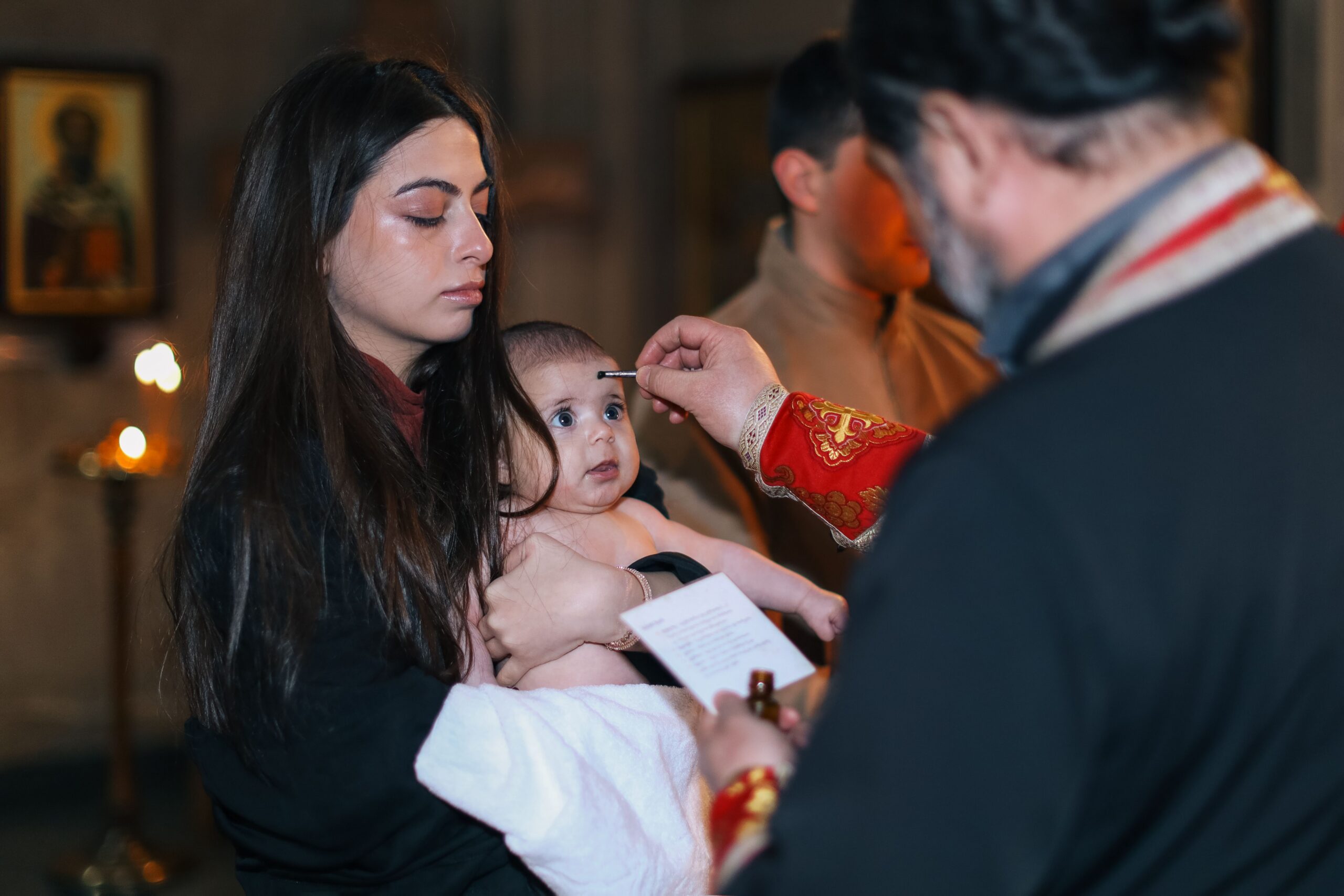
Later that morning a family may come into the parish office and ask, ‘Father, how much is the baptism?’ The question is understandable. Clothes, the reception and the other expenses are already pressing on the family budget. After a death, accounts from the funeral director and cemetery arrive while relatives are still trying to grasp what has happened. The parish has expenses as well and sometimes asks for a contribution, so money deserves clear and honest discussion. Yet language can shift very quickly, and soon enough the Church begins to sound like a provider, the family like a customer, and the sacrament like a ceremony ordered from a catalogue. At the baptismal font the Church calls the person by name and clothes him or her with Christ (Galatians 3:27). In the parish office, the conversation can shrink that same human life to a price if the right mindset is absent.
Christian life unfolds among wages, bills, mortgages, rent, shops and services. Prices and comparisons belong to mundane household decisions. Trouble begins when the habits we use for things become the habits by which we judge people and circumstances. We compare the price and expected life of a refrigerator because it is an object made for use. The elderly mother who needs more of our time, the disabled child, the difficult relative, or the man whose unemployment has taken away the role by which he once understood himself belongs to a completely different arrangement. Even the familiar phrase ‘human value’ borrows the language of pricing, as though a person could be assigned a figure, however high. Orthodox Christianity speaks of life as God’s gift, of His image in every human being, and of our calling into communion with Him. What a person can do or produce tells us very little about who they are before God.
At the Proskomide we commemorate Michael, Maria, Dimitrios and Sophia. In everyday life, we may think of them as successful, difficult, elderly, generous, dependable or troublesome. Beside the Lamb those descriptions lose their power to define them. Baptism uses the same personal address: ‘The servant of God N. is baptised…’ Christ says of the Good Shepherd that ‘he calls his own sheep by name’ (John 10:3). The prophet Isaiah gives the same language to God’s relationship with His people: ‘I have called you by your name, you are Mine’ (Isaiah 43:1). Michael and Maria come before God with their own faces, histories, relationships, sins, repentance and hope. God knows each of them personally, and the Church learns to meet them in the same way. Human existence begins as a gift from God, grows through communion with others, and finds its fulfilment in communion with Him.
Genesis tells us who the human person is before anything is said about achievement or usefulness. ‘Let Us make man in Our image, according to Our likeness’ (Genesis 1:26). To speak of the human person is to speak of someone who stands before God with a face and a name. We share the same human nature, but no one is interchangeable. Intelligence, independence, memory and usefulness may increase or diminish, while the person remains known and called by God.
God gives His image with life itself. The infant who depends entirely on others bears it, as does the elderly person whose memory is fading and the relative whose life has become disordered. The likeness points to the life God calls us to by grace, the life of communion with Him that reaches towards theosis, participation in the divine life (2 Peter 1:4). Grace acts first and human freedom answers. Sin can do terrible damage. Addiction brings chaos and pain into families, while violence may require separation and firm protection. Serious wrongdoing must be faced and spoken about with honesty and in truth. Accountability still addresses someone who can face the truth, repent and return. When we see a sinner only through the worst thing he has done, that one act becomes the measure of his entire life. Yet through repentance he can turn again to God, and his life can take a different course.
Saint John of Damascus, drawing on Saint Basil, writes that ‘the honour given to the image passes over to the prototype’ (St John of Damascus, Exact Exposition of the Orthodox Faith, IV.16). In the Incarnation ‘the Word became flesh and dwelt among us’ (John 1:14). The Son of God took our human nature, received the touch of the sick, allowed people to interrupt Him, wept at a grave, suffered in the flesh and rose bodily from the tomb. On the road from Jericho, blind Bartimaeus cries out while the crowd urges silence, and Christ stops (Mark 10:46–52). The people around Him want to keep moving, yet He gives His full attention to Bartimaeus and asks, ‘What do you want Me to do for you?’ (Mark 10:51). Bartimaeus speaks for himself. Christ gives time to the man whom everyone else wants quietened so that the road can clear and so that they can go on with their schedules and fulfil their goals. We imitate the crowd whenever the task in front of us becomes so important that the person beside us almost disappears.
I have visited people in aged care who could no longer remember my name or form the prayers they had said for most of their lives. The Church still calls each one by name and, when possible, brings them Holy Communion. Saint Paul says that the members of Christ’s Body who appear weaker are ‘necessary’ (1 Corinthians 12:22). God knows them even as their own cerebral memories are fading, and their place in the Church remains their own, unique and distinct.
Main North Road is filling before sunrise as people leave Gawler and the northern suburbs, while others set out from Seaford, Aldinga and towns across the Fleurieu Peninsula for work that consumes much of the day. Many households face high rents, long commutes, children’s needs, ageing parents and demanding work, and some will drive a considerable distance again for the Divine Liturgy on Sunday. When someone says, ‘Father, I am exhausted,’ a priest should believe them. Exhaustion deserves compassion, and convenience sometimes helps greatly: prepared food, an online appointment or a delivery can make a difficult week manageable. Problems arise after enough weeks ruled by rosters, deadlines and costs, when efficiency begins to shape our expectations of family and friendship as well. We start counting the hour an elderly parent needs, feel impatience when a child begins a long story at the wrong moment, or avoid the friend who needs an open-ended conversation. Relationships can become thinner in this way even among people who genuinely love one another.
For some households, the working day does not end with the first job. In March 2026, 978,000 Australians held more than one job, equal to 6.5 per cent of employed people. Workers aged twenty to twenty-four had the highest rate, at 10.3 per cent. People take second jobs for different reasons, so the figure cannot explain every household. It does show how many people are arranging meals, care, sleep and family life around more than one roster. The introduction of a legal right to disconnect also shows how difficult the boundary between work and home has become. Australian employees may refuse to monitor, read or answer contact outside their working hours when that refusal is reasonable. The law cannot create a peaceful household, but it recognises that employment does not make a person permanently available. An evening free from email may be the only time in which a parent listens to a child, a meal is shared or the mind becomes quiet enough to pray (Australian Bureau of Statistics, Multiple Job-holders, March 2026, and Fair Work Ombudsman, Right to Disconnect, 2026).
The same habits enter workplaces and institutions. An aged-care worker may have only a few minutes to wash and settle a resident before moving to the next room. The roster records a completed task, although there was scarcely time to hear the person’s fear or confusion. Budgets and rosters are real, yet Christian conscience must also ask what these arrangements require of workers and what kind of care they allow them to give. Saint James says that wages withheld from labourers cry out to God (James 5:4). A system may balance its figures while treating the people within it unjustly.
A workplace also reduces people when a change in performance is treated only as a problem in output. Safe Work Australia recorded 17,600 serious workers’ compensation claims for mental health conditions in 2023–24, equal to 12 per cent of all serious claims. The median time lost was 35.7 working weeks. A manager may see missed targets, slower work or more sick leave before knowing about grief, harassment, fear or pressure carried at home. Performance measures have a legitimate place, and responsibility should not be abandoned. Humane management begins by asking what has changed, listening without humiliation and making proper support available. The employee remains a person when the figures fall, and the way authority responds at that moment reveals what the workplace believes people are for (Safe Work Australia, Key Work Health and Safety Statistics Australia 2025).
Some of the work that keeps a household alive never appears on a payslip. In 2022, three million Australians were unpaid carers, including 391,300 people under twenty-five. They may help with meals, transport, medication, appointments or supervision before beginning their own work or study. Carers may appear unreliable because they decline invitations, arrive late or leave early. What cannot be seen is the person waiting at home. A parish that speaks about service should also notice those who have already spent the day caring for someone else. They may need practical help, a chance to rest, or simply a place where they can say honestly that caring for someone they love has left them exhausted. (Australian Bureau of Statistics, Disability, Ageing and Carers, Australia: Summary of Findings, 2022).
Children learn this way of judging themselves earlier than adults realise. A child who receives most attention after a high mark or public success may slowly come to believe that achievement is what makes them worth noticing. Parents rightly teach effort and responsibility, but family life should also assure the child that their place at the table is secure, even on days when there is no achievement to announce.
Philoxenia is tested when someone arrives at a time we had kept for ourselves. Many immigrant families who built our parishes knew homes where vegetables passed over the fence and relatives would simply turn up at the side gate, without any fuss. Those homes also had loneliness, conflict and the usual difficulties of family life. Contemporary life often makes withdrawal easier: houses are smaller, timetables tighter, garage doors close behind us, and an unexpected knock comes at the end of an already demanding day. Christian love respects genuine limits while still leaving some part of life available to others. Hospitality may be as simple as setting another place at the table, taking food to a neighbour, moving a chair closer in the parish hall, or speaking for a moment in a language a newcomer understands (Hebrews 13:2). Each action says, in its own way, that the person in front of us belongs among us.
Loneliness is not always easy to see, for a person may spend each day among others and still have nobody they can call. In 2024, the Australian Institute of Health and Welfare estimated that 15 per cent of Australians aged fifteen and over were experiencing loneliness, with the same proportion experiencing social isolation. Even a crowded parish hall may contain people who feel unseen. Philoxenia reaches beyond attendance figures and the warmth exchanged among friends. It is present when someone approaches the person standing alone, remembers the one who has quietly stopped coming, or makes time for a conversation with someone who simply needs to be heard. (Australian Institute of Health and Welfare, Social Isolation and Loneliness, 2026).
This same attention to the person has a particular meaning in Australia. In his message for National Reconciliation Week, Archbishop Makarios of Australia writes that ‘the other as a person created in the image of God lies at the very heart of life and witness in Christ’. He calls us to listen carefully and to see the stories of the past and the hopes for the future through the eyes of Aboriginal and Torres Strait Islander peoples (Message for National Reconciliation Week, 28 May 2026).
During the Anaphora the priest lifts the holy gifts and says, ‘Thine own of Thine own we offer unto Thee, on behalf of all and for all.’ Bread and wine have passed through human hands, and soil, rain, strength to labour and life itself came first as gifts. Saint Paul asks, ‘What do you have that you did not receive?’ (1 Corinthians 4:7). Parents provide for their children, households practise prudence and bills are paid. The Eucharist teaches us to receive even what we call ours with thanksgiving, because what we possess remains part of God’s creation. Saint Basil looks at surplus possessions and asks about the neighbour who lacks what is necessary (St Basil the Great, Homily 6, §7, I Will Tear Down My Barns). Saint John Chrysostom speaks just as directly when he joins reverence for Christ at the altar with reverence for Him in the hungry person outside the church (St John Chrysostom, Homily 50 on Matthew, §§3–4). ‘Inasmuch as you did it to one of the least of these My brethren, you did it to Me’ (Matthew 25:40). Different households will make different prudent decisions, yet the neighbour still enters those decisions because Christian stewardship begins with what has first been received from God.
A supermarket may offer aisle after aisle of food, yet a household can enter knowing that much of it is beyond what they can afford. The Australian Bureau of Statistics found that 1.3 million households, more than one in eight, experienced food insecurity at some point in 2023 because there was not enough money for food. Among lone-parent households with dependent children, the figure rose to 34 per cent. For a parent living under that pressure, shopping may mean deciding what to put back at the checkout or how to stretch what remains until the next payment. Talk of consumer choice bears little relation to this kind of hardship. The question is often not what to buy, but which need will have to wait. Christian stewardship asks us to see the household behind the statistic and to let its need shape how we use what God has entrusted to us. (Australian Bureau of Statistics, Food Insecurity, 2023).
We seldom see the people behind the things we buy. A parcel arrives at the door, a shirt hangs on a rack or fruit is arranged on a supermarket shelf, while the worker who packed, stitched, picked or delivered it remains out of sight. The price tells us what the item costs us, but it says nothing about the hours spent producing it, the wages paid or the family living from that work. We cannot trace the whole story of every purchase, but Christian stewardship keeps us from forgetting that ordinary goods come to us through the labour of other people.
When dinner or groceries are ordered through an app, the customer sees an arrival time, a small vehicle moving across a map and, at the end, a prompt to leave a rating. The person bringing the order can easily disappear behind the screen. In 2024–25, 178,500 Australians undertook digital platform work. Of those, 63 per cent were born overseas and 57 per cent were aged between fifteen and thirty-four. About one in six said they had felt unsafe while working during the previous four weeks. Australian workplace law uses the term ‘deactivation’ when a platform suspends or removes a worker’s access to jobs. Since February 2025, platforms covered by the relevant code have been required to follow a fair process before deactivating an eligible worker. The term serves an administrative purpose, but it also reveals how easily someone’s livelihood can be reduced to an account that can be switched off. Christian attention sees the person behind the icon, waiting at the restaurant, making their way through traffic and relying on the next job to pay the bills. (Australian Bureau of Statistics, Working Arrangements, August 2025, and Fair Work Ombudsman, Employee-like Workers, 2026).
In Christ’s parable, the rich man is described by his purple clothing, fine linen and the table set for him each day. The poor man lying at his gate is the one Christ calls by name, Lazarus (Luke 16:19–31). To those inside, he may have been only the beggar at the door, someone they had grown accustomed to passing without asking who he was. The man they had learned not to see is the one whose name the Gospel remembers.
Giving turns into a transaction when we expect gratitude, obedience, admiration, influence or the pleasure of feeling indispensable. Money may be absent and the expectation of return still remains. Christian diakonia places giver and receiver together before God’s mercy. Someone receiving groceries still prays, thinks, gives advice, loves others and offers gifts of his or her own, and the volunteer arrives with limitations and needs as well. Parents helped through a difficult month may later cook for somebody else, while a visitor who expected to help may leave having learned patience, faith or courage from the person he visited. Synergeia describes God’s grace and our response to it. We answer by giving, receiving, repenting, thanking and learning. Communion leaves no account to settle.
Online life can lead us to present ourselves in much the same way that products are presented to us. We learn which photographs attract attention, which opinions bring approval and which achievements receive a response. Even suffering may be shared with one eye on how others will react. Gradually we begin to watch ourselves from the outside. ‘Who am I before God?’ gives way to the anxious question, ‘Which version of me will be received?’ Vainglory and envy are ancient passions, but now the algorithm feeds them and keeps us comparing ourselves with others late into the night. Christ warns against seeking honour from one another while neglecting the honour that comes from God (John 5:44). We consume images and then offer our own image for consumption. Life received from God often becomes a performance that needs constant adjustment for public approval.
Archbishop Makarios of Australia describes the same pressure when he says, ‘The world today pushes the human person to give weight to appearance and not to being.’ He asks how much we torment ourselves when we struggle to present a version that is not real (Message on appearance and public approval, 11 May 2026).
Children enter this economy of attention long before they are mature enough to understand how it is shaping them. Research released by the eSafety Commissioner in 2026 found that 74 per cent of Australian children aged ten to seventeen had seen or heard content associated with harm online, and 63 per cent had encountered it during the previous twelve months. Asked about their most recent exposure, 69 per cent said the material had appeared accidentally, often in a feed or pop-up. A screen handed over for homework, friendship or entertainment can therefore bring violence, sexual material, hateful speech or encouragement of self-harm into a child’s room without the child searching for it. Algorithms can place things before children that no parent could have anticipated, and fearful warnings alone do little to prepare them for that moment. Children need adults who respond calmly, stay close after they have seen something disturbing, and help them understand that the systems competing for their attention neither know them nor love them (eSafety Commissioner, How Common Is Exposure to Content Associated with Harm among Children in Australia?, 2026).
Even looking for companionship can start to resemble shopping. On a dating app, we may look at a face for a few seconds before deciding with a movement of the thumb whether to move on. These apps can bring together people who would never otherwise meet, but the steady stream of profiles makes it easy to assume that another possibility is always waiting. A photograph and a few lines reveal very little of who someone is before God, while truly knowing another person still takes time, patience and honesty.
Advertising may begin by persuading us to buy particular things, but over time it can alter the way we look at our own bodies. Ageing, weight and the normal differences in appearance are presented as faults that the right product might correct. A young person may look in the mirror and wonder how others are judging them, while someone growing older may become anxious about every visible sign of age. In time, the body God has given us can begin to feel unacceptable unless it is continually changed. Christian life includes proper care for the body, but that care has nothing to do with the shame used to sell us something.
Beneath the epitrachelion, the penitent stands before Christ, with the priest as witness, and admits his sins as honestly as he can. The penitent may stop halfway because the words are difficult to say, and the priest waits. What comes before Christ is the life actually being lived: mixed motives, shame, repeated sins and unfinished repentance. Scripture joins confession with the forgiveness and cleansing that come from God (1 John 1:9), while the risen Christ entrusts His apostles with the ministry of forgiving sins (John 20:22–23). The truth spoken in Confession is met by Christ’s call to repentance and by the mercy on which absolution rests. If what is disclosed also includes serious mental illness, self-harm or abuse, professional care may be needed. Speaking about Confession, Archbishop Makarios of Australia says that in a society already filled with rejection, ‘a person cannot bear one more rejection from the Church. They want to feel affection from the Church’ (Address at the Parish of the Presentation of Our Lady to the Temple, Balwyn North, 10 August 2025). The priest helps the person reach that care and does not regard the referral as the end of his concern. Where appropriate, relatives or trusted friends may also remain close, so that the person does not face the next steps alone.
Fasting, prayer, almsgiving and hesychia teach desire to wait. Consumer life encourages quick satisfaction: hunger reaches for food, boredom for a screen, discomfort for an exit, and every preference seeks immediate fulfilment. Saint Paul describes the ascetic struggle in bodily terms when he speaks of disciplining his body and bringing it into obedience (1 Corinthians 9:27). During a fast we let hunger remain for a time. Through the Jesus Prayer the mind returns from thoughts and notifications that continually demand attention. At first, silence may seem empty, but hesychia teaches us to remain before God and wait. Almsgiving puts into another person’s hands something we could have kept. Through these practices, desire acquires patience and freedom, and that freedom enters our relationships. We stay through the slow conversation, receive the visitor who arrives at an inconvenient hour, and listen again when an elderly person repeats a familiar story. Ascesis forms the patience that communion requires. Archbishop Makarios of Australia draws the same distinction when he says that ‘the essence of our relationship with God is not commercial, but existential’. We learn, he says, from God’s ‘no’, from His silence and from waiting without haste (Video message, 2 May 2026).
We will continue to buy and sell, use technology, run businesses and manage household budgets. Prices have their proper place in these parts of life. They help us decide what we can afford and what goods, services and labour cost. Our relationships become distorted when we begin to apply the same calculations to people. ‘Is this person useful to me? Is this relationship worth my time? What am I getting in return? How quickly can I get this inconvenience out of the way?’ These questions carry the habits of the marketplace into the way we see another human being. The Gospel turns our attention to a different question: Who is this person before God? This is someone whom God knows personally and who bears His image. Christ has assumed our human nature, and every one of us is ‘called into the fellowship of His Son, Jesus Christ our Lord’ (1 Corinthians 1:9), a communion through which we are invited to share in the divine life (2 Peter 1:4).Ecumenical Patriarch Bartholomew has described this as ‘economic reductionism’: the reduction of the human being to homo oeconomicus and of society to ‘a gigantic market’ (Address at Izmir University of Economics, 9 February 2015). During his 2024 visit to Melbourne, he returned to the same concern, saying that the human person is more than an economic entity and calling for ‘being, over having, and sharing, over hoarding’ (Address at Government House, Melbourne, 15 October 2024).
During Holy Week, the Church hears Judas ask, ‘What are you willing to give me if I deliver Him to you?’ (Matthew 26:15). His question turns discipleship into a bargain, and the Lord whom he had followed is handed over for thirty pieces of silver. The betrayal shows how far the desire for gain can reach when another person becomes the means by which it is secured.
The Church teaches us this in the way she prays and lives. Baptism and the Proskomide preserve the same personal address: Michael, Maria, Dimitrios, Sophia. In the Eucharist, creation is received as a gift and offered back in thanksgiving. Confession brings the actual life of the penitent before Christ. Fasting and prayer teach desire to wait, while diakonia places us beside people from whom we often receive as much as we offer. Sunday worship continues in the way we use money, time, attention and authority during the week. Its theology becomes visible when someone needs us at a time we had planned to use differently.
‘Let us depart in peace,’ the deacon says before the people leave the Divine Liturgy. They return to townhouse kitchens, traffic on Main North Road, hospital rooms, bills that still have to be paid and telephone calls that arrive at inconvenient times. The names we commemorate in the Liturgy belong to the people we meet during the rest of the week: the person who rings asking for help, the one lying in hospital, or the one sitting across from us at the table. The way we remember them before God should shape the way we receive them face to face. Cost, convenience and practical benefit may help us manage our time and resources, but they are poor measures of a human life.
Sometimes a young man waits near the candle stand because he wants Confession and hesitates to ask. I put away the Gospel, bring two chairs and sit with him while the traffic outside begins to thin. During the week people will judge him by what he produces, how useful he is and whether the version of himself he presents is acceptable, and in time he may begin judging himself in the same way. Earlier, I had already commemorated him beside the Lamb. God knows him personally and the Church receives him as someone called to communion with Christ. Usefulness changes, health changes, reputation rises and falls. He remains God’s creature, bearing His image and invited into His life. Price belongs to commodities. His life belongs to God. The human person is not a product.