

And forgive us our debts as we also have forgiven our debtors.
Matthew 6:12
The Lord’s Prayer, as we have discussed, is the most complete prayer. The first two words “Our Father” summarize the two great commandments—to love God and to love one another. The hardest four words of prayer are the words “Thy will be done” because these reflect a complete submission to God. Today we examine what might be considered the most dangerous words of prayer: “And forgive us our debts as we also have forgiven our debtors.” In other words, forgive us Lord, in the same way that we forgive others. Thus, if we can’t forgive others, we can’t expect the Lord to forgive us. If we hold a grudge against others, we should expect the Lord to hold a grudge against us. If we keep a list of sins others have done against us and constantly remind them of it, we can expect the Lord to do the same, to keep a record of our wrongdoings and recite it to us when we stand before His awesome judgment seat. That is a scary prospect! This is why we are supposed to be generous with forgiveness, since we are hoping that the Lord will be generous with us as well.
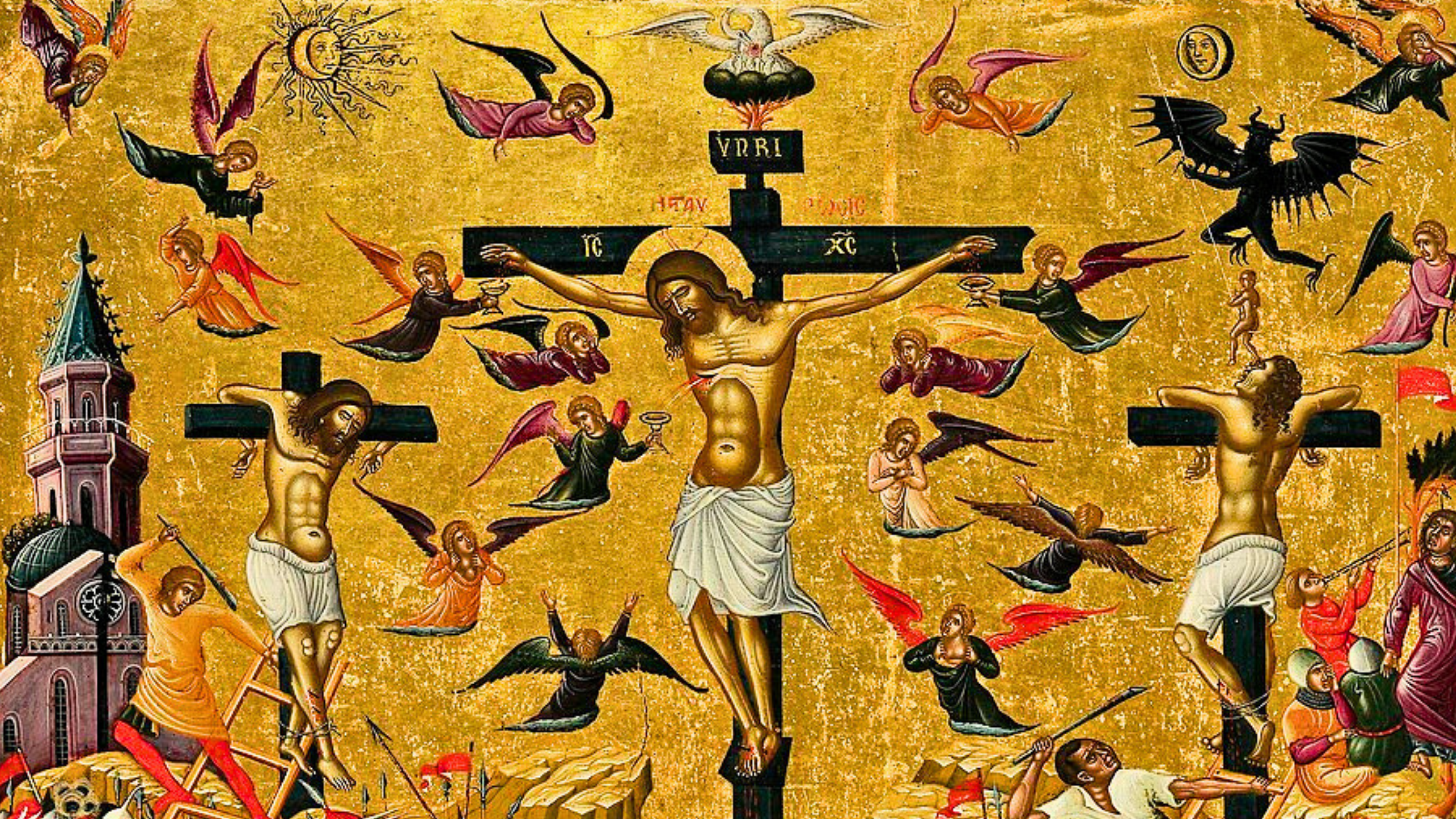
Perhaps the greatest example of forgiveness was Christ forgiving from the cross. He looked down at the world—His own Jewish people who demanded He be crucified; the Romans who were brutally carrying out His execution; His friends who abandoned Him—and He said “Father, forgive them; for they know not what they do.” (Luke 23:34) He didn’t forgive something that had happened in the distant past. He forgave something that was happening at that moment, in real time, something that was going to continue even after He offered forgiveness. He was forgiving future wrong, as His execution would last for several more hours. Even though the sin of His crucifixion was calculated, as it lasted many hours, Jesus, it seems, gives all those responsible, passes for their lack of awareness that what they were doing was wrong. When we think of the forgiveness that Jesus offered humanity while it was killing Him, it seems petty that we cannot forgive others.
The Greek word for forgiveness is sihorisis which means “overlooking of sin.” It means we accept that sin happened, but we choose to overlook the sin of someone else and not let it affect our relationship. The word sihorisis is not in the Lord’s Prayer. Rather, we find an even more powerful words, afes and afiemen which come from the Greek word afeseos which translates to “remit” (remission), which means to completely wipe out the record of sin, as if it never happened. This is what Jesus did by dying on the cross. He paid the debt for our sins, so there is no debt, no record of sin against us, or between humanity and God.
When we have some kind of bill to pay, like a credit card or utility bill, there is a perforated portion of the bill which is to be detached and sent in with a check in order to pay the bill. Often the word “remittance” will be found on this portion of the bill. This is what we place with the check, the remittance owed for the bill. If I owe $300 to the utility company, my bill might say “please remit $300.” The utility company doesn’t care whose name is on the check. If you take my remittance, and send in $300, the utility company got what it was due, regardless of who it came from. And in remitting what is owed, the utility company doesn’t remind, humiliate, or shame me that I once owed $300 and that it was remitted either by me or someone else. The debt is cancelled and forgotten, of course, until the next bill is due. But if we stop using a company, and pay the last remittance, then all former debt owed and now remitted is never spoken of again.
This is actually the way that forgiveness is supposed to work, whether it is between people, or between us and the Lord. We are supposed to wipe out the record of sin against other people, just as the Lord has wiped out the record of sin against us. In other words, the clear implication of being forgiven is that we have no real right to withhold forgiveness from anyone.
It is important to note that forgiveness doesn’t necessarily mean reconciliation. Sometimes trust between two people can be irretrievably broken down. Forgiveness is releasing the anger, but might involve still keeping distance. In the instance of a crime being committed, there may be forgiveness but still a need for justice and punishment.
In the example of a close relationship with two people, such as close friends or spouses, things go amiss all the time. The more people are together, the more likely something is to go wrong. Obviously, we commit more sins against the people we are closest to than those we have only infrequent contact with. Forgiving doesn’t mean forgetting. We are supposed to learn from past mistakes. Forgiving means not talking about it constantly. If we are still bringing up the records of past wrongs, it means we haven’t forgiven them.
Finally, in a long-term relationship, i.e. a marriage, a close friendship, a long-standing working relationship, there are going to be missteps. The only way to keep a relationship viable is forgiveness of the missteps as they occur, not to keep a long running ledger of wrongs, or debts, that can’t be paid off. Because if every sin is recorded on a life ledger, eventually the debt in any relationship will be too great to pay off. If God kept a ledger of our sins, the debt would be too great to pay off. Hence, in the Lord’s Prayer, sometimes the translation is given as forgive us our debts, as we also have forgiven our debtors. Because if the debt becomes unpayable, then the relationship becomes insolvent, it fails.
Forgiveness is not a uniquely Christian concept. One can be non-Christian and still forgive. Because no relationship can work without some degree of forgiveness. What is uniquely Christian is the concept of remittance, the idea that the record of sin can be wiped out. There is a saying: “To err is human; to forgive is divine.” From the Christian perspective, it should be “To forgive is human, to remit sin is divine.” If we are called to be like Christ, then we should strive not only to forgive and be forgiven, but to wipe out the record of sin that exists between us and those around us, in the hopes that God will wipe out the record of our sin against Him. If we can’t do that for one another, it will be hard to expect Him to do that for us.
Blessed is he whose transgression is forgiven, whose sin is covered. Blessed is the man to whom the Lord imputes no iniquity, and in whose spirit there is no deceit. When I declared not my sin, my body wasted away though my groaning all day long. For day and night Thy hand was heavy upon me; my strength was dried up as by the heat of summer. I acknowledged my sin to Thee, and I did not hide my iniquity; I said, “I will confess my transgressions to the Lord”; then Thou didst forgive the guilt of my sin. Therefore let everyone who is godly offer prayer to Thee; at a time of distress, in the rush of great waters, they shall not reach him. Thou art a hiding place for me, Thou preservest me from trouble; Thou dost encompass me with deliverance. I will instruct you and teach you the way you should go; I will counsel you with my eye upon you. Be not like a horse or a mule, without understanding, which must be curbed with bit and bridle, else it will not keep with you. May are the pangs of the wicked; but steadfast love surrounds him who trusts in the Lord. Be glad in the Lord, and rejoice, O righteous, and shout for joy, all you upright in the Lord! Psalm 32
Points to ponder: Why is it important we forgive others who offend us? How should we deal with people who refuse to forgive us? What role does prayer have in helping us to forgive others?