

Give us this day our daily bread.
Matthew 6:11
In the Old Testament book of Exodus, we read about Moses leading the children from Israel out of slavery in Egypt, with the goal of making it the “Promised Land,” the land of Canaan. What no one knew at the time of the Exodus was that it would take forty years for this journey to be completed. This time would be a time of both frustration and faith building as the Israelites made their journey.
The people complained often, and in Exodus 16, they complained that they were hungry and perhaps would have been better off staying slaves in Egypt. In Exodus 16:4-5, we read: Then the Lord said to Moses, “Behold, I will rain bread form heaven for you; and the people shall go out and gather a day’s portion every day, that I may prove them, whether they will walk in My law or not. On the sixth day, when they prepare what they bring in, it will be twice as much as they gather daily.” This is where the phrase “daily bread” comes from. This was going to be a test of faith and trust in God. Because God told the people you are only to take enough bread for the day, and then they would have to trust God that there would be bread outside the next day. The natural inclination of someone who is starving would be to hoard whatever food they could capture, and not chance no food being around for a while. But God’s message to the people was clear—you are not to hoard, or take more than what you need for the day. Some people did that and what they had taken turned to worms and made them sick. The only exception for the “daily bread” rule would be on Friday, when people could collect double their daily portion, so that they could rest on the Sabbath. In fact, it became a requirement to take double on Friday and store it away for Saturday, because no one was allowed to work on the Sabbath.
There are many references to God giving to people what they need. For instance, in Matthew 25, the Parable of the Talents, the Master (God) gives to each servant (us) a talent sufficient to subsist and to serve. We are supposed to ask Him daily how to use our talents. As we will see later in Matthew 6, God wants us to pay the most attention to the day that is at hand. This makes sense, because we no longer have the days that are passed, and we are not guaranteed any days in the future, which brings our thoughts to today. I’m sure there were people in the company of the Israelites who must have wondered, especially at the beginning, “will God really have food for us tomorrow?” That would have been understandable, especially for those who like planning their lives out well into the future and having all things coming up be known. That’s why the exercise of the daily bread was an example of faith and trust.
We should come to God daily in prayer, not only in times of crisis, or only when needs have piled up. Just like the Israelites had their daily “communion” with God, in the sense that they would go to God and God would come to them through the manna in the wilderness, we are to go to God daily with our needs and He will come to us daily with comfort and direction.
The bread from heaven was called manna, and it looked like frost on the ground. The people were initially confused about what it was. Moses said in Exodus 16:15, “It is the bread which the Lord has given you to eat.” Bread has long been associated as the staple food to sustain life. For instance, prisoners whose food is being rationed are given “bread and water,” not fruit and vegetables, or meat and potatoes. Bread has always been viewed as the most staple of all foods. In John 6, we read:
For the bread of God is that which comes down form heaven, and gives life to the world.” They said to Him, “Lord, give us this bread always.” Jesus said to them, “I am the Bread of Life; he who comes to Me shall not hunger, and he who believe in Me shall never thirst.” (John 6:33-35)
“I am the Bread of Life.” Your fathers ate the manna in the wilderness, and they died. This is the Bread which comes down from heaven, that a man may eat of it and not die. I am the Living Bread which came down from heaven; if anyone eats of this Bread, he will live forever; and the Bread which I shall give for the life of the world is My flesh.” (John 6:48-51)
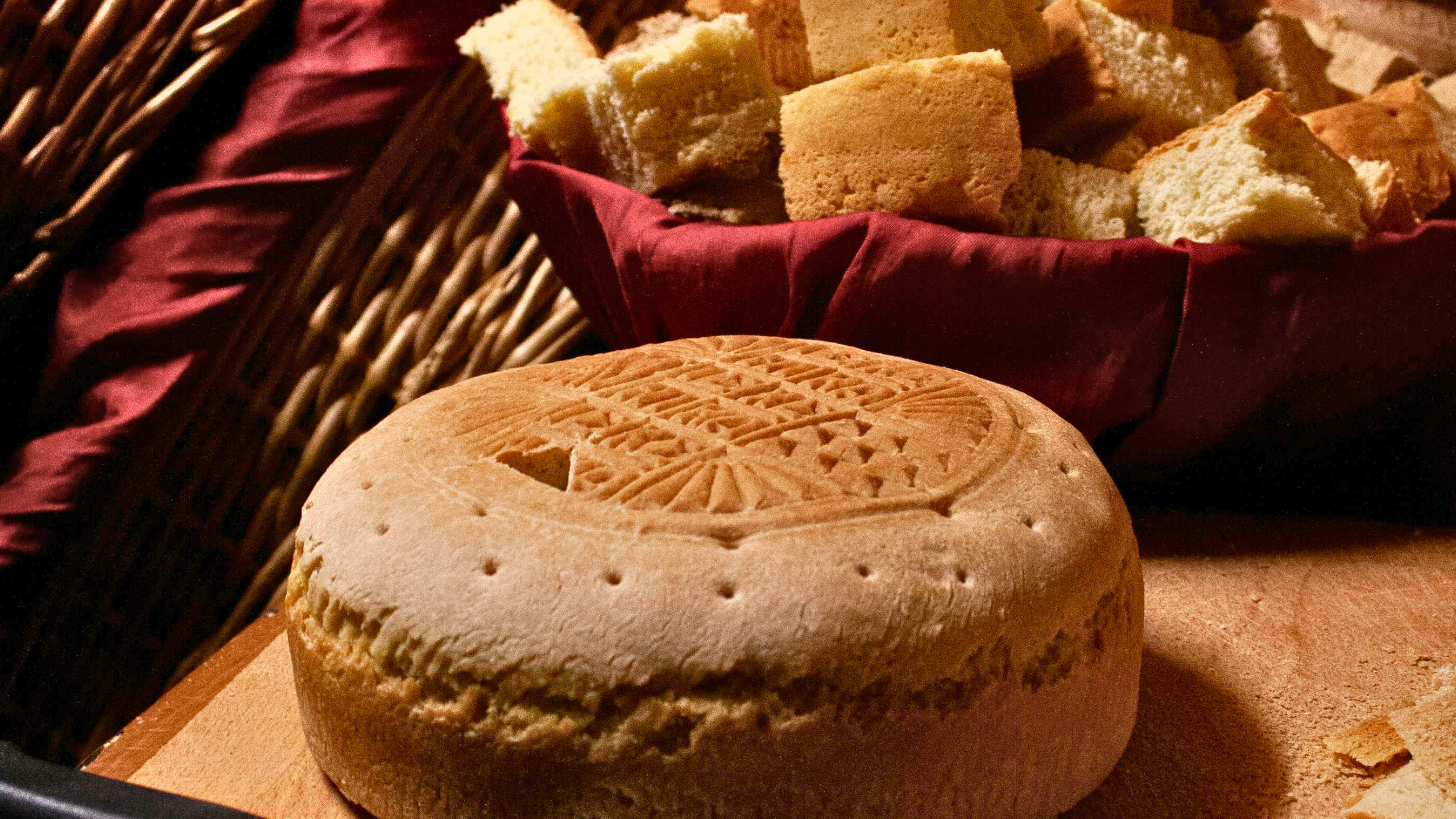
The word which is translated as “daily” in the Lord’s Prayer is the Greek word epiousios, which literally means “above the essence,” and goes beyond what is essential to life, such as food. Its deeper meaning is that spiritual food we need for the nourishment of our souls. We now receive the Eucharist, the bread of Life, as our “daily bread,” which is why we are are encouraged to receive frequently. This line of the Lord’s Prayer, Ton arton imon ton epiousion, dos imin simeron literally translates as “our bread which is above the essence, to us give it today.” In other words, “Give us today, the bread which is above essence,” which means “Lord, we trust you to give us today, Your things which are above essence, above our ability to comprehend.” This means we trust God to give us what we need today, that there is a faith that God has our best interests in mind. This is why St. Paul writes in Philippians 4:19-20, And my God will supply every need of yours according to His riches in glory in Christ Jesus. To our God and Father be glory forever and ever. Amen.
Years ago, there was a man in my parish who was severely stricken with cancer. And I was confused about how to pray for him. I didn’t want to pray for a miracle, when all signs pointed to the likelihood he would die soon. However, I also didn’t want to pray for him to die, as he was still fighting through treatments in the hope he would get better or at least extend his life. In speaking with my Spiritual Father, he told me that I should pray the Lord’s Prayer on behalf of that man, asking for God to give to him whatever he might need on that day, i.e. no pain, the ability to eat, the opportunity to laugh, the chance to engage with friends. The essence of prayer is not to beg God for specific outcomes but coupled with “Thy will be done” to ask God to give to us according to His will on a particular day, in a particular circumstance.
When we offer prayers for daily bread, we must also consider our contentment; there is a difference between what we need and what we want. We trust God to take care of our needs, as He sees them. St. Paul wrote in Philippians 4:10-13:
I rejoice in the Lord greatly that now at length you have revived your concern for me; you were indeed concerned for me, but you had no opportunity. Not that I complain of want; for I have learned, in whatever state I am, to be content. I know how to be abased, and I know how to abound; in any and all circumstances I have learned the secret of facing plenty and hunger, abundance and want. I can do all things in Him who strengthens me.
An emphasis on the needs of today and trusting in God to meet them according to His will, is the meaning and intention behind the prayer to give us our daily bread.
Point to ponder: In your prayers, do you focus more on the needs of today or beyond today?