

The fruit of the Spirit is love, joy, peace, patience, kindness, goodness, faithfulness, gentleness, self-control; against such there is no law. And those who belong to Christ have crucified the flesh with its passions and desires. If we live by the Spirit, let us also walk by the Spirit. Let us have no self-conceit, no provoking of one another, no envy of one another. Brethren, is a man is overtaken in any trespass, you who are spiritual should restore him in a spirit of gentleness. Look to yourself, lest you too be tempted. Bear one another’s burdens, and so fulfill the law of Christ.
Galatians 5:22-6:2 (Epistle on the Feast of St. Athanasios the Athonite)
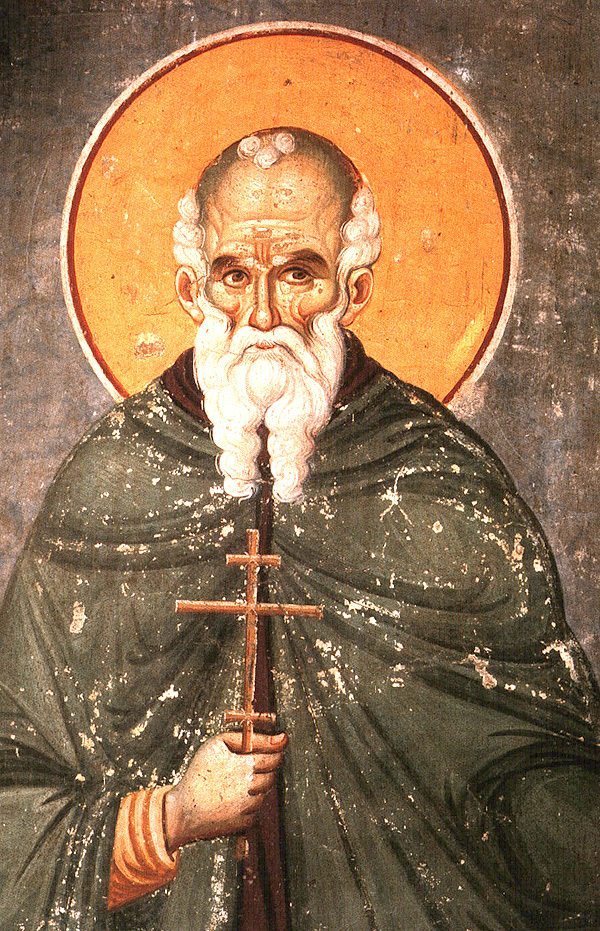
St. Athanasios the Athonite lived in the tenth century. He founded the monastery of the Great Lavra on Mount Athos, which still stands to this day. He lived a pious life and was well-known throughout the world as a man of faith, grace, humility and prayer. He, along with five other monks, were working on the dome of the church of the Great Lavra when it collapsed, killing all of them. The body of St. Athanasios remained incorrupt, many miracles were attributed to him and he was later recognized as a saint.
There are several groupings of saints. These include martyrs, people who were killed for their faith. Even though the word “martyr” means witness and every saint is a witness for the faith, the term “martyr” in grouping saints is used specifically for those who were killed for their faith. There are hierarchs, those who were bishops, some of whom were martyred. These are called “hieromartyrs” but are usually classified with the hierarchs. There are “unmercenaries”, saints who were known for healing. And there are “ascetics,” saints who lived a monastic existence. Under the ascetic grouping are found saints like St. Anthony, St. Efthimios, St. Savas, St. Paisios (modern day saint) and St. Athanasios of Athos. It is not uncommon for some of the Scripture readings to repeat for saints in the same classification. There are few Epistle readings and a few Gospel readings that are connected to the ascetics. And one of the Epistle readings is Galatians 5:22-6:2, which are the Fruit of the Spirit. These are ascribed to the ascetics who modeled them in their lives. It is rare that this Epistle lesson happens on a Sunday. It is not in the Sunday lectionary. However, when one of the great ascetics is commemorated on a Sunday, the Epistle lesson from Galatians replaces the one from the normal Sunday lectionary.
Entire books have been written on the Fruit of the Spirit. There is so much packed into just a few verses. Each of the nine fruits will take a lifetime to learn. Each is interdependent on the others. You can’t have love without joy, or joy without peace, etc. This is why if a person wants to focus just on one of the fruits, he or she will be developing the others as well. As an example, our lack of inner peace is affected by a lack of self-control. Work on self-control, and inner peace will follow. Work on inner peace and self-control will follow. A great strategy in cultivating the Fruit of the Spirit is to focus on one each week, or each month and really check in with it on a daily basis.
The fruit of labor is money, material acquisition, recognition and advancement. Many of us cultivate our labor so that we can realize these fruits. Another fruit of labor is that it honors God, who has blessed us with a talent to be able to do something, and it honors our neighbor, who is helped by our labor. Many people don’t think of God or neighbor when laboring, but focus on the material and financial fruit. Ultimately, the financial fruit becomes unusable, when we die. The cultivation of spiritual fruit has a direct impact on eternal life and our judgment before God. This is why it is more important to cultivate the spiritual fruit than it is to cultivate the material fruit.
St. Paul writes that there is no law prohibiting the Fruit of the Spirit. It is never wrong to love, or to seek joy or peace, to have patience, to show kindness and goodness, to be faithful and gentle or to have self-control. Those who belong to Christ choose to cultivate these fruits, rather than the fruits of the flesh. Immediately prior to listing the Fruit of the Spirit, St. Paul writes about the works of the flesh: fornication, impurity, licentiousness, idolatry, sorcery, enmity, strife, jealousy, anger, selfishness, dissension, party spirit, envy, drunkenness, carousing and the like. (Galatians 5:19-21) He warns that these kinds of behavior will prevent people from inheriting the Kingdom of God. The Fruit of the Spirit, however, are what lead us to live by the Spirit and walk by the Spirit. These essentially help us love both God and our neighbor.
One interesting thing about reading and re-reading Scripture is the potential to get a new thought from something one has read many times. On this reading of this passage, which I have read and written on many times, something really struck me in a way that it hasn’t before. We (I) often go right from the Fruit of the Spirit to Galatians 6:2, that we are to bear one another’s burdens and so fulfill the law of Christ. And we miss Galatians 6:1: Brethren, if a man is overtaken in any trespass, you who are spiritual should restore him in a spirit of gentleness. Look to yourself, lest you too be tempted. In other words, one of the burdens we are supposed to bear with our brethren is helping and encouraging others when they have fallen into temptation. If we are too harsh or too judgmental, we risk our own pride, or as Jesus said, we miss the log in our own eye trying to take the speck out from the eye of our brother. When one does wrong, we should seek to correct and restore in a spirit of gentleness. And we should hope that when we do wrong, others will show gentleness to us. The law of Christ is to bear one another’s burdens, whether they are material things like feeding the hungry or visiting the sick, or spiritual, if one has fallen into temptation and needs guidance, gentle correction and encouragement.
Angelic hosts on high were filled with wonderment, seeing your life in the flesh: how with your body you courageously went out to wrestle with invisible foes; and to the demonic hordes you inflicted serious wounds. Therefore, Athanasios, you received from the Master Christ, a wealth of gifts. Holy Father, intercede on our behalf with Christ our God, to save our souls. (Apolytikion, St. Athanasios of Athos, Trans. by Fr. Seraphim Dedes)
We focus so much on the fruit of our labor. We must not neglect the Fruit of the Spirit.