
The following in an excerpt from “Eros of Orthodoxy,” translated by Fr. Nicholas Palis and written by Mr. Pantelis Paschou.
It seems that today we greatly underestimate the power and the craftiness of satan. In particular, in the chapter which deals with the salvation of our soul, Christ said, “If we loose it, nothing benefits us,” even if we were to gain the whole world.
The demon often puts his own words in our minds, showing us his ways of life and whispering with a sweet siren’s voice: “Who told you that the security of your soul exists in the Church alone? This is a great lie. How did you discover that Orthodoxy is the most genuine expression of Christianity or that Christianity is the lode, religion with which man can be saved? This is not true. Then the Orthodox priests tell you, that you must sanctify Sunday, by going to Divine Liturgy, where after preparing for spiritual and physical purity, you can take part in the divine table of Christ and receive new power for your problems. Nor is this true. Sunday is for you to rest, to sleep a bit more in the morning- something which you cannot do on the other days since the office, the store, the factory, the vineyard, the field, digging or watering or whatever other work awaits you. And if, however, you want to get up early,” continues the good-hating Satan, ” I have beautiful roads to show you far away from church: sign up on Sunday for an excursion that the (so-and-so nature loving, soccer, tourist, artist etc.) group is organizing. Or if you can’t find an excursion, create your own and with your relatives. You will enjoy your Sunday better, at the mountains or at the sea, or wherever you wish. Only it should be very far from Church. “
These are a few of the sweet and alluring words, which the most wicked demon whispers to us and whose sole goal is to draw us away from the blessed and salutary fold of the church. Thus it becomes easier to tear to pieces our hurting toiled soul, for which “Christ died” like the wolf does to the lamb that is all alone and has fallen away from the flock.
We should be aware that Satan also changes his wickedness and advice toward man as it relates to different persons and circumstances. To an illiterate person he will suggest some things, to a learned person other things. He will differ his advice with poor person and a wealthy one, to a man of the village and a man of the city, to a wife, and to the husband, to a young person and to an adult, and to the layman and to a clergyman. Unfortunately Satan always has the greatest adaptability as a teacher leaving no one untaught! He never stops the war against us. He never tires of fighting to kill us spiritually, to make us unable for the spiritual battles which we must wage for our soul’s salvation.
He almost makes us believe that words and meanings like “soul,” “sin,” “deliverance,” and “salvation” are indifferent for contemporary man who will find deliverance from the pains which torture him by using his own knowledge and strength. And Satan still operates in this mode today even in the ranks of the Church. He attempts to convince us that dogmatic teaching that shows us the “landmark” the bright road of Orthodoxy is not necessary. That the synaxarion that discusses the miracles that the saints did with God’s grace are no longer needed. That we must modernize and make the word of God practical with the usual minor ethics, wherein the demon runs no danger, even if he grants us certain small victories. –Then, on the other hand, he places doubt and disbelief in dogmatic truths, in the word of God and in his Holy Church and subtlety doing his soul corrupting works.
Even yesterday – and let the pious readers not be scandalized by this use – we were informed that a theologian of the sacred theological school of Halki, along with his young wife, adopted the religion of Mohammed, wherein he hopes to find an answer and solution to his problems which supposedly Christianity could not solve. A rich Muslim helped them change their names and enter into the religion of Mohammed. He strengthened them financially, thus pressuring them to change their faith. We hope this event can be corrected with the grace of God and the prayers of Christians and that our brother may return to the sanctified flock of Christ.
This obligates us to stress one more time that the only true road of salvation for the Orthodox Christian is that which our Orthodox church shows us. All our problems and tormented seeking cannot be resolved in any way except in the life and teachings of Christ and His saints which as “images” of God and of His Gospels’ perfection, teach, strengthen, and console us, and by their intercessions and petitions bring us to salvation and peach, which only the faithful may taste.
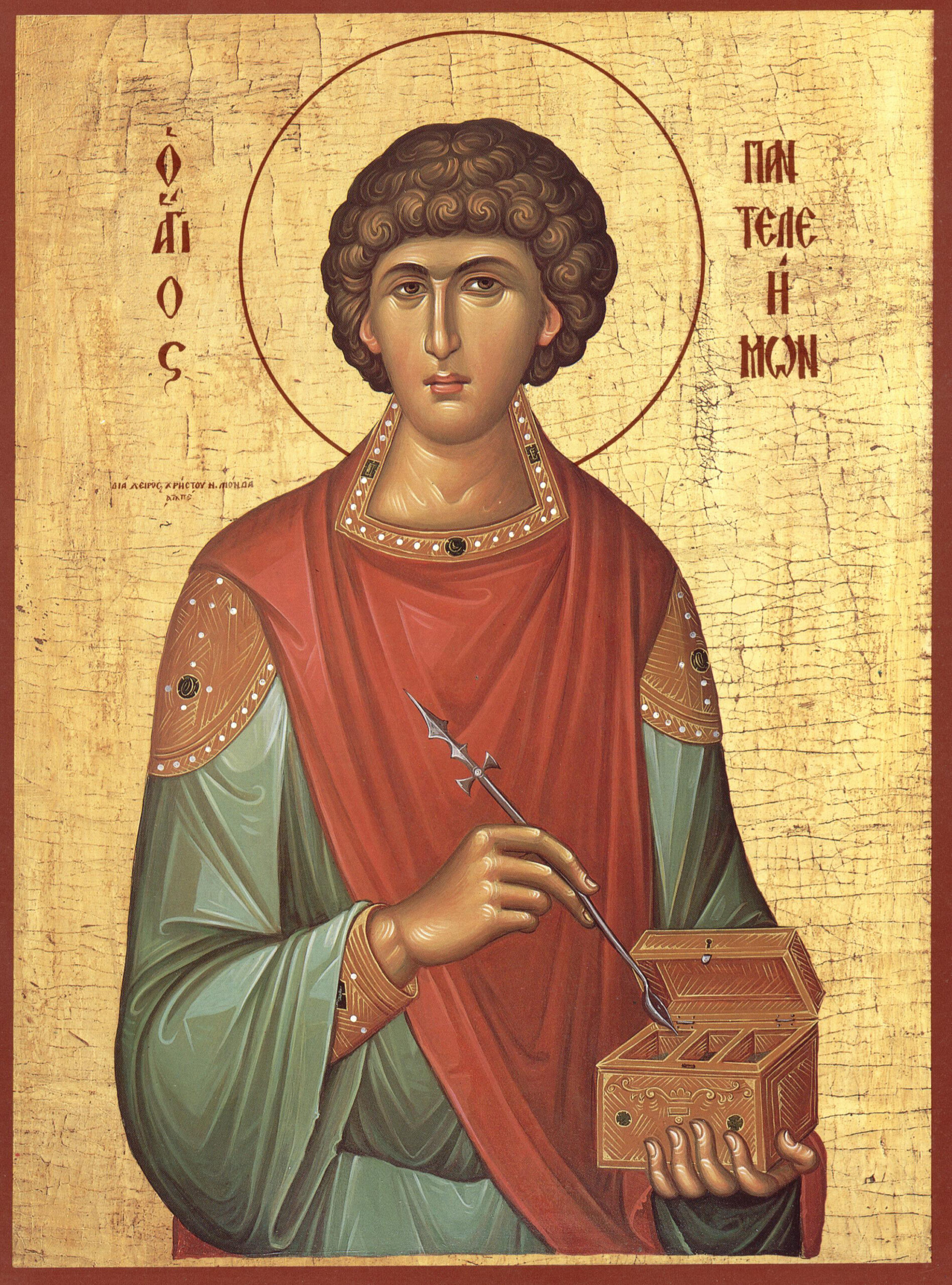
The Life of St. Panteleimon
Our Church triumphantly teaches us the preceding during the panegyrical commemoration of the Healer, the unmercenary doctor, the holy and glorious great martyr Panteleimon.
Pantoleon – the saint’s name till the hour of his martyrdom – was born in Nikomedia of Bythinia (of Asia Minor) and lived at the end of the third century A.D. From the time of his childhood he faced the “lively” vivid religious oppositions of his parents. His father, Efstorgios, was an idolater officer – probably a member of the Senate as well – and as St. Symeon the Translator notes, “noted for his life and more noted for his impiety for he respected the beliefs of the Hellenes and had an enthusiastic zeal for these things.” His mother, however, Evoulon, was a very pious Christian, “of forefathers who respected Christ”. For this reason, the first upbringing that the saint received from his mother, in secret from his idolater father, was according to the faith of Christ and the Gospel. Early in life, his pious and holy mother fell asleep in the Lord, leaving her small son, with great pain and many prayers, with warm tears in the hands of God, rather than in the hands of his fanatical idolater father.
When the saint finished his basic learning, his father took him to the famous doctor of the palace, Efrosino, to learn the science of healing. The saint’s natural beauty, his great “brilliance” and his astonishing progress for his age in this new science, quickly made him the brightest personality in the capital, Nikomedia. His father and his teacher were proud of him. The emperor, Maximinian, destined him as the head doctor of his palaces and all the people rejoiced at his acquaintance and sought his company: “He was “lenient in ethos and “delightful” in his speech and excellent in beauty”.
It seems, however, that the palaces of the human King did not move the saint, but that the more luxurious and incorrupt palaces of the King of all, that is the soul of man where God himself dwells, did. Thus, God placed in his path, St. Hermolaon (who together with the Saints Hermipos and Hermocratis miraculously escaped when Maximian burned 20,000 Christians in the church of Nikomedia) to bring him near to Him. As a result of St. Hermolaos, Panteleimon began learning about the mysteries of the Christian faith and of Christ’s healing more deeply. The presence of God strengthened the first Christian steps of the saint.
One day, as he returned home, he found a child on the road, fallen dead from the poisonous bite of a “scorpion”. The saint knelt and prayed and his eyes opened into another world unknown up to this present moment to the world we know today wherein disbelief strengthened by satanic crafts prevents our seeing. He saw the beautiful world of God which becomes approachable only with deep faith and where all the dark things are enlightened and all the sick are healed. At the same time he prayed, the dead child arose and the “scorpion” “immediately burst ” and remained dead. St. Hermolaos saw in Panteleimon a new chosen vessel of the Lord, baptized him and had him commune of the Incorrupt Sacrament.
The saint remained near Hermolaos for many hours, sometimes for entire days. Sick people with various sufferings came there and the saint made them well. The saint, however, had a great “ache” in his heart and prayed to God a great deal concerning this: to save his faithless idolater father and God heard him. And here’s how: hearing of the saint’s miracles, many ran to him to be healed of their various sicknesses. One day they brought to his house a blind man who spent his entire estate on doctors but did not gain his sight. His father, knowing that not even his teacher-doctor, Efrosinos could make him well advised his son not to attempt anything so that he would not be shamed. But the saint denied healing anyone. He extended his hand, made the sign of the cross on the closed eyes of the blind man and a great miracle occurred! The eyes of the blind man opened. Being an idolater, the eyes of his soul also opened up and he became a Christian. Many pagans, hearing of the great miracle became Christians. The saint’s father, seeing the miracle with his eyes, thought of an answer to the question once posed by his son: “Father, why do some idols that were made never sit and many never stand? After the baptism of the blind man and his father, who had returned to the true faith, he went home and smashed all the idols of his old religion to bits, those that were standing and sitting. And when shortly he approached death, the saint gave his baptized and faithful, father the Holy Sacraments.
The saint remained alone with a huge paternal estate. He freely scattered it “to the poor” through charities. He dressed the naked, covered the roofless, fed the hungry, cared for the pained orphans, and gave himself completely to those suffering of body or soul. He became a flame of love enlightening and warming Christians and those pained, burning the traps of Satan and of idolaters!
The Martyrdom of the Saint
But the work of the saint couldn’t remain secret becoming widely known to the whole world. The idolater doctors, who were losing their business and the trust of the people because of the saint’s many miracles, slandered him to the Emperor saying he cursed the gods. They summoned him to the palace. The saint admitted that he was a Christian and that the miracles that he performed were not done by magic but with the grace of Christ. The emperor sent for the blind man who had recently been healed by the saint to question him. But he told him the same things: “With the name of Christ and the sign of the cross he healed me!” Then the emperor became angry and ordered them to behead the healed blind man, whom our church honors as a martyr, on the same day as St. Panteleimon.
A Blind Man easily finding a dawn of fleshly lamps gathered a spiritual dawn by the swords.
He then suggested that the saint sacrifice to the idols and deny his faith. But the saint denied honors and palaces and persisted in his Christian faith. The doctors pressured the emperor, and the emperor forced the saint. Then the saint invited the doctors and the emperor to take a paralytic and have the idolater-priest doctors heal him. If however, they could not and the saint instead healed them, they must be convinced that the true God is the God of the Christians which is what occurred. As much as the false priests prayed to the idols, the paralytic remained motionless. Then the saint also knelt and prayed, rose, grabbed the paralytic by the hand, and said to him: “In the name of Jesus Christ, arise and walk.” Immediately the paralytic walked, glorifying God and thanking the saint. Many of the idolaters at once believed, but the doctors and the emperor got even angrier because their art and religion was in danger.
The emperor tried to lure the saint with promises, honors and riches. Then he made threats. But when these had no affect he commanded them to begin torturing him. The emperor believed that with these tortures he would change his faith.
First they hung him on a tree and ripped apart his flesh with iron nails. Then they burnt his wounds with lit torches. The saint patiently prayed to God, who appeared before him in the form of St. Hermolaos to strengthen his faith. Immediately the torturer’s hands became paralyzed and the torches were extinguished. Next they lit a great vat with lead, and when it smoldered they put the saint inside. God however cooled it and the saint suffered no harm. At the same time, the pagans seeing the miracles were becoming Christians in great numbers. They tied a great rock to the saint’s neck and threw him into the sea but the rock became as light as a feather and the saint walking on water, surfaced again on land. Instead of their hearts softening and repenting with these miracles, they become even more enraged. They put him in a theater and loosed the wildest beasts to tear him to shreds but they instead caressed the saint with their tails. They licked his hands and he blessed them. The emperor almost lost his mind and ordered them to kill all the beasts that did not harm the saint and to prepare a great wheel with nails in order to martyr the saint. But this also did not harm the saint because an angel untied the saint from the wheel that subsequently rolled down killing many of the idolaters.
After more tortures, the emperor ordered him behead and his body burnt. The executioners tied him to the trunk of an olive tree and lowered their swords. But their swords melted like wax! The executioners knelt and asked him to intercede to the true God for them as well. The saint prayed and a voice heard from heaven said: “All that you asked will happen and other things as well. Henceforth, do not be called Pantoleon but Panteleimon and things will certify you name, for through you many will find compassion and mercy.” (Footnote: Panteleimon in Greek means All-Merciful.) Then the saint bent his neck and the soldiers beheaded him, on July 27, 305 A.D. Tradition says that instead of blood, the saint brought forth milk and when the executioners hit his neck and the dried olive tree blossomed bearing fruit. The faithful took the saint’s body and secretly buried it outside the city. Not finding the sacred relic, the angry emperor cracked and burned the olive tree, so that it could not substantiate the saint’s miracles by which the true God glorified him even from earth.
The Feast Day
On the day the saint’s is commemorated millions of faithful in our pious villages and in the cities, leave their summer jobs and with celebrations and religious services honor his memory. Since he never ceases healing the suffering of souls and bodies, our Holy Church invites all who are physically and spiritually ill, to piously approach the Saint:
a flow of healings as from a fountain, engrossing miracles, anointing freely Panteleimon the all-wise healer. Let those searching for healing, come “draw”.