

The Gospel of the Gergesenes and the mercy we resist when God asks us to change
By Fr. Michael Psaromatis
Greek Orthodox Archdiocese of Australia
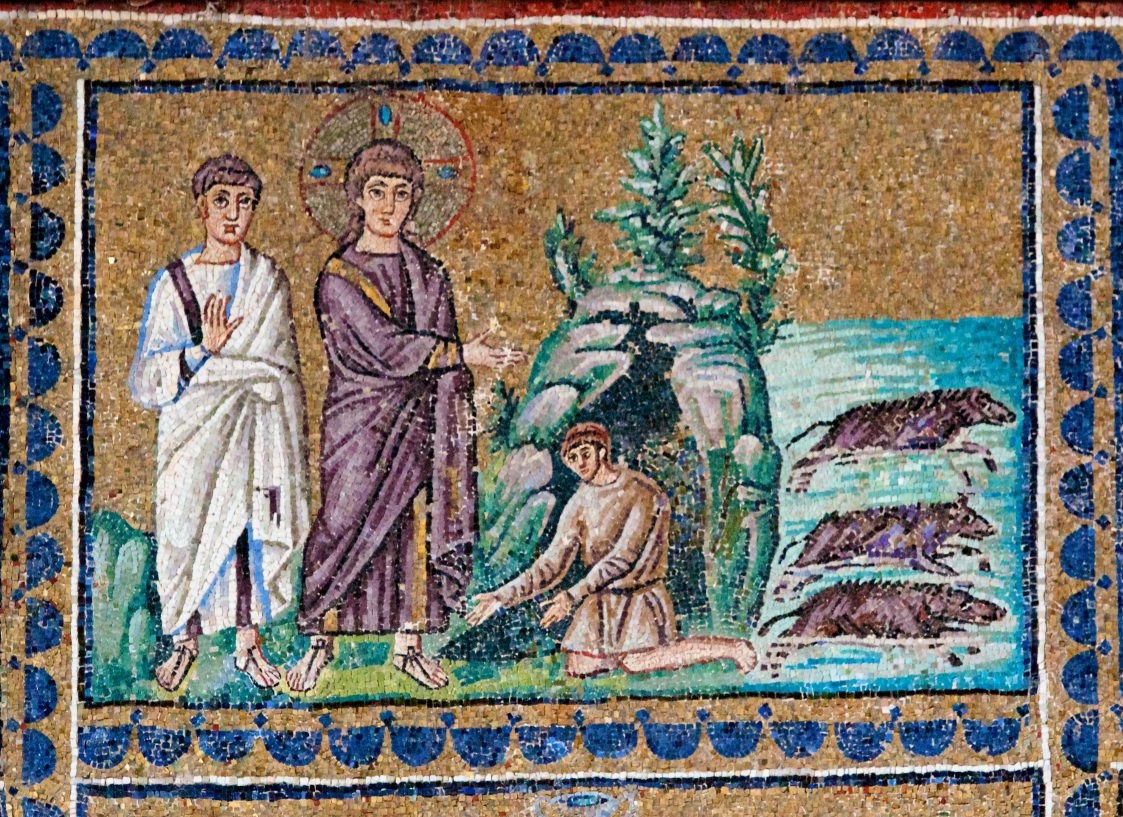
When Christ enters the country of the Gergesenes, He does not only deliver two men from demons. He also reveals what the people around them had learnt to accept. These men were living among the tombs, feared and avoided, cut off from home, family and neighbour, no longer looked upon as sons, brothers, friends, or bearers of the image of God, but as a danger to be kept at a distance. The people knew where they were. They knew which road to avoid. They had not brought these men back into the life of the community; they had only learnt how to live around them. Christ did not only confront the demons in the men. He confronted the peace the people had made with their abandonment.
Christ does not avoid the tombs. He walks into the place everyone else has learnt to bypass, and beneath the violence, beneath the demonic ruin, beneath the fear that had caused others to retreat, He sees the image of God not erased but buried. The demons cry out, “What have we to do with You, Jesus, Son of God?” (Matthew 8:29). Their words are true, yet no one would call their confession faith, because truth without repentance does not save. Saint James says that even the demons believe and tremble (James 2:19), and that word should humble every religious heart. A person can speak about God, defend holy things, carry inherited customs, quote Scripture, argue about Orthodoxy, and still refuse the healing of his own soul.
For a hearer shaped by the Law, the herd of swine would have carried immediate meaning. Swine were unclean (Leviticus 11:7-8; Deuteronomy 14:8). Whether the region was Gentile, mixed, or simply accustomed to compromise, the Gospel places before us a people comfortable with a disordered life. In the tombs were men they had stopped facing. In the fields was profit they did not want to lose. Suffering could remain at the edge, the herd could remain in the open, and the town could continue with its familiar rhythm, provided Christ did not come close enough to expose both.
When the demons enter the swine and the herd rushes into the sea, the violence that had been hidden in the men becomes visible in the animals. Saint John Chrysostom says Christ permitted this so the malice of the demons would be made plain, and so all would know that they could not even enter swine without the Lord’s permission (St John Chrysostom, Homily 28 on Matthew). Blessed Theophylact says the demons desired the destruction of the herd so that the owners, grieving over their loss, would turn against Christ rather than receive Him (Blessed Theophylact, Explanation of the Gospel of Matthew, on Matthew 8:28-34). Two men are healed, the herd is lost, and what the people mourn shows what had hold of them.
This is where the Gospel begins to press on our own life. We often call for Christ when suffering becomes too much to carry, and we are right to do so. We ask for His help, His blessing, His healing, His miracle. Yet when His mercy begins to remain in the home, in the marriage, in the conscience, in the raising of children, in the Sunday morning routine, in the way we forgive, speak, pray and return to Church, we may find ourselves troubled by the very presence we once begged for. We wanted Him to enter the pain, but not always to remain as Lord of the life He has touched.
In our own lives the herd often appears under different names. Sometimes it is money, reputation, control, comfort, family pride, a false peace at home, convenient ignorance, or a cultural Orthodoxy that wants Baptisms, weddings, funerals, names, food, photographs and feast days, but not confession, fasting, forgiveness, prayer and Holy Communion. It may be a Sunday morning filled with everything except the Divine Liturgy. It may be resentment called justice, greed called responsibility, lust called freedom, indifference called balance, or spiritual laziness called being busy. The swine are often not the things we hate, but the things we have learnt to defend. Whatever we want God to bless but never touch, whatever we protect while the soul becomes dull, whatever we grieve losing more than we rejoice when a person is restored, that has become our swine.
Saint Luke shows the healed man “sitting at the feet of Jesus, clothed and in his right mind” (Luke 8:35). The man who had been scattered, naked, violent and among the dead is now clothed, still, teachable and near Christ. When he asks to remain with the Lord, Christ sends him home: “Return to your own house, and tell what great things God has done for you” (Luke 8:39). Mercy does not return a man to life so that he can simply disappear back into the old arrangement. He is sent home carrying in his own restored life the proof of what God has done.
I have seen this Gospel lived in the life of the parish again and again. People come to the Church in pain, and naturally they should come. The Church does not turn away from human need. A couple longs for a child. A family is terrified for someone sick. Parents ask that a future daughter-in-law be received into Orthodoxy. Someone is addicted, ashamed, grieving, confused, exhausted, close to death, or buried beneath a life that has become too overwhelming. They ask for prayers, Paraklesis, Holy Unction, relics, confession, catechism, a house blessing, a hospital visit, a word to steady the heart. These cries belong before Christ. The Gospel is full of them: “Lord, help me” (Matthew 15:25), “Lord, I believe, help my unbelief” (Mark 9:24), “Jesus, Master, have mercy on us” (Luke 17:13).
Many times we ask Christ for one thing, but He begins to heal more than we expected. We ask Him to take away the pain, but He also touches the home, the marriage, the parents, the children, the friendships, and sometimes even the parish. He touches the way we speak, the way we pray, the way we forgive, and the things we have avoided changing. Once God’s mercy enters, life cannot honestly remain as it was.
I have had families ask me to help a future daughter-in-law become Orthodox. They want the wedding in the Church, the family united, the children one day baptised, the proper order kept. Catechism begins, and by the grace of God the young woman does not treat it as paperwork before a ceremony. She listens, asks, reads, comes to services, learns to pray, prepares seriously, receives Baptism or Chrismation, marries in the Church, and then continues coming. Prayer in the home begins to matter to her. Sunday begins to belong to the Lord. Future children, if God grants them, are not to be raised only with customs and a baptismal photograph, but with confession, fasting, Communion, icons, Scripture, reverence, and a real life in the Church.
At that point the very people who wanted her received into Orthodoxy can become uneasy. The Orthodox spouse who wanted the Church wedding may not want the Church life. Relatives become irritated that she has taken Orthodoxy more seriously than those born into it. I have heard the words, “Father, what have you done? You have turned her into a nun.” It may be said jokingly, or as anger hidden inside a joke, but the meaning is painful enough. We wanted her Orthodox enough to belong to us, not Orthodox enough to expose us. We wanted the sacrament, the photographs, the family unity, the respectability, the continuation of identity, but not the conscience that now asks why the Orthodox home does not pray, why Liturgy is optional, why confession is strange, why fasting is mocked, why the children are told that Church matters while being shown that everything else comes first.
A similar pain appears when a couple struggles to have children. Childlessness is a deep and often silent suffering. Scripture knows that cry in Hannah, who prayed in bitterness of soul before the birth of Samuel (1 Samuel 1:9-20), in Sarah, in Elizabeth, and the Church remembers the righteous Joachim and Anna as those who waited upon the mercy of God (Genesis 18:10-14; Luke 1:5-25). The priest prays, blesses, anoints, encourages, and asks the intercessions of the Theotokos and the saints. Sometimes, by God’s mercy, a child comes. There are tears, candles, Baptism, joy, photographs and thanksgiving. Then, slowly, the gift can be treated as though it came from nowhere. Sunday becomes difficult. Sleep, sport, parties, routine, school commitments and convenience become stronger than the Divine Liturgy. The baby once begged for in prayer is baptised, but not raised in prayer. The miracle is received while the Giver is gradually forgotten.
“Behold, children are a heritage from the Lord” (Psalm 127:3). Saint John Chrysostom urges parents to bring children up in the admonition of the Lord, not treating the spiritual formation of a child as something secondary (St John Chrysostom, Homily 21 on Ephesians). A child received through tears is not given so the home can remain prayerless. Every child is a trust and every Baptism places a responsibility on parents and godparents. Answered prayer asks to become thanksgiving, and thanksgiving in the Church is not merely a feeling but Eucharistic life of thanksgiving and communion.
Hospital rooms have their own version of this Gospel story. As priests many times we may spend hours, days, even months with parents, spouses, children, friends and relatives of someone dying or gravely ill. Paraklesis is prayed, Holy Unction is served, relics are brought for veneration, the Cross is placed upon the sick, Psalms are read beside machines and monitors. Families who had not prayed for years begin to pray with tears. People who had been far from confession ask for mercy, as hands reach for icons and candles are lit. The room becomes a small church because death, fear and love strip away the illusion that man is in control. Speaking about the Mystery of Holy Unction, Archbishop Makarios of Australia reminds us that “we must be willing to accept it and ready to make a new beginning in our spiritual life” (Archbishop Makarios of Australia, Address after the Sacrament of Holy Unction, Church of Saint Nicholas, Canberra, Holy Wednesday 2024). That is the point. The grace of healing is not given so that man may return unchanged to the life he had before. It is given so that the soul may begin again.
By the mercy of God, the person sometimes lives. Results change and doctors are surprised. A door opens where everyone thought there was only an end. “It is a miracle,” the family says. “God saved me,” says the one who was sick. Tears, prostrations, promises and the sense that life has been handed back fill those days. For a little while everyone understands that physical healing is not given merely so the same life can continue with a few more years added to it. In the Church, healing of the body is time given for repentance. God heals so that a person may reconcile, forgive, confess, pray, come back, and remember that life is a gift.
As time passes, even God’s mercy can be forgotten. A miracle received on the knees can slowly become a story told with less prayer, then an unexplained turn, then simply luck. Unless thanksgiving becomes a way of life, the heart begins to edit its own memory. The hospital room, the fear, the candles, the prayers, the promises, the tears, all of it moves further away, and the person who once said, “God saved me,” can later shrug and say, “Eh, I was just lucky.” I have heard it. The same mouth that thanked God with tears and promised to change later spoke as though God had never entered that room of pain at all.
The priest who came again and again, prayed at the bedside, anointed, listened, carried the family’s fear into prayer, and stood beside them when the shadow of death was near, can later become an uncomfortable reminder. His presence recalls the vows, the tears, the gratitude, the hour when everyone knew that life had been given back by God. If the healed person, or those around him, no longer wants to live under that memory, then the priest must be moved away in the heart. “Father, thank you, but that is enough now. Please move on. We are fine. We do not need you anymore.”
At times this is said tenderly, at times coldly, and sometimes never aloud, though everything begins to say it. The person who once asked for prayer avoids the priest who prayed. The one who wept before God becomes embarrassed by those tears and old patterns return.
When gratitude fades, the priest can be recast as the problem. Perhaps he was too young, too old, too emotional, too direct, too involved, not senior enough, not wise enough, not relatable, no longer suitable. It may even become easier to say that another clergyman would have handled things differently, because then the real question can be avoided: what did God ask of me when He answered my prayer? The priest is not the point. Christ is. Yet sometimes the priest remains as the uncomfortable witness that Christ really did enter the room. Of course no priest or bishop should demand personal loyalty as though it were faithfulness to God. Saint Paul says that we carry the treasure in earthen vessels, “that the excellence of the power may be of God and not of us” (2 Corinthians 4:7). Still, it is dangerous when the weakness of the priest becomes a convenient veil over the claim of God upon the life that was healed.
The Gergesenes did not have to argue against the miracle. They only had to ask Christ to leave. The same thing can happen after God has helped us. A person may not openly deny that God was present, but he begins to move away from everything that reminds him of that presence. The prayers, the tears, the priest, the promises, the nearness of death, the sense that life had been returned by God, all of it is slowly pushed to the side. What had once demanded repentance and thanksgiving is softened into a safer memory, until the soul can return to its old life without being disturbed by what God had done.
Abba Dorotheos warns that the soul remains troubled when it keeps placing the cause of its disturbance outside itself, while peace begins when a man learns to accuse himself before God instead of blaming another (Abba Dorotheos of Gaza, Discourses, On Self-Accusation). The Fathers do not pretend that others never make mistakes. They know the heart and how easily another person’s weakness can become the hiding place for our own refusal to change. It is easy to say, “The priest failed me,” when the deeper wound may be that the mercy of God now asks me to live differently. It is easy to say, “Someone else would have handled this better,” when the harder truth may be that Christ’s healing has placed a new responsibility before me and I do not want it.
Illness and healing must always be approached with humility and care. Many faithful people are not healed in the way they hoped, and the saints themselves knew sickness, pain and weakness. But when God does give healing, when He gives time, strength and another chance, it cannot be treated as something that belongs only to us. It is a visitation of His mercy, and it should lead the person back to repentance, gratitude and a life closer to Him.
Christ’s question after healing the ten lepers still stands over every answered prayer: “Were there not ten cleansed? But where are the nine?” (Luke 17:17). The tragedy was not that the nine failed to feel grateful for a moment, but that they did not return.
It is much the same when there is addiction, illness, grief, marriage breakdown, anxiety, or a child returning after drifting from the Church. The priest is called when the tombs are too dark to bear, but when Christ begins restoring someone, that restoration can unsettle the whole household. Someone recovering may need boundaries, prayer, confession, quiet, honesty and a different spirit in the home. A spouse who has found strength in Christ may no longer be able to accept the old cruelties. Young people who begin coming to Church may no longer laugh at the same things, keep the same company, or accept the same excuses. Often the family wanted the pain to stop, but not the repentance that healing now asks from everyone.
Here the god we have made for ourselves begins to show his face. We prefer a god who blesses without cleansing, comforts without correcting, forgives without calling us to repentance, and understands our absence from prayer without asking why we have time for everything else. Useful at Baptisms, weddings, funerals, exams, sickness, crises and family milestones, this god does not interfere with our money, speech, screens, grudges, pleasures, pride, children’s formation, Sunday routine, or distance from the Chalice. Such a god is easy to live with because he has been made from our own preferences.
The real Christ, however, heals the paralytic and says, “Arise” (Mark 2:11). He heals the man at the pool and warns him, “Sin no more, lest a worse thing come upon you” (John 5:14). To the woman caught in adultery He says, “Go, and sin no more” (John 8:11). To the weary He gives rest, but He also says, “Take My yoke upon you” (Matthew 11:29). Christ receives the person where he is, without leaving him there. Saint John Climacus calls repentance the renewal of Baptism and a covenant with God for a new life (St John Climacus, The Ladder of Divine Ascent, Step 5). Saint Maximus the Confessor teaches that self-love is the mother of the passions, because when the self becomes the measure of all things, even God is reshaped to serve the ego (St Maximus the Confessor, Four Hundred Texts on Love, Second Century, 8).
Mercy softens the conscience again. When Christ heals someone we had dismissed, that person can no longer be held prisoner to the story we heard or told about him. When someone in the home begins to wake up spiritually, the rest of us are no longer able to call our own sleep wisdom. A sincere convert can unsettle those who were born into the Church but have forgotten how to live from her life. A child given through prayer cannot be treated as though he belongs only to the plans of his parents. Health restored by God cannot be spent as though life were our own possession. Every gift of God asks for gratitude, patience, humility, reverence, and a life ordered again around Him.
The Gergesene people could live with tombs nearby, swine in the fields, and a compromised peace. What they could not live with was Christ changing what had become normal. Their loss revealed their love. The swine mattered more than their own countrymen who had been delivered from demons.
I cannot judge the Gergesenes honestly unless I also ask what I protect in the same way. What have I begged God to give, then forgotten to return in gratitude? What have I asked Him to bless, while refusing to let Him purify it? What person has Christ healed whom I now find inconvenient? What habit, comfort, resentment, income, pleasure, family pattern, or false peace do I fear losing more than I desire salvation? Where have I politely, practically, religiously asked Christ to leave me alone?
Coming back to Church does not mean placing a little religion on top of the same old life. It means allowing Christ into the parts of life we had kept guarded from Him. It means standing in the Divine Liturgy as people who need healing, going to confession without excuses, praying at home when life is calm and not only when fear drives us there, raising children as gifts from God and not as projects of our own ambition. Sometimes the seriousness of a convert, a spouse, a child, a healed person, or someone returning after many years is the very thing God uses to wake up what has gone cold in us.
When God gives a child after tears of longing, returns life after sickness, blesses a marriage, brings a soul into the Church, answers prayer, or grants another chance to live, the gift cannot be placed back inside the old life as though nothing has changed. Thanksgiving is more than saying “thank God” until the fear passes. It means the whole life begins to turn back to Him through the Divine Liturgy, confession, prayer in the home, children raised in the faith, husband and wife learning to forgive, and the family remembering honestly Who had mercy on them. Without this, the years make the gift feel like something we own. The miracle becomes luck, the answered prayer becomes coincidence, and the heart walks back into the very life it once begged God to save it from. The Church keeps calling us back before that happens, before the swine become dearer to us than Christ.
The people of the Gergesenes lost more than a herd that day. They lost the nearness of Christ. The Lord had crossed into their darkness, restored their own, and shown them the worth of a human soul. But because His mercy disturbed the life they preferred, they asked Him to go. May God keep us from the same tragedy: receiving His gifts, His healings, His miracles and His mercy, only to send Him away from the life He has touched. Let every mercy He gives become repentance, thanksgiving, return to the Church, and a life changed enough to show that Christ has not merely visited us, but remained with us.