

The following in an excerpt from “Eros of Orthodoxy,” translated by Fr. Nicholas Palis and written by Mr. Pantelis Paschou.
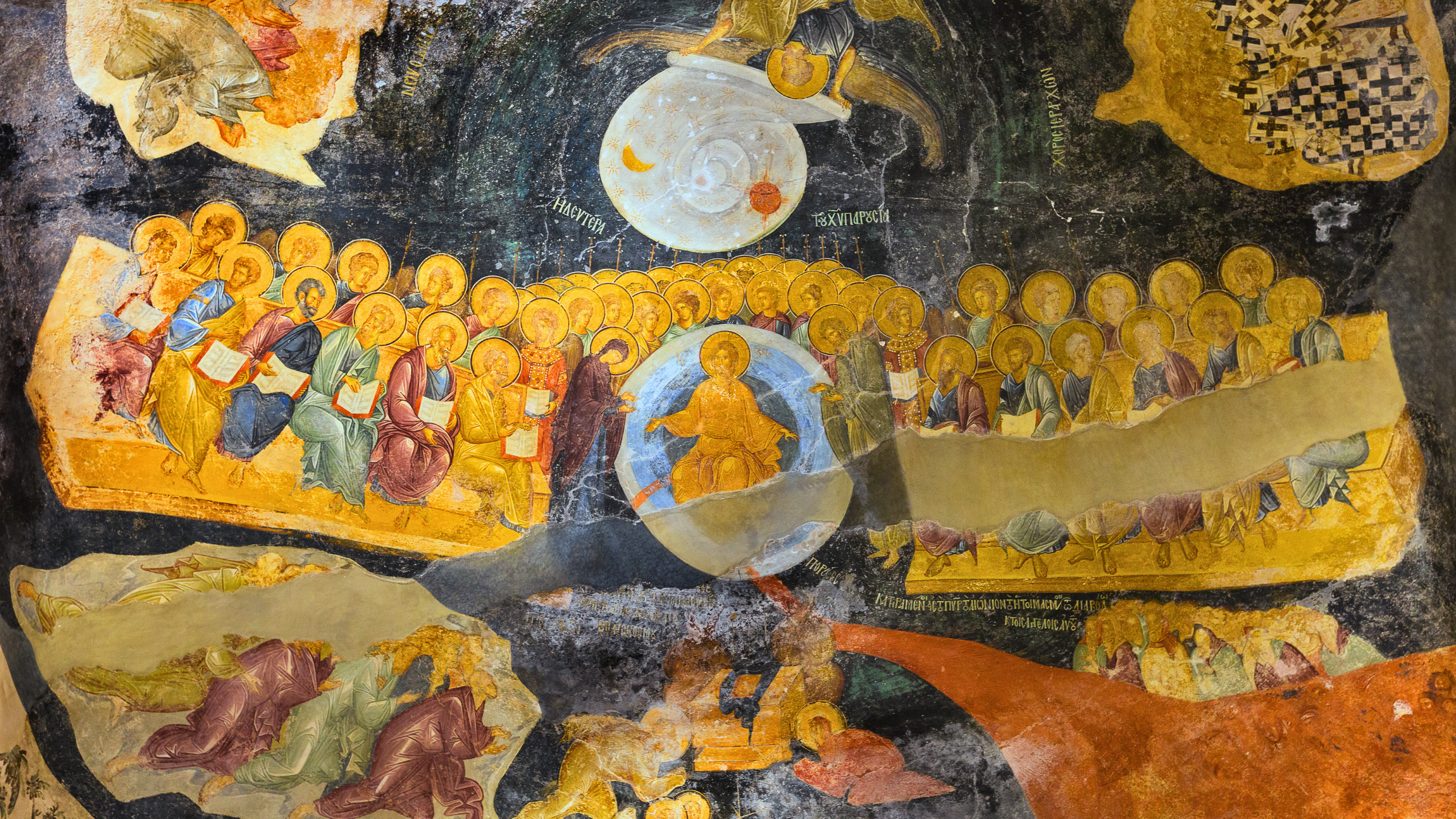
It is called the Second Coming because in the first Christ came down to us “bodily”. However in the Second Coming He won’t come like He did in the first: poor, unknown, without glory. He will come with great glory, with great brilliance and with divine magnificence. And then He won’t come to save, but to judge the world. To reward those who did good with His eternal Kingdom, and to whomever did evil, with eternal hell. We synoptically affirm this in our faith’s Creed. “And He shall come again in glory, to judge the living and the dead, whose Kingdom shall have no end”.
And that, which the Holy Fathers put in the Creed of Faith as an Article, they took exactly from the Gospel of Judgment, which says: “The Lord said. When the Son of man comes in His glory and all His holy angels with Him, then He shall sit on the throne of His glory, and all nations will be gathered before Him, and He will separate amongst them, as the shepherd takes the sheep apart from the kids, and He will place the sheep on His right side and the kids on His left.
And then the king will say to those on His right side: come O ye blessed of my Father, to inherit the kingdom which is prepared for you, from the earth’s creation. Come to inherit that kingdom, because I hungered and you gave me to eat. I thirsted and you gave me to drink. I was naked and you clothed me. I was a stranger and you invited me in, I was ill and you came and saw me. I was in jail and you came and visited me.
Then the righteous will humbly respond saying: “Lord when did we see you hungry and we gave you to eat, or thirsty and we gave you to drink. Or when did we see you naked and we clothed you or a stranger and we took you in. Or when did we see you ill or in jail and we served you?” And He will answer and tell them: “Verily I tell you, certainly, that as much as you did for one of these small brothers of mine, you did it for me”.
Then He will tell those who are on his left side: “drag away from me those condemned to the eternal fire, which is prepared for the devil and his angels, because I hungered and you did not give me to eat. I thirsted and you did not quench my thirst. I was naked and you did not clothe me. I was ill and in jail and you did not visit me”. Then they will answer but with shamelessness, and will say: “Lord, when did we see you hungry or thirsty or naked or a stranger, or sick or in jail and we didn’t care for you?” And the king will respond telling them: “Verily I tell you, that as much as you didn’t do for one of these small ones, neither did you do it for me”. And thus these will go to eternal hell, and the righteous will go to eternal life”.
This is how Meletius Pigas presents the Judgment Gospel.
“He wants us to always be ready.”
Man would very much like to know when the Second Coming of the Lord will occur. When all men both those living and dead up to that time will appear before the dreadful judge to be judged for their good or evil deeds. But just as death comes as a thief, at an unknown time, thus the Lord left us ignorant of the time when He will come, concerning the Second Coming.
Once when His disciples asked Him about this He answered: “it is not for you to know the times or periods, which the Father placed in His own authority”. And at another place it tells us: “concerning that day and hour, no one knows, nor the angels of the heavens, but only my Father alone.”
Why then doesn’t Christ reveal the hour of Judgment even when His Disciples anxiously ask Him? And the Fathers of our Church wisely respond: “He only gives the signs of the times, but He does not mention the times themselves. Because He wants us to always be ready. By us not knowing the ordained time, He wants us to know nothing, so that we may always be ready.”
There are many, who are Christian in name only and even Orthodox identified as such willingly but who, like other Athenian idolaters, don’t believe in the resurrection of the dead, nor in the Second Coming of our Lord, nor in the dreadful Judgment, which will be followed by eternal Paradise or eternal Hell. These people say with indifference: “Hell is here on earth as well as Paradise.”
And thus not only do they walk the path of sin, without fearing any judgment or any Hell, but they also draw others into the easy road of luxurious living, the good life, of earthly and physical prosperity. They do not want to open any window, for the supernatural light to enter their lives. They settle for the bright darkness and dark lights of the misinterpreted civilization of the epidermis. Their mouths and stomachs are full of injustices that they are unable to thoroughly know the taste of heaven. This is why they say that all things end here, that “Hell is here and Paradise is here”.
However every Christian must realize that these are words of the devil who whispers them in our ears to make us more indifferent for virtue and more eager for sin. And it is a great sin for one to say them. As uncertain is the hour of death, just as certain is the time of the Second Coming of the Lord, even more certain is the coming of the Second Coming and its dreadful Judgment, with eternal Hell and Eternal Paradise. So that not only His infinite philanthropy towards those worthy of Paradise may be revealed, but also His infinite justice towards those worthy of Hell.
“For we must all appear before the judgment seat of Christ, so that each one may receive good or evil according to what each one has done in the body.”
For whoever believes in God, as was revealed to us in the Sacred Scripture and in the Sacred Tradition, and is firm in his faith, there does not exist room to doubt if there is Judgment in Heaven above, and what consequences this will have for the continuation of his spiritual life. “And I shall gather all the nations, says the Lord to the Prophet Joel, and I shall place them about in the field of Joasaphat, because there will I sit to discern all the surrounding nations” (Joel 4 2/12).
And again in another place in the Prophet Daniel it says: “As I looked, thrones were placed and one that was ancient of days took his seat; his raiment was white as snow, and the hair on his head glowed like pure wool; his throne was fiery flames, its wheels were burning fire. A stream of fire issued and came forth from before him; a thousand thousands served him, and ten thousand times ten thousand stood before him; The court sat in judgment and the books were opened” (Dan. 7,9-10).
The deeply compunctionate hymns that are chanted in the vespers are based exactly on this. “When you will come to make a just judgment, books will be opened, the deeds of men will be revealed before the insufferable Judgment Seat; Trumpets will sound, and the tombs shall be emptied and the whole nature of humans shall arise trembling.”
So for the Christian, the coming Judgment and the coming life are a certainty, graspable we would say, with our spiritual senses. “For we must all appear before the judgment seat of Christ, so that each one may receive good or evil according to what each one has done in the body. 2 Cor: 5, 10). This certainty however for the supernatural life, which the atheists don’t believe in, obliges us to live the present life in an analogous manner, with love for God and neighbor, with spiritual and bodily purity, in a word keeping the law of God. “Remember your end and you shall not sin” says Solomon the wise.
Only in this way do we have hope that He shall put us with the gentle and tame sheep and not on his left, with the wild and naughty kids. And being charitable to our poor neighbor, showing in this way love for God, at the same time we should often say this troparion:
When you come O God on earth with glory
and the universe trembles a river of fire,
draws before the judgment seat and books
are opened and the hidden are made known
then deliver me from the unquenching fire
and grant me worthy to stand at your right
O most just judge.