

The following in an excerpt from “Eros of Orthodoxy,” translated by Fr. Nicholas Palis and written by Mr. Pantelis Paschou.
Whoever believes that the Church, continuing the salutary work of Christ, is the only bearer of grace, the unmistakable teacher and interpreter of the divine truth and the only ark of salvation for all men of all ages—honors and celebrates Holy Pentecost, as Orthodox theology teaches, with an extra special spiritual rejoicing.
Historically, Pentecost is the birth date of our holy Church—it is called “the feast of feasts and celebration of celebrations,” the “metropolis of feasts,” according to sacred Chrysostom. And also because this is “the after feast and last celebration,” according to saint Kosmas the Melodist, “the time and fulfillment of the promise” takes place. These promises were born in the flaming mouths of the prophets from ancient times and held the thirst and expectation of the faithful unquenched.
Behold some characteristic voices from the Old Testament. “I will pour out My Spirit on all flesh” says the prophet Joel (Joel 2:28). “There is not one obeying them, if I do not fill them with power from the Holy Spirit,” the Prophet Micah shouts out (Mic 3:8); “from thy fear, O Lord,” the prophet Isaiah notes, “we have conceived in the womb and have pained and given birth. The spirit of your salvation we have made on the earth” (Is. 26:18). While the great prophet David, in the 50th Psalm, begs God, “Create in me a clean heart, O God, and renew a right spirit within me,” and a little further down, “And do not take Thy Holy Spirit from me.”
We also find prophecies concerning the Holy Spirit in Job (27:3,33:4), as well as in the prophet Ezekiel, where this very deep passage exists. “I will give you a new heart and put a new spirit within you; I will take the heart of stone out of your flesh and give you a heart of flesh. I will put My Spirit within you.” (Ezekiel 36:26-27).
“It is to your benefit that I go away. For if I do not go away the Comforter will not come upon you.”
Mention is also made of this promise in the New Testament, God’s promise that He will send us the Holy Spirit. Truly touching, is the promise which Christ gave to His disciples when they, seeing the tragic hours of martyrdom which He was going through, attempted to keep Him close to them, as they feared that He would depart from them and leave them orphaned. But Christ tells them that He will not leave them orphaned, and that He must “go away” for sure. “It is to your benefit that I go away. For if I do not go away the Comforter will not come upon you” (John 16:7). “And I shall pray (in other words I shall petition) the Father and He will give you another Comforter, that He may abide in you forever” (John 14:16). “When the Comforter comes whom I shall send to you from the Father” (John:15-26). And, “Behold, I send the promise of My Father upon you” (Luke 24:49).
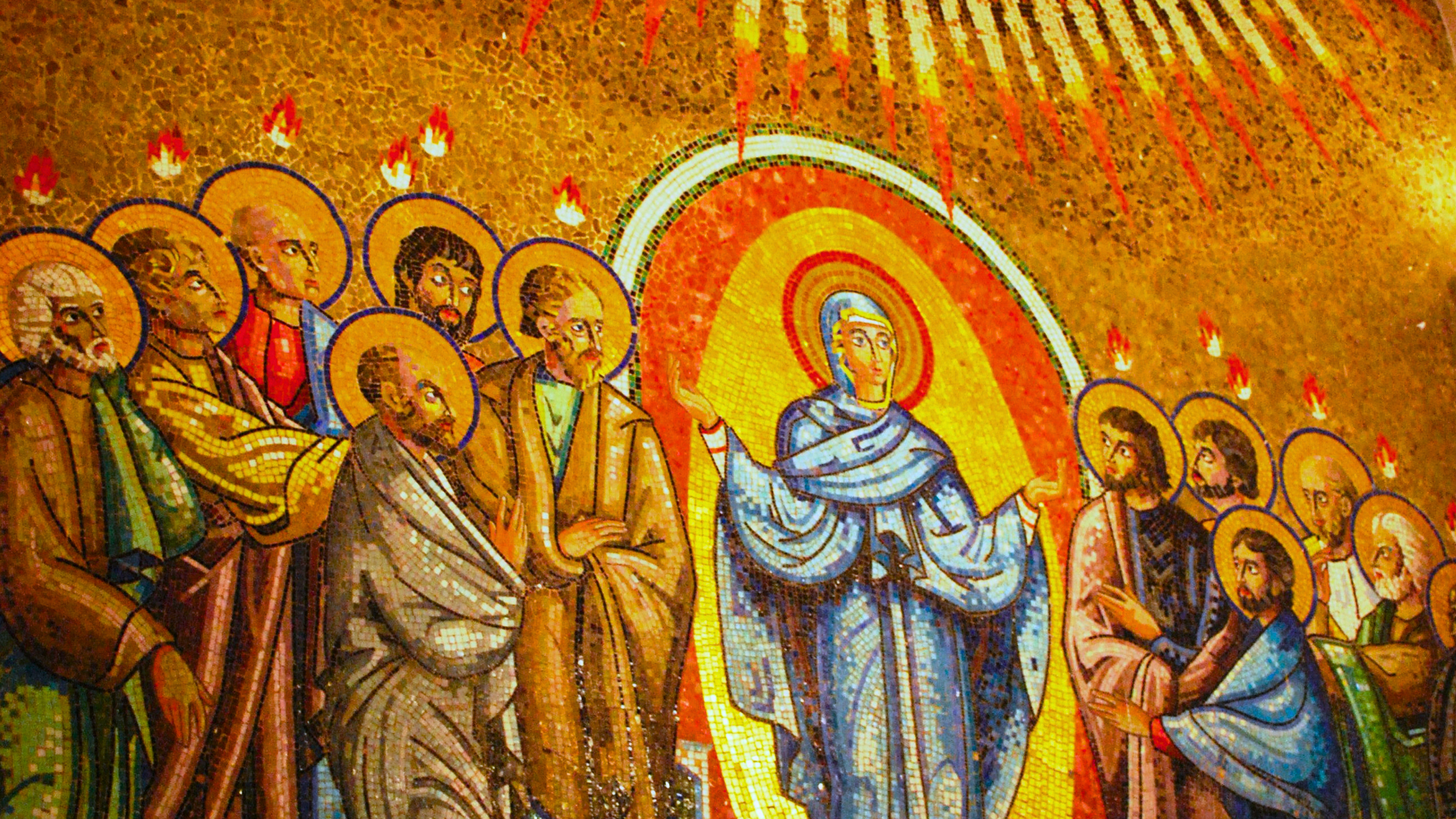
The fulfillment of this “promise and expectation” occurred on the day of Holy Pentecost, with the descent of the Holy Spirit, in the upper room, where the holy Apostles were gathered “together”.
Here we probably should note a misunderstanding that many Christians have. They think that the Holy Spirit first appears in the Church now. [i.e., at Pentecost] Concerning this point, we will use the words of two great ecclesiastical authorities, so that they can assure us what our holy Church believes. “This Spirit,” says Saint Gregory the Theologian, “worked in the fathers and the prophets [of the Old Testament]. The fathers imagined God or knew Him while the prophets, being imprinted upon by the Spirit, foreknew the future, as if present with those who would exist in the future”. (Here in the word “fathers” we must of course mean the fathers prior to the Law).
“The Holy Spirit worked previously as well because it is that which spoke through the prophets and foretold future events.”
Saint Gregory Palamas reveals this detail even more in his celebratory sermon on Holy Pentecost, where amongst other things he says the following. “Now [i.e., at Pentecost] all those things beginning to be performed reveal that the Holy Spirit exists in its own hypostasis [person], so that we could know and think of the great and worshipful mystery of the Holy Trinity. Truly, the Holy Spirit worked previously as well because it is that which spoke through the prophets and foretold future events.”
When some of the people of Judea asked Saint John the Forerunner if he were Christ whom they were awaiting, He answered them: “I indeed baptize you with water; but One mightier than I is coming, whose sandal strap I am not worthy to loose. He will baptize you with the Holy Spirit and with fire” (Luke 3:16). And Christ began the baptism of the Holy Spirit and also taught it to His disciples. But the baptism of fire came at Holy Pentecost.
And while the Jews were celebrating Pentecost, because the Mosaic Law was given fifty days after Pascha, we celebrate the baptism of fire fifty days after Christ’s resurrection. Which the newly born Church received, with the “fiery-tongue-formed” descent of the Holy Spirit, thus starting its “perfecting” work from the upper room of the Apostles.
“It was the enlightenment and the divine awesomeness of the Spirit that opened the mouths of the holy Apostles to speak on the day of Pentecost.”
The Comforter, in other words the Holy Spirit, which stayed with its indwelling on the heads of the Apostles, “in the form of fiery tongues,” consoled them, strengthened supported, enlightened, cleansed them from every sin, strengthened their will and enflamed their faith towards confession and martyrdom. And it was the enlightenment and the divine awesomeness of the Spirit that opened the mouths of the holy Apostles to speak on the day of Pentecost. This enabled the multitudes gathered from many different parts of the widespread seed of the celebratory to hear, “each in his own dialect.”
Soon thereafter with his first sermon this Fire of Pentecost strengthened Saint Peter to return three thousand people to Christ. This holy Fire spreading the teaching of the Gospel burned all the machination of satanic idolatry. This divine Fire lit up the hearts of the Apostles who didn’t want to know anything other than how to give it out with the word of Christ to all the world: to whomever had a clean heart to receive the Fire of the Spirit, to be enlightened, warmed in zeal, and to be saved. While to whoever had totally acceded to sin and satan, to be censured and burned by its Fire as Saint Gregory the Theologian says:
To whom it flows and in tongues of fire afterwards was apportioned bearing the mark of the godhead, when out of the nether world the Savior. For I know God to be a fire to the evil, as a light to the good.
This fire of the “crucible” (Malachi. 3:2), which “consumes” the vileness of the evil and wicked ones and “enlightens the Apostles,” shows us the nature and action of God in the expression of Saint Cyril of Alexandria: “in the form of fire the divine and unspeakable nature is shown.”
The holy Apostles took this light and this fire of Holy Pentecost, like resurrection lamps. They in turn gave it to their successors who they ordained these to successors of their own. Thus the fire and the light of Holy Pentecost comes to us to this day, the Shepherds, who hold the lamps which they lit from the successors of the Apostles and to the faithful, who follow the Church’s tradition, which binds together its shepherds and teachers.
“Just as from the light-bearing lamp another one is lit, and from this one still another, and so forth…the grace of the divine Spirit proceeds through all generations.”
What Saint Gregory Palamas says on this topic is characteristic. “Just as from the light bearing lamp another one is lit, and from this one still another, and so forth and hence maintaining it through succession, always having the light permanently. Thus through the ordination by the Apostles of their successors, and from these upon others and so forth, the grace of the divine Spirit proceeds through all generations, and enlightens all who are obedient to the Spiritual Shepherds and Teachers. This grace and gift of God, and enlightenment of the divine Spirit through evangelization, each Hierarch of the time comes to bring to the city.”
Today, to speak in terms of the “Symbolical Theology” of Saint Dionysios the Areopagite (which unfortunately has not been preserved), about the fire and light of Holy Pentecost, in the cold world of concrete and of many sins, makes man indifferent even for his salvation. But if one doesn’t learn what the Holy Spirit is, which enlightened the Apostles at Pentecost, and if one doesn’t try to become the habitation of his enlightenment and Grace, he will never be able to become a disciple of Christ and be saved. This saying is written in the Gospel: “whoever does not have the Spirit of Christ is not His.”
Everyone of our dealings with the third person of the Holy Trinity would be the most untimely discussion and wasting of time…if we didn’t attempt to always struggle, to be made worthy to receive the grace and the uncreated energies of the all-holy Spirit, like the Holy Apostles on Pentecost. For this we must disdain some of the things of the world, which tie us to sin and corruption. Each of us must return, with a pure heart and a sanctified mind to our “altar”. We must also surely ascend to the upper room like the Apostles, in order for the Holy Spirit to descend upon us.
This means we must rise above earthly things, above sensuality, greed, ambition, and from every other passion that lowers us to mud, to the dark depth of the abyss. When we go to that upper room and rise above earthly things that choke man’s mortal soul, then the Holy Spirit also descends upon us.
“It is necessary for God to descend to us…for us to go up, and thus for man’s communion with God to occur.”
At this point let’s again bring to mind the classic expression of Saint Gregory the Theologian. “It is necessary for God to descend to us…for us to go up, and thus for man’s communion with God to occur, commingling the importance. For as long as each remains separate, the one admirable and the other in humility, goodness is not mixed and the love of man is uncommuned.” For this reason must we kill the “mind of the body,” which is death, and to gain the “mind of the Spirit, which is life and peace” (Rom 8:6). And the mind and grace of the Holy Spirit will come in accordance with our purity.
It is impossible for us to receive divine grace in an unclean place of the soul, filled with slynesses, earthly bodily passions and foul thoughts. “It is impossible” says Basil the Great, for us to become containers of divine grace if we don’t drive out of our souls the passions of evil which occupy them. Because a container “occupied” by foul water, unwashed, will not receive flowing myrrh. The soul of man should wash itself well from thoughts of sin and passions, and become totally peaceful, “and His place was born in peace,” (Psalm 75:3) to receive the coolness and the enlightenment of the Holy Spirit as a forceful breath” or like a slender beam.