
The following in an excerpt from “Eros of Orthodoxy,” translated by Fr. Nicholas Palis and written by Mr. Pantelis Paschou.
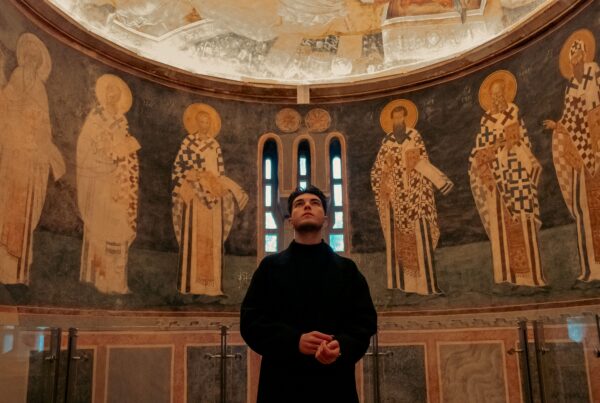
In order for someone to speak of hagiography, a precious area of the Orthodox Church, preparation is perhaps needed comparable to that which the wholly pious and dedicated hagiographer does—fasting, chanting, bodily and spiritual purity, prayer with much piety and compunction. This is because if someone approaches Orthodox iconography unprepared he will understand absolutely nothing.
It is like the troparion of the Church and like the holy Gospel, which if one doesn’t approach them with humility and purity of heart, no matter how educated he is in the world he will always remain outside of their salutary meanings. He must even learn the mystical language of the Divine Liturgy, with which the liturgical arts of Orthodoxy work. Together they serve the holy purpose of the Divine Liturgy: the salvation of man.
This language has nothing in common with the other language and terminology that man uses, which is directed to the bodily senses of man. These operate with aesthetics. However, the sacred and liturgical art of hagiography is incapable of conceiving anything aesthetic because hagiography is above and beyond every aesthetic. A super-aesthetic or hyper-aesthetic language and feeling is needed—that is, spiritual—so that man can come into contact with the holy world of hagiography. It is this language and this sense which man must acquire to prepare him to understand the mysteries of the liturgical art of Orthodoxy.
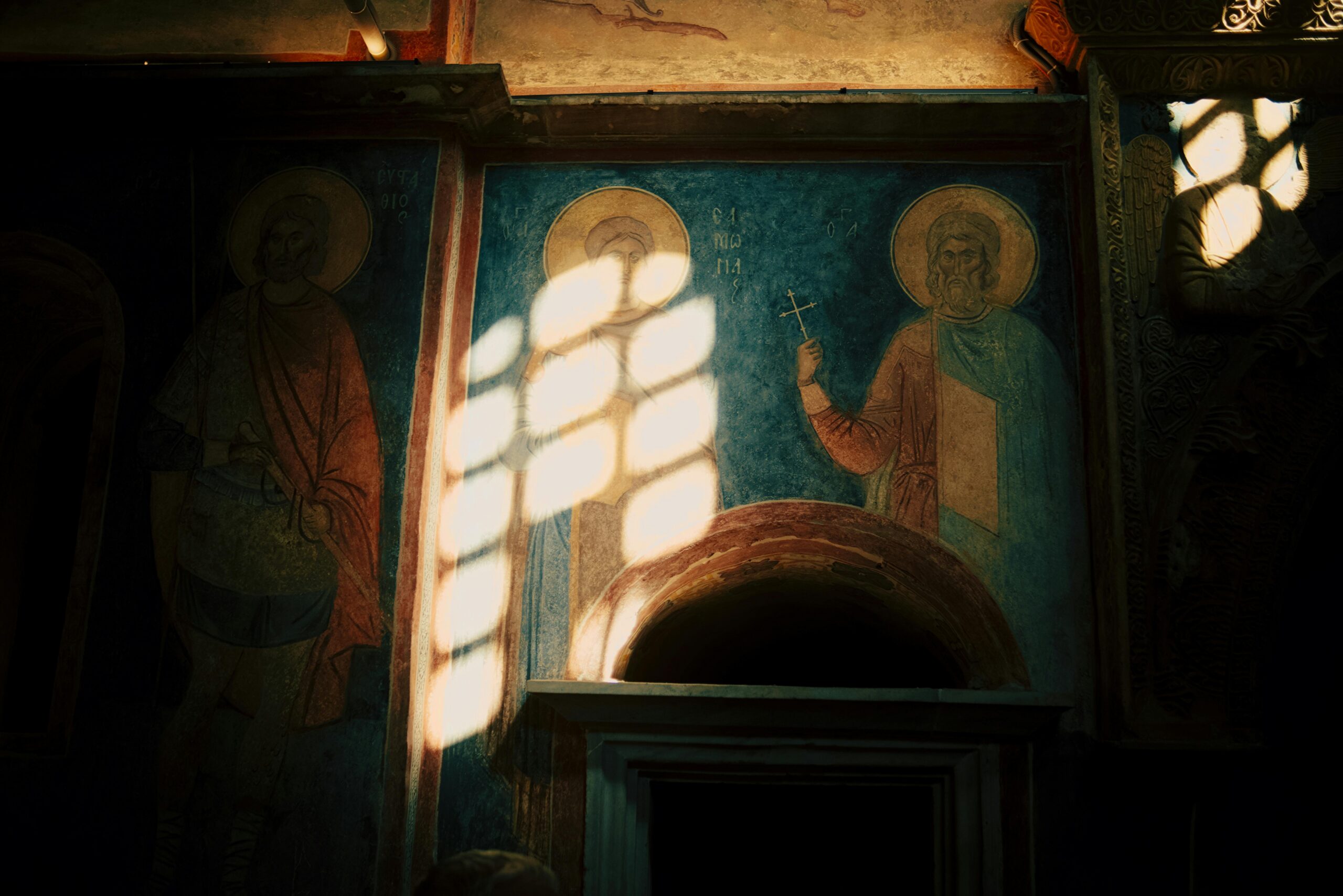
The goal which Orthodox hagiography and its separate and specialized spirituality serve places the icon on a portable wood or on the fresco, in an elevated area and at the indivisible time of the Divine Liturgy. This means that the icon becomes a step in the spiritual ladder that is used by the Church to raise the faithful Christian from worldly to spiritual and heavenly things. To release him from carnal senses and to introduce him to the world of Grace, to the mystical paradise of the spirit, where everything exhales “a sense of spiritual fragrance.”
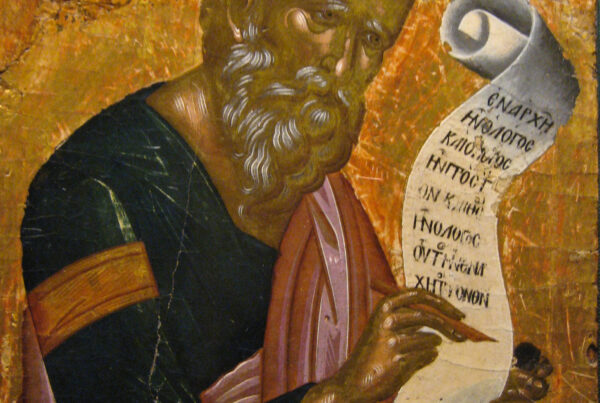
One feels that “a tongue-bearing book is opened up to him,” as Saint Gregory of Nyssa says, when as a pious worshipper he kisses and “reads” the holy icons in Church. A book sanctified by centuries of sacrifices, which is open both to the young and old, the poor and wealthy, the educated and uneducated. It is enough as long as they approach it with humility and a pure heart. And towards this end the spiritual, incorporeal, sanctified expression of Byzantine icons helps very much.
No art beyond Byzantine Orthodox iconography would be able to harmonize with the hymnography of the Orthodox Church, and more generally with the judicious and majestic word of God as well, which is offered by the sacramental Divine Liturgy. From the Pantocrator in the dome, “being Great, Powerful, All-working, All-seeing, Prudent, Man-loving, Savior, Judge, Humble, Stern, Compassionate, which gently drips holy feelings” into the pious soul. The “One Wider than the Heavens,” who is there between heaven and earth, to unite the faithful with their Heavenly Father, the Apostles, the Martyrs, the Confessors, the Monastic Saints, the Neomartyrs—no matter which page of the book of our icon-painted Church one reads, he will hear with his spiritual ears the awe-inspiring tone from the cherubic hymn of Holy Saturday: “Let every human body be still and let it stand with fear and trembling and let it not consider any earthly thing.”
This art which leads upward pulls you away from bodily and earthly things and makes you discard as an annoying piece of clothing “every daily care,” giving you the power to converse with God, the Panaghia and all the Saints. Pray, to get strength on the road to Christ, for you are struggling to walk; cry before the Panaghia when you feel your pains becoming unbearable, and await the miracle with hope and firm faith, which will unify you with the Saints and with God.
The importance of our hagiography, organized within our divine worship with the spirit and dogma of Orthodoxy, is deeply theological. It is the divine art which transforms the Church to “earthly heaven, in which the heavenly God swells and walks” (Fr. Germanos). And this liturgical content, which Orthodox hagiography never departs from, is its inmost and fundamental characteristic.
It does not allow a simple portrayal of religious themes—like Western art—but expresses in the most spiritual manner the transcendent world of God, which draws us persistently, till we also repose in its bosom, in the expression of sacred Augustine. But this divine love of spiritual man with his God and Savior is, as we noted at other times, a mark of those strong, humble, creative souls. Steeped in the tradition of Orthodoxy, they didn’t let their souls and spiritual senses become corrupted by the “artistic” weapons of Satan, who fights us day and night.
Hagiography shows very beautifully how much a person lives or doesn’t actually live the Orthodox tradition, Orthodox theology. According to an eminent specialized scholar, the professor of Christian and Byzantine Archaeology of the University of Thessalonica, Mr. K.D. Kalokyris, Orthodox hagiography with its liturgical, dogmatic, highly spiritual and theological character “remains an element of prominent importance of the Tradition today.”
Professor K.D. Kalokyris, in his very scholarly but deeply spiritual book concerning the “Essence of Orthodox Hagiography,” notes the following: “The heterodox, who are far from our liturgical and other tradition, are ignorant of or are indifferent, in the most part, to the importance of Byzantine hagiography. But the sad thing is that our own people, accountable to the Church, have not totally familiarized themselves with its spirit. This is what leads today to the existence in Orthodox churches of everything other than the Byzantine tradition. Hagiographies of worldly minded art, censuring the lack of a greater artistic breadth, works following western models, or comprising poorly made copies, are not only unrelated to the high spirit of Orthodoxy, but also suspect dogmatically.” (K.D. Kalokyris, The Essence of Orthodox Hagiography, p. 7)