

The following in an excerpt from “Eros of Orthodoxy,” translated by Fr. Nicholas Palis and written by Mr. Pantelis Paschou.
In one of his troparia in the 6th ode, the inspired hymnographer who wrote the canons for the Synaxis of Saint John the Forerunner, offers a timely characterization of him:
We know you as the soul of the Prophets,
as mediating between the Old and the New
both a Baptist and Forerunner,
we declare of the Savior Christ.
In other words “we know you as the signet and perfection of all the Prophets, as a link, and a bridge, bringing us from the Old to the New Covenant, from the Law to Grace. And we preach it manifestly, that you are the Baptist and Forerunner of our Savior, of Christ”.
For this reason our Church celebrates the Synaxis of the holy Forerunner on the day after holy Theophany, ” as serving the mystery of divine Baptism”. Just as the day after the Birth of Christ, the Church celebrates the Synaxis of the Most Holy Theotokos, “as serving in the mystery of the birth of Christ”.
His Birth and Ministry
John the Forerunner, was an amazing saint for believers, but also a tragic prophetic personality.
His birth took place by the grace of God, and his conception was evangelized in the church, (as the Evangelist Luke mentions, 1:5:25), to his father Zachariah, while he was censing. There the archangel Gabriel told Zachariah that his barren and aged wife Elizabeth would give birth to a son: “And you shall call his name John. “And you will have joy and gladness, and many will rejoice at his birth; for he shall be great before the Lord,”. This proclamation of the angel came true.
The Forerunner was born “of the very barren womb of Elizabeth; simultaneously loosening his father Zachariah’s muteness. Even when he was in Elizabeth’s womb and leapt, he prophesied the incarnation of the divine Word in the virginal womb of the Panaghia.
Without knowing sin, the Forerunner left the world for the desert while still very young, living with fearsome ascesis nourished by crickets and wild honey as if he were a bird. In many icons of Byzantine hagiography, the holy Forerunner is shown (for real) with two wings growing off his shoulders and with the ascription “the bird of the desert”.
There in the desert, in the great furnace where saints are tried and matured, he began preaching repentance. He thundered that “it has come” that the kingdom of the heavens has arrived and is very near -meaning that Christ was coming near him, and Who as God, “came before him”.
He does not cower in his preaching and censuring, even if he knew that this would cost him his life for he pointed out even Herod’s adultery. With his beheading, on the nefarious birthday gathering, the Forerunner opened the gates of Hades and evangelized the coming of the Savior as is also chanted in his apolytikion. “Whence becoming a martyr of the truth, rejoicing, evangelizing to those in Hades as well, God manifest in flesh, who bears the sin of the world and grants us the great mercy”.
And in the end he was granted to hear the encomium, which no man had ever heard, from the fearsome mouth of his Lord and God Himself, whom he baptized in the Jordan River. “Verily I say unto you, among those born of women there has risen no one greater than John the Baptist”. (Math. 11:11)
His Portrayal in Icons
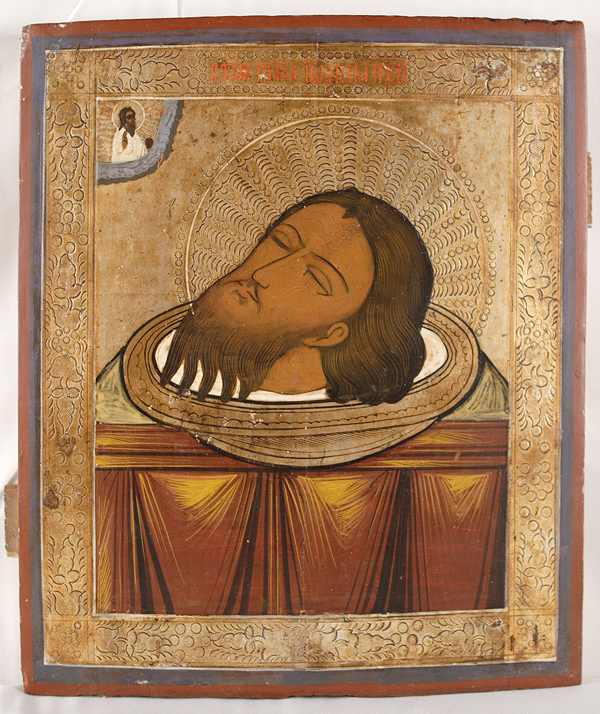
John the Baptist is the most spiritualistic personality of Byzantine hagiography. He is portrayed according to the tradition that preserved him, “as a real bird of the desert”.
Behold, an image of him, portrayed by the hand and the pen of Saint Nikodemos the Haghiorite: “He was in bodily appearance wild and simultaneously fearsome, and unlike other men, because of the many years he stayed in the desert. His hair was thick and uncombed. His face was sun burnt. He was so thin that his arms and sides looked like a spider and his legs were similar to those of locusts.
His speech was coarse but also sweet – coarse with his reproaching, sweet with his preaching of repentance. Because he said to the Jews: “Race of vipers” (this is coarse and wild), “bear fruits worthy of repentance” (this is sweet and meekness of peech). Just as John’s food was wild honey, thus his teaching was also mixed with sweetness and harshness”.
On this tradition of the Holy Fathers is based the Orthodox hagiography of today as well as painted icons of the holy Forerunner.
Behold his icon made “by the hand of Photios Kontoglou”: “he stands on a rock, as a wild winged bird, with thin legs, wearing a camel skin cloak on his body reaching just below the knee, and above is wrapped an oil green garb. His hair is wind-tossed like a wild oak. His eyes are very sad looking far off and his mouth is melancholic. His expression is stern with calm vigilance. His hair lies tangled on his shoulders. The palms of his hands and feet are fleshless, like those of birds.
His face is lean and dark from the heat of the desert, his hair and beard made wild from the hardship and wind. His eye is harsh and full of perseverance, his nose is turned up, his cheeks stand out, long chinned, long necked, with his chest bare, the bones protruding below the dark skin.
With his right hand he makes the blessing sign, and with the left he holds a pike with a cross, and an open scroll. In the right corner of the icon on a rock is a vessel with his severed head, while in the left he holds a wild tree, an oak tree. Among its branches a wedged axe is shown symbolizing the prophet’s words, “even now the ax is laid to the root of the trees.” (Matt. 3:10).
On his shoulders, wild eagle wings are implanted, according to the prophetic saying: “Behold I send my messenger before thy face who shall prepare thy way before thee” (Mark 1:3 Malachi 3:1). These wings appear to make this sacred bird seem supernatural” (Photios Kontoglou, “Ekphrasis,” Vol. 1 p. 86-87).
We put these two texts here for two reasons, first of all so that the continuity of the tradition of the Orthodox Church in its liturgical arts may show. Secondly, in seeing an icon of a saint with spiritual eyes” we are brought to compunction” and more readily approach his life, his example, and his teaching. We open the spiritual gates of our senses for the message of deliverance and salvation to enter within us according to the saying of saint John Damascene: “I saw the human image of God and my soul was saved” (The 1st Sermon in Support of Icons, ch. 22).
His Names and His Call to Repentance
Saint John the Forerunner has many names in Holy Scripture and in the Tradition of our Church. In the Old Testament he is prophetically named “the voice of one crying in the wilderness”-according to the Prophet Isaiah who says “a voice crying out in the wilderness, prepare the way of the Lord, make His ways straight” (Is. 40,3). From this preparation of the way of the Lord he was also named Forerunner,” “the voice of the Word,” “the lamp of Light,” “the Bearer of dawn) of the Sun,” “the friend of the Bridegroom” etc.
The name “the voice of one crying in the wilderness” gives birth to certain problems in interpreting the Divine Word. The Evangelist Matthew writes: in those days came John the Baptist preaching in the wilderness of Judaea” (Matt. 3:1). While Luke notes: and he went into all the region about the Jordan preaching a baptism of repentance for the forgiveness of sins” (Luke 3:3).
It is very possible, then that the place in the surrounding area of the Jordan, where the people gathered and listened to the preaching of John was a desert: according to the word of the Evangelist Matthew; “then went out to Jerusalem and all Judaea and all the region about the Jordan” (Math. 3:5). An old interpreter says that because “the word (i.e. the command) came to John in the desert,” for this reason it is said, also that he preached his ministry in the desert.
Efthymius Zygavinos says “we mean two deserts. One being the inner desert, from which John came and in which the word of the Lord came to him, according to Luke. The second being that around the Jordan from which he came out, which Matthew named the desert of Judaea, while Luke called it the surrounding area of the Jordan”.
Saint Nikodemos the Haghiorite makes a very subtle suggestion: “If one wants to understand the desert as being men absent of knowledge of God and good work, it is appropriate for “the voice crying in the wilderness” to refer to men. A later commentator on the gospel, close to the viewpoint of Saint Nikodemos, wrote, “John cries out in the desert. Because there is no desert more grievous than the hearing of men, who don’t wish to hear, and from the eyes of the world, which don’t want to see. There are no men blinder, than those who don’t wish to see”.
John is among the most beloved saints of Orthodoxy. Every village and every city will have at least one Church or a magnificent Church dedicated to the holy Forerunner. And they honor him with great piety, holding services, vigils, liturgies, celebrations in his memory, because he is close to Christ and the Panaghia, and because he works many miracles to whoever seeks his mediation, petition, and intercession to Christ with faith.
And whoever hears and reads his life, is taught that they must be pure and totally immaculate, just as he who was granted to touch “the head of the Master,” with his sanctified hands was. They are taught furthermore that they must be humble as he was who while he heard from the mouth of Christ that “no other who was born of a woman, was so great as John,” he told them who heard him: “I am not the Christ, nor the Messiah, nor the sun of Righteousness. It is He who is coming and I am not worthy even to bow down and untie the cords of his sandals”! If the Forerunner bowed down lower than the Lord’s footwear because he did not consider himself worthy how much lower should we bow down and how much more humble of an opinion should we have of ourselves!
However beyond this, the Forerunner is the “it is not permissible for you to have the wife of your brother”. In other words, after the Baptist Forerunner, the fearless censurer Forerunner comes. How many “it is not permissible to you” does he not thunder today as well to each one of us separately: to a son and daughter for misbehavior; to a mother and father for carelessness and guilty negligence; to the worker for complaining and frivolity; and to the employer for evil exploitation and abuse.
To the student and the teacher, to the country and the urban dweller, to the educated and uneducated, who tread on the Gospel and righteousness, so that their interests aren’t harmed. To all of us the eagle of the desert has one or more “it is not permissible to you” to say.
But we must first unplug our ears well, and then listen and come to our senses. Because the way we are now journeying, far from the Church, far from the way of God, the tragic voice of the great hermit will not echo except as “the voice of one crying in the wilderness”.