

By Fr. Michael Psaromatis
Greek Orthodox Archdiocese of Australia
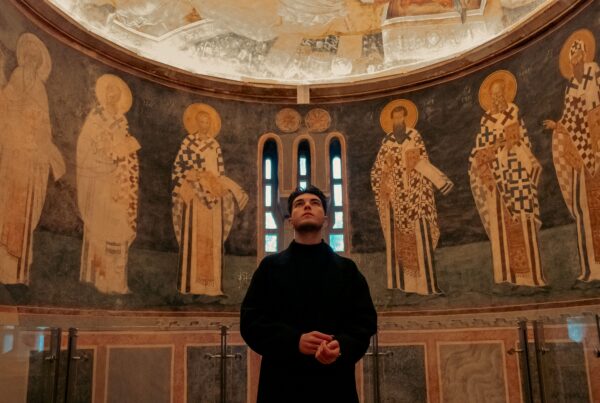
As the Church approaches the Feast of the Holy Transfiguration of our Lord and Saviour Jesus Christ, she turns our attention towards Mount Tabor and the radiance revealed there.
During the Dormition Fast, we also gather to pray the Paraklisis to the Most Holy Theotokos. At Matins, the Church calls her the “Theotokos and Mother of the Light,” for she bore in the flesh Jesus Christ, the true Light of the world (John 8:12; Matins, exclamation before the Magnificat).
The eternal Son and Word of God received His humanity from her. She carried Him in her womb, bore Him in Bethlehem and followed Him to the Cross. It was this same Christ who revealed His divine glory upon Mount Tabor. Whenever the Church turns towards the Mother of God, she is led again to her Son.
The Transfiguration reveals who Christ eternally is. It also opens before us the calling of the human person and, through humanity, the destiny of creation itself. We were created for communion with God and for a life illumined by His grace.
Within this mystery, Mount Tabor and the Orthodox mission in Fiji meet. One is a mountain in the Holy Land. The other lies among the islands of the Pacific. Their connection is found in Christ, who opens the eyes of those who follow Him and changes them through the light they receive.
The Face They Already Knew
Peter, James and John looked upon a face they already knew.
They had walked beside Christ, heard His voice and shared food with Him. They had watched Him receive those whom others avoided, touch the sick, forgive sins and speak with authority about the Kingdom of God. Then He led them up the mountain.
There, the face they knew shone like the sun. His garments became radiant. Moses and Elijah appeared beside Him. A bright cloud overshadowed them, and the voice of the Father was heard:
“This is My beloved Son, in whom I am well pleased. Listen to Him”
(Matthew 17:5).
The troparion of the feast tells us that Christ showed the disciples His glory “as far as they could bear it”:
“You were transfigured on the mountain, O Christ God, showing Your disciples Your glory as far as they could bear it. Let Your everlasting light shine upon us sinners, through the prayers of the Theotokos. O Giver of Light, glory to You”
(Troparion of the Holy Transfiguration).
Christ received no new glory upon Tabor. The radiance was eternally His. Saint Gregory Palamas explains that Christ revealed what He truly was, while the disciples were strengthened to perceive His glory according to their capacity. The light was neither ordinary brightness nor a symbol created for the occasion. They truly experienced the uncreated glory of God (Saint Gregory Palamas, Homily 34: On the Holy Transfiguration).
God remains beyond human comprehension in His essence, yet He truly communicates His life through His uncreated energies, through His grace. We cannot comprehend or possess the divine essence, but we may participate in the life of God. This teaching preserves both the mystery of God and the reality of our communion with Him. God remains transcendent while being genuinely present and active in the lives of His people.
On Tabor, grace opened the eyes of the disciples to the glory already before them.
When the voice came from the cloud, they fell upon their faces in fear. Saint Matthew then records a quiet and beautiful detail:
“Jesus came and touched them and said, ‘Rise, and do not be afraid’”
(Matthew 17:7).
The hand radiant with divine glory reached towards frightened men. Christ approached them, touched them and raised them. Divine glory is neither cold nor impersonal. It is encountered in the face and voice of Christ, and in the hand that reaches towards those who have fallen.
Saint Paul writes:
“We all, with unveiled face, beholding as in a mirror the glory of the Lord, are being transformed into the same image, from glory to glory”
(2 Corinthians 3:18).
The word translated as “transformed” belongs to the language of metamorphosis, the language of transfiguration. Saint Paul describes a work of grace that begins within us now.
The Fathers call this theosis, or deification. We remain creatures, while through grace we participate in the life of God. Our humanity is healed, illumined and sanctified. The mind begins to perceive more clearly, the heart is purified and the will becomes freer to obey God.
Saint Athanasius the Great expressed this with characteristic boldness when he wrote that the Son of God “became man that we might become god.” He spoke of participation in divine grace, never of a change in our created nature or essence (Saint Athanasius the Great, On the Incarnation, 54.3).
His Eminence Archbishop Makarios of Australia has spoken of the purpose of the Church as the “good transformation” of the human person, a renewal founded upon truth, light and freedom (Archbishop Makarios of Australia, “The Aim of the Orthodox Church Is to Bring About a Good Transformation,” 6 August 2024).
The feast therefore concerns the whole direction of Christian life. It is the renewal of the person through communion with Christ.
This renewal reaches beneath appearances and enters places where anger, fear, pride and defensiveness have settled. Someone may pray for years before recognising how deeply resentment has shaped his responses. With time, he begins to speak differently. Another person, accustomed to guarding every possession, may discover the freedom of generosity. A heart enclosed by grief may open again. Someone burdened by shame may begin to trust that the mercy of Christ is greater than the past.
Illness may remain. Loss may remain. The consequences of earlier choices may remain. Yet the person who lives within those circumstances may be renewed.
Our sight also changes. Someone we had dismissed may appear before us with a depth we had failed to notice. A suffering once remote may enter our prayer. A name spoken on a distant shore may acquire a weight we never expected.
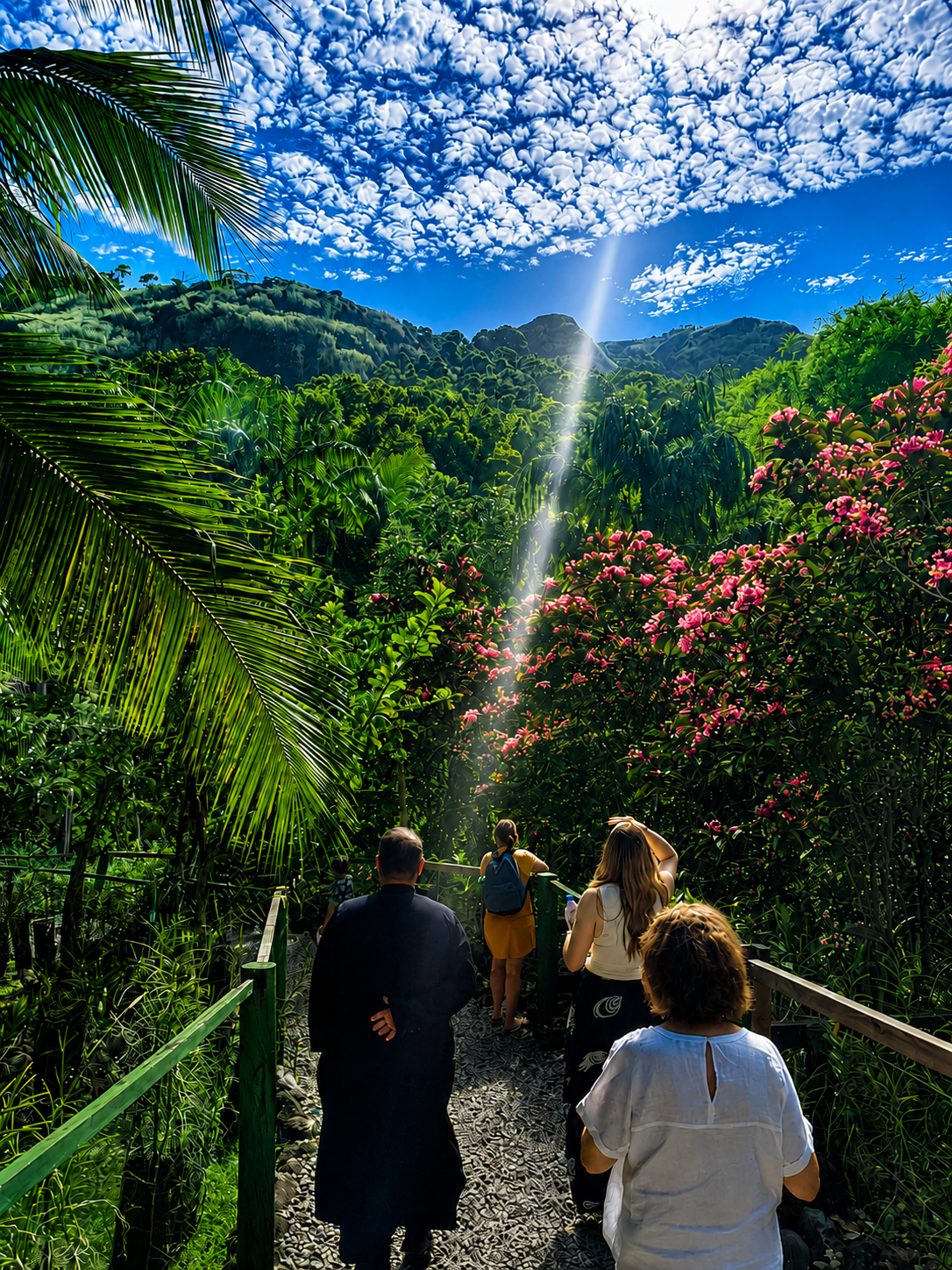
The Orthodox mission in Fiji has often given me such an experience.
The Light Has Gone Before Us
We travel intending to share the light of Christ, and there is real work before us.
Children need food, shelter and education. Catechumens require patient teaching. Clergy and their families need support. Long roads must be travelled so that the faithful can receive the Mysteries of the Church. Transport, pastoral care and the formation of local communities depend upon prayer, sacrifice and sustained generosity.
Christian love must acquire practical form. Saint James warns against offering pious words to those who lack food and clothing while refusing to respond to their bodily needs (James 2:14–17). Saint John likewise teaches us to love “in deed and in truth” (1 John 3:18).
Those who travel to share the light soon discover that Christ has arrived before them.
Near Votualevu, we visited a man who was gravely ill. He had been unable to attend church for many months and lived with his wife and grandchildren in a simple tin home. The night before our visit, he had prayed that God would somehow allow him to go to church and receive a blessing.
The following day, the priest and several parishioners came to his house. Inside were icons and incense. His family gathered around the bed while the Mystery of Holy Unction was served. They answered the prayers of the Church with “Kyrie eleison,” “Paraschou, Kyrie,” and “Amin.”
The priest anointed him. Incense rose beneath the iron roof, and the prayers filled the small room. Afterwards, his wife brought roti and tea for the visitors.
The man said:
“Jesus came to me in my hut.”
He had prayed to reach the church. By the following afternoon, the Church was gathered around his bed.
The hut was unchanged, and the man remained ill. Yet he knew that God had heard him. Like the disciples on Tabor, we were being taught to see what had been before us all along: Christ among His people, beneath an iron roof.
We had arrived thinking about what we might offer. We left having seen more than we expected.
One question remained with me:
Who is being a missionary to whom?
We may bring something genuinely needed, yet those whom we visit also give. Their faith may expose the caution of our own. Their gratitude may show how casually we receive our blessings. Their generosity may reveal how tightly we hold what we possess. Their joy may awaken something within us that has grown tired.
I have sometimes spoken about mission as though it were something we take to others. Fiji has made me recognise how easily I can speak about generosity while protecting my own comfort. It has also shown me how readily I can imagine myself as the giver when Christ is preparing to teach me how to receive.
None of us leaves such an encounter untouched. We go hoping that another life may be changed and often find that ours is changing too.
Saint Irenaeus wrote that “the glory of God is a living human being, and the life of the human being consists in beholding God” (Saint Irenaeus of Lyons, Against Heresies, 4.20.7). To behold God’s glory draws us more deeply towards the people around us. As our vision of Christ becomes clearer, we also begin to recognise His image in the vulnerable, the forgotten and those who have nothing with which to repay us (Matthew 25:31–46).
In my poem The Wearied Hem, I wrote of a child in Fiji who ran towards me and took hold of my cassock. I lifted him onto my shoulders:
He rises laughing,
legs fast around my neck,
one hand lost in my beard,
his whole body trusting
the shoulders beneath.
He gave me his whole weight. The black cloth was simply what his fingers found, and for those few moments he knew there was room for him.
A child does not need the moment explained. He knows he is safe because he gives you his whole weight. He also knows when you are truly with him and when part of you has already begun to leave.
The Gospel is spoken, but it is also encountered. The sick man remembered that the Church crossed the threshold of his home. The child remembered the arms that held him. A grieving person knows when we have stayed with their sorrow, and a catechumen knows when they have been received as a person rather than treated as another task.
The Mysteries, prayer, fasting and repentance form us so that the life of Christ may be seen in the way we receive those placed before us.
Listening and Descending
On Tabor, the Father says, “Listen to Him” (Matthew 17:5).
The disciples are called to more than admiration. They must listen when Christ speaks of the Cross, when He leads them down the mountain and when human suffering interrupts their plans.
Peter wanted to remain there. “Lord, it is good for us to be here,” he said, offering to build three tents and preserve the moment (Matthew 17:4).
Christ led them down.
At the foot of the mountain, a suffering child and a father were waiting for mercy (Matthew 17:14–18). Beyond them lay Jerusalem.
Saint Luke tells us that Moses and Elijah spoke with Christ about the “exodus” He would accomplish in Jerusalem, His Passion, death and Resurrection (Luke 9:30–31). The disciples saw His glory before they saw Him mocked. They saw His radiance before they saw Him stripped. They saw the uncreated light before darkness covered the earth at His Crucifixion.
Tabor taught them that the One who would hang upon the Cross remained the Lord of glory.
Saint John Chrysostom observes that Moses and Elijah bore witness to Christ as the fulfilment and Lord of the Law and the Prophets. The whole history of Israel converges upon Him (Saint John Chrysostom, Homily 56 on the Gospel of Matthew).
The vision on Tabor did not remove the Cross. It revealed the identity of the One who would freely ascend it.
Christian mission follows this movement. Prayer draws us towards the mercy and glory of God, according to the measure we are able to receive. Christ then leads us towards the roads, villages, hospital rooms and relationships where people wait to be met with patience and love.
In Fiji, those roads pass through heat, dust, illness, poverty and fatigue. Local clergy travel them because they know the villages, the families and the quiet burdens of those entrusted to them. A priest may rise early and drive for hours to gather people for the Divine Liturgy. He visits the sick, teaches catechumens, listens to families and remembers their names in prayer before returning along the same difficult roads.
Children stand at the chanting place. Families pray before icons in their homes. Young Orthodox Christians prepare food and supplies for households poorer than their own. Visitors arrive and eventually depart, while the life of the local Church continues.
At Saint Tabitha’s, I once asked some of the children why they preferred chanting in Greek. One replied, “It sounds better in Greek, Father.”
I told them they should also understand what they were singing. A child of twelve answered, “But we understand it in English, and it has been explained to us in Fijian.”
The child had received the sound in Greek, the meaning in English and the teaching in the language of his home. The apostolic faith had entered his life without erasing who he was.
At Pentecost, the Holy Spirit did not abolish the languages of the nations. Each person heard the apostolic proclamation in his own tongue (Acts 2:5–11). The unity of the Church is communion in Christ, within which the particular gifts of peoples and cultures are sanctified.
The child remains Fijian while his life is formed more deeply within the Church. Grace enters language, memory, kinship, land and culture, healing and fulfilling them in Christ.
Mission has taken root when the local priest serves his own people, children know the responses of the Liturgy, families pray before their icons, and those who once received help begin helping others. We see this already in the young Orthodox Christians who divide food and supplies for families with less than themselves. Generosity first offered from abroad is finding a local expression in diakonia.
The aircraft should be able to leave while the prayer continues.
A Name Beside the Lamb
Departure still has its sorrow.
The child who laughed upon my shoulders is lowered to the ground. His hands remain upon the cassock, and he wants the moment to continue. Peter wanted to remain on the mountain. We understand something of that desire. Grace draws near, and we wish to preserve the moment. Yet obedience leads us towards unfinished responsibilities. Another parish, another family and another duty wait on another shore.
What remains after we leave?
The deepest answer is found in the Divine Liturgy.
Before the Liturgy begins, the priest prepares the bread and wine at the Proskomide. The Lamb is cut from the prosphoron and placed upon the diskos. Around Him are placed particles commemorating the Mother of God, the saints, the living and the departed (The Divine Liturgy of Saint John Chrysostom, the Proskomide).
The child’s name is spoken, and a small particle of bread is placed beside Christ.
In the words of The Wearied Hem:
His name is cut
with all the others,
a wound in the bread
beside the Lamb.
I can no longer lift him onto my shoulders, but I can place his name beside Christ.
The Pacific remains between Fiji and Adelaide, yet both stand before the same Lamb. The children, clergy, presvyteres, catechumens, families, the sick and those who have departed this life are remembered by name.
Once a name is known, Fiji can no longer remain an abstraction. Remembrance enters our prayer, our conscience and our decisions. Those names begin to appear in the prayers, budgets and sacrifices of the parish. Money becomes food, schooling, transport, repairs and support for a priest travelling a difficult road to serve the Divine Liturgy.
A distant country enters the Eucharistic concern of the parish. Statistics acquire faces, and needs are known by name. Those names are placed beside the Lamb.
After receiving the Holy Mysteries, the Church sings:
“We have seen the true light; we have received the heavenly Spirit; we have found the true faith, worshipping the undivided Trinity, for He has saved us”
(The Divine Liturgy of Saint John Chrysostom, hymn following Holy Communion).
These words concern the life awaiting us beyond the church doors. Having seen the true light, how shall we now see one another?
Most of us will never cross the Pacific in the service of the Church. The distance before us may be the silence at a family table, the hospital room we keep postponing, or the person whose story we decided before hearing it.
Repentance may begin when we recognise that we have seen someone wrongly. We may then find the courage to speak, to listen, to seek forgiveness or to return after a long absence. At other times, we may simply be asked to remain beside someone whose pain offers no quick answer.
The situation may remain difficult even after repentance has begun. Yet something has already changed when we see the other person more truthfully.
Years after Tabor, Saint Peter wrote, “We were eyewitnesses of His majesty” (2 Peter 1:16). He remembered the voice from heaven and the glory of Christ upon the holy mountain (2 Peter 1:17–18). Yet Peter came down and still faltered. He misunderstood Christ, resisted the way of the Cross and later denied the Lord whom he had seen transfigured.
Christ met Peter again after his denial and restored him. The frightened disciple became the apostle who strengthened the Church and gave his life for Christ. What Peter had seen upon Tabor passed through failure, repentance and restoration before it became the witness of his life.
Peter’s life tells us that the work of grace continues after failure. We may return from the mountain and fall again into fear, resentment or concern for ourselves. Yet the hand radiant with divine glory still touches those who have fallen, and the voice of Christ still says, “Rise, and do not be afraid” (Matthew 17:7).
The aircraft eventually rises from Fiji. In Adelaide, his name is spoken and a particle is placed beside the Lamb. The Pacific is still between us, and the work has not ended.
We have seen enough, however, to know that the light was never ours to possess or transport. Christ had gone before us. Through the prayer, faith and generosity of those we hoped to serve, His grace reached parts of our own lives that still awaited transfiguration.
We go to share the light of Christ. Through His mercy, we may return seeing more clearly and living with greater faithfulness to what He has allowed us to see.
The Wearied Hem
He knew my heart
before he saw my face
felt it beating
beneath the hand
that crossed him
in Mumma’s belly
Now he contests the kitten
for the hem of my cassock
small fingers caught
in its rugged black folds
red clay woodsmoke
and incense in the cloth
Lifting him is easy
He rises laughing
legs fast around my neck
one hand lost in my beard
his whole body trusting
the shoulders beneath
Aaron bore the names
of Israel upon his shoulders
Mine come barefoot
laughing
smirking
clapping
singing
running
gripping
each one bringing
all the others
Then my hands descend
Laughter breaks
He searches my face
hurt gathering in the space
between his eyes
until the first tears fall
darkening the earth beneath
I lower him
The vanua receives his feet
mine already tread
the distance opening between us
His palms clutch again
at the cassock
He cannot utter
what was said at Emmaus
yet the cloth around me
gives one resounding cry
stay
Behind him stand the others
beneath iron roofs
and open skies
dividing rice and soap
for homes poorer than theirs
chanting with such might
the Sleeping Giant
turns in the night
The aircraft rises
Land gathers beneath the wing
green ridges cane roads
the pale reef
then ocean
deep upon deep
Elijah rose
and left his mantle
As I ascend
the belt tightens at my waist
no mantle falls
nothing remains in my place
The cassock is black
for a dying
barely begun
Duty
distance
the parish waiting
upon another shore
are proper phrases
carefully taught
to veil a hidden fault
He knows only
that I lifted him high
laughter bright on his face
and let him believe
my shoulders were his place
Then I reached for his waist
and lowered him slow
while the laughter between us
had nowhere to go
His tears are not mine
to fold into sorrow
Crossing the ocean
before me they ask
when the cartons lie empty
the last rice is eaten
and the road falls silent again
what does love leave behind
that departure cannot take?
In Adelaide
the spear enters
the prosphora
His name is cut
with all the others
a wound in the bread
beside the Lamb
And there before God
the child I lowered
to the island earth
is lifted once more
upon my shoulders
Within his small weight
all their faces
gather again
And every road out of Fiji
begins beneath the eyes
of children
still holding
the hem of my robe
Saweni, July 2026